Results by title
159 books match the query 'Present' and 3 start with j

Japan After Japan
Social and Cultural Life from the Recessionary 1990s to the PresentTomiko Yoda and Harry Harootunian, eds.
Duke University Press, 2006
Several of the essayists reflect on the politics of history, considering changes in the relationship between Japan and the United States, the complex legacy of Japanese colonialism, Japan’s chronic unease with its wartime history, and the postwar consolidation of an ethnocentric and racist nationalism. Others analyze anxieties related to the role of children in society and the weakening of the gendered divide between workplace and home. Turning to popular culture, contributors scrutinize the avid consumption of “real events” in formats including police shows, quiz shows, and live Web camera feeds; the creation, distribution, and reception of Pokémon, the game-based franchise that became a worldwide cultural phenomenon; and the ways that the behavior of zealous fans of anime both reinforces and clashes with corporate interests. Focusing on contemporary social and political movements, one essay relates how a local citizens’ group pressed the Japanese government to turn an international exposition, the Aichi Expo 2005, into a more environmentally conscious project. Another essay offers both a survey of emerging political movements and a manifesto identifying new possibilities for radical politics in Japan. Together the contributors to Japan After Japan present much-needed insight into the wide-ranging transformations of Japanese society that began in the 1990s.
Contributors. Anne Allison, Andrea G. Arai, Eric Cazdyn, Leo Ching, Harry Harootunian, Marilyn Ivy, Sabu Kohso, J. Victor Koschmann, Thomas LaMarre, Masao Miyoshi, Yutaka Nagahara, Naoki Sakai, Tomiko Yoda, Yoshimi Shunya, Mitsuhiro Yoshimoto
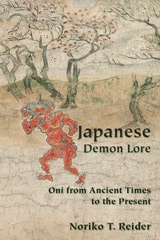
Japanese Demon Lore
Oni from Ancient Times to the PresentNoriko Reider
Utah State University Press, 2010
Oni, ubiquitous supernatural figures in Japanese literature, lore, art, and religion, usually appear as demons or ogres. Characteristically threatening, monstrous creatures with ugly features and fearful habits, including cannibalism, they also can be harbingers of prosperity, beautiful and sexual, and especially in modern contexts, even cute and lovable. There has been much ambiguity in their character and identity over their long history. Usually male, their female manifestations convey distinctivly gendered social and cultural meanings.
Oni appear frequently in various arts and media, from Noh theater and picture scrolls to modern fiction and political propaganda, They remain common figures in popular Japanese anime, manga, and film and are becoming embedded in American and international popular culture through such media. Noriko Reiderýs book is the first in English devoted to oni. Reider fully examines their cultural history, multifaceted roles, and complex significance as "others" to the Japanese.
Japanese Foodways, Past and Present
Edited by Eric C. Rath and Stephanie Assmann
University of Illinois Press, 2010