Results by title
376 books match the query 'Racism' and 4 start with j
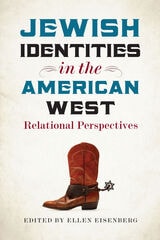
Jewish Identities in the American West
Relational PerspectivesEdited by Ellen Eisenberg
Brandeis University Press, 2022
Since the onset of New Western History in the 1980s, the complexity of race and ethnicity as it developed in the American West has increasingly been recognized by scholars and the wider public alike. Ethnic studies scholars have developed new perspectives on racial formation in the West that complicate older notions that often relied on binary descriptions, such as Black/white racialization. In the past few decades, these studies have relied on relational approaches that focus on how race is constructed, by both examining interactions with the white dominant group, and by exploring the multiple connections with other racial/ethnic groups in society. Historians are discovering new stories of racial construction, and revising older accounts, to integrate these new perspectives into the formation of racial and ethnic identities. This collection of essays on Jews in the American West advances this field in multiple ways. With essays that cover the period from the mid-nineteenth century to the present, these authors present a collective portrait of change over time that allows us to view the shifting nature of Jewish identity in the West, as well as the evolving frameworks for racial construction. Thorough and thought-provoking, Jewish Identities in the American West takes readers on a journey of racial and ethnic identity in the American West.
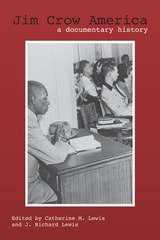
Jim Crow America
A Documentary HistoryCatherine M. Lewis
University of Arkansas Press, 2009
Jim Crow Networks
African American Periodical CulturesEurie Dahn
University of Massachusetts Press, 2021
As Eurie Dahn demonstrates, authors like James Weldon Johnson, Nella Larsen, William Faulkner, and Jean Toomer wrote in the context of interracial and black periodical networks, which shaped the literature they produced and their concerns about racial violence. This original study also explores the overlooked intersections between the black press and modernist and Harlem Renaissance texts, and highlights key sites where readers and writers worked toward bottom-up sociopolitical changes during a period of legalized segregation.
Just Who Loses?
Discrimination in the United States, Volume 2Samuel Lucas
Temple University Press, 2013
In Just Who Loses? Samuel Roundfield Lucas continues his penetrating and comprehensive assessment of sex and race discrimination in the United States that he began in Theorizing Discrimination in an Era of Contested Prejudice.
This new volume demonstrates that the idea of discrimination being a zero-sum game is a fallacy. If discrimination costs women, men do not necessarily reap the gains. Likewise, if discrimination costs blacks, non-blacks do not reap the gains. Lucas examines the legal adjudication of discrimination, as well as wider public debates about policy on the issue, to prove how discrimination actually operates.
He uses analytic methods to show that across the socioeconomic lifecycle—including special education placement, unemployment, occupational attainment, earnings, poverty, and even mortality—both targets and non-targets of discrimination “lose.”
In Just Who Loses? Lucas proposes the construction of a broad-based coalition to combat the pervasive discrimination that affects social relations and law in the United States.