Results by title
436 books match the query 'Renaissance' and 4 start with j
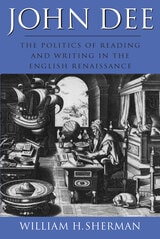
John Dee
The Politics of Reading and Writing in the English RenaissanceWilliam H. Sherman
University of Massachusetts Press, 1995
This book challenges the conventional image of John Dee (1527–1609) as an isolated, eccentric philosopher. Instead, William H. Sherman presents Dee in a fresh context, revealing that he was a well-connected adviser to the academic, courtly, and commercial circles of his day.
[more]
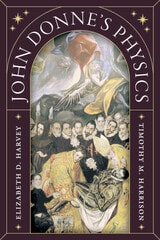
John Donne's Physics
Elizabeth D. Harvey and Timothy M. Harrison
University of Chicago Press, 2024
A reimagining of Devotions upon Emergent Occasions as an original treatment of human life shaped by innovations in seventeenth-century science and medicine.
In 1624, poet and preacher John Donne published Devotions upon Emergent Occasions, a book that recorded his near-death experience during a deadly epidemic in London. Four hundred years later, in the aftermath of our own pandemic, Harvey and Harrison show how Devotions crystalizes the power, beauty, and enduring strangeness of Donne’s thinking. Arguing that Donne saw human life in light of emergent ideas in the study of nature (physics) and the study of the body (physick), John Donne’s Physics reveals Devotions as a culminating achievement, a radically new literary form that uses poetic techniques to depict Donne’s encounter with death in a world transformed by new discoveries and knowledge systems.
In 1624, poet and preacher John Donne published Devotions upon Emergent Occasions, a book that recorded his near-death experience during a deadly epidemic in London. Four hundred years later, in the aftermath of our own pandemic, Harvey and Harrison show how Devotions crystalizes the power, beauty, and enduring strangeness of Donne’s thinking. Arguing that Donne saw human life in light of emergent ideas in the study of nature (physics) and the study of the body (physick), John Donne’s Physics reveals Devotions as a culminating achievement, a radically new literary form that uses poetic techniques to depict Donne’s encounter with death in a world transformed by new discoveries and knowledge systems.
[more]
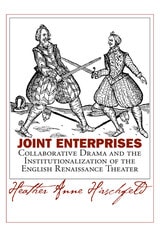
Joint Enterprises
Collaborative Drama and the Institutionalization of the English Renaissance TheaterHeather Anne Hirschfeld
University of Massachusetts Press, 2004
Over half of the plays of the English Renaissance were written collaboratively—by multiple dramatists working together. Joint Enterprises examines this kind of dramatic production, charting its social and professional significance as a historically embedded but personally inflected creative phenomenon. By situating individual joint works such as Eastward Hoe, The Two Noble Kinsmen, and The Changeling in specific institutional contexts, Heather Hirschfeld explores the diverse motivations driving dramatic collaborations, traces the distinct writerly relationships that developed from such energies, and analyzes their rhetorical effects in individual plays.
Drawing on a range of documentary and literary sources as well as recent methodological advances in theater history, the book presents a sequence of case studies designed to accommodate both the larger cultural setting of the early modern theater and the localized, idiosyncratic factors influencing discrete literary productions. Each chapter chronicles the professional setting of a particular joint work and then investigates its rhetorical or linguistic traces in the resultant text. This approach allows Hirschfeld to locate specific links between modes of collaborative production and forms of dramatic representation and then explicate the literary and political implications of these connections.
Hirschfeld's case studies provide a fresh account of the institutionalization—the steady growth, organization, and incorporation—of the professional drama in sixteenth- and seventeenth-century English cultural life. By attending to the changing shapes and stakes of joint enterprises, she shows that dramatists did not unconsciously absorb the practice of collaborative writing from general social discourses, but rather were aware of the material and symbolic significances of their work, meanings structured by the traditions of the developing professional theater and by the cultural pressures and anxieties attendant upon a new and often fragile institution.
[more]
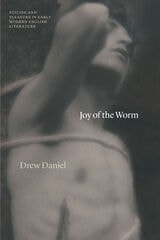
Joy of the Worm
Suicide and Pleasure in Early Modern English LiteratureDrew Daniel
University of Chicago Press, 2022
Consulting an extensive archive of early modern literature, Joy of the Worm asserts that voluntary death in literature is not always a matter of tragedy.
In this study, Drew Daniel identifies a surprisingly common aesthetic attitude that he calls “joy of the worm,” after Cleopatra’s embrace of the deadly asp in Shakespeare’s play—a pattern where voluntary death is imagined as an occasion for humor, mirth, ecstatic pleasure, even joy and celebration.
Daniel draws both a historical and a conceptual distinction between “self-killing” and “suicide.” Standard intellectual histories of suicide in the early modern period have understandably emphasized attitudes of abhorrence, scorn, and severity toward voluntary death. Daniel reads an archive of literary scenes and passages, dating from 1534 to 1713, that complicate this picture. In their own distinct responses to the surrounding attitude of censure, writers including Shakespeare, Donne, Milton, and Addison imagine death not as sin or sickness, but instead as a heroic gift, sexual release, elemental return, amorous fusion, or political self-rescue. “Joy of the worm” emerges here as an aesthetic mode that shades into schadenfreude, sadistic cruelty, and deliberate “trolling,” but can also underwrite powerful feelings of belonging, devotion, and love.
[more]