Results by title
82 books match the query 'Revolution, 1775-1783' and 3 start with j
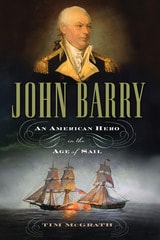
John Barry
An American Hero in the Age of SailTimothy McGrath
Westholme Publishing, 2010
The Life of the First Captain of the United States Navy
Finalist for the Rear Admiral Samuel Eliot Morison Award for Excellence in Naval Literature
“Ashore as well as at sea, Tim McGrath paints an informative, engaging and highly entertaining portrait of this worthy but neglected hero of American independence. The author shows us a man who was a magnificent embodiment of common sense—and uncommon courage and dedication. That such a work is long overdue makes its achievement all the more pleasurable.”—Wall Street Journal
“Combining sophisticated use of sources with a pleasing writing style, McGrath masterfully rescues a father of the U.S. Navy from unmerited eclipse.”—Publishers Weekly
“A nearly indispensable addition to U.S. Navy collections.”—Booklist“McGrath employs exemplary narrative style in this work. . . . In John Barry, the author adroitly juxtaposes maritime history, narratives of naval combat, and early U.S. social history.”—New England Quarterly
“McGrath is a compelling and lucid writer. He brings Barry to life, makes battles understandable, and provides the clearest description of Barry's 1778 capture of the British transport ships Mermaid and Kitty that this reviewer has seen.”—Pennsylvania Magazine of History and Biography
“A great read and an absorbing account of a drama-filled life.”—Naval History
“Well researched, well written, and a pleasure to read, this book restores John Barry to the important place he once held as one of our nation’s great heroes. It is a tale of high adventure and personal courage and you will not want to put it down.” —JAMES L. NELSON, author of George Washington’s Secret Navy
“Readers of this vivid biography will imagine they smell the ocean’s salt air and the sulfurous fumes of gunpowder as they navigate these action-packed pages. Fans of Horatio Hornblower and Lucky Jack Aubrey will rejoice in discovering their real-life American counterpart.”—GREGORY J. URWIN, author of Facing Fearful Odds: The Siege of Wake Island
The man regarded as “the Father of the American Navy” returns to the quarterdeck in John Barry: An American Hero in the Age of Sail, the first comprehensive biography of this legendary officer in generations. Son of a hardscrabble Irish farmer from County Wexford, Barry was sent to sea as a child, arriving in Philadelphia during the restless decade before the American Revolution. Brave and ambitious, he ascended the ratlines to become a successful merchant captain at a young age, commanding the most prestigious ship in the colonies and recording the fastest known day of sail in the century.
Volunteering to fight for the Continental cause, Barry saw his star rise during the War for Independence. As captain of the Lexington, Raleigh, and Alliance, Barry faced down broadsides, mutinies, and even a fleet of icebergs. He captured the first enemy warship taken by a Continental vessel and fought the last battle of the American Revolution. His hard-won victory over two British warships simultaneously garnered him international notoriety, while his skill as a seafarer and cool temper established Barry as a worthy foe among British captains. Without a ship during the winter of 1776-77, the ever resourceful Barry lead a battery of naval artillery at the battle of Princeton. With peace came a historic voyage to China, where Barry helped open trade with that reclusive empire. In 1794, President Washington named Barry as the first commissioned officer in the new United States Navy. Given the title of commodore, Barry ended his career during America’s naval war with France, teaching the ropes to a new generation of officers, most notably Stephen Decatur.
Drawn from primary source documents from around the world, John Barry: An American Hero in the Age of Sail by Tim McGrath brings the story of this self-made American back to life in a major new biography.
John Robert Shaw
An Autobiography of Thirty Years, 1777–1807Oressa M. Teagarden
Ohio University Press, 1992
In the summer of 1807 more than a thousand subscribers from New England to Tennessee paid for the initial printing of The Life and Travels of John Robert Shaw: A Narrative of the Life and Travels of the Well-Digger, now resident of Lexington, Kentucky, Written by Himself. Shaw had come to Rhode Island as a British redcoat to put down the colonial rebellion. Through various quirks of fate, including being taken a prisoner of war, he ended up fighting with the Americans. Shaw was an exuberant spirit whose rowdy drinking bouts and related predicaments alternated with periods of wholehearted efforts at reform. His autobiography, written while he recuperated from injuries from one of several explosions (an occupational hazard for the frontier well-digger), is an articulate and entertaining record of the Revolutionary War era.
A 1930 printing of Shaw’s autobiography was rescued from the trash by an alert librarian in Kentucky in 1950. She passed the tattered copy on to journalist Oressa M. Teagarden, who became intrigued with Shaw’s story and spent much of her free time over the next two decades finding out more about the ebullient American. On Teagarden’s death, co-editor Jeanne Crabtree assumed the task of making Shaw’s authentic and colorful view of early America available to a new generation of readers.

Jonathan Odell
The Loyalist Poet of the American RevolutionCynthia Dubin Edelberg
Duke University Press, 1987
One of the best-educated of the colonialists, Odell, a physician turned Anglican minister and then writer, lived the gamut of experience: powerful friends sustained him and the British commanders-in-chief Sir William Howe, Henry Clinton, and Sir Guy Carleton employed him; nevertheless, during the war he was a lonely exile ("Tory hunters" forced him from his home in 1775), and, at the end of the war, when his hope for reconciliation between the Loyalists and the Americans came to nothing, he reluctantly emigrated to Canada.
Here is a voice, all but silenced for over two hundred years, that must now be heard if we are to better understand the American Revolution.