Results by title
74 books match the query 'Sociology, Urban' and 3 start with j
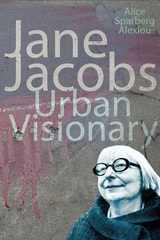
Jane Jacobs
Urban VisionaryAlice Sparberg Alexiou
Rutgers University Press, 2006
Today, we take for granted the wisdom of renovating old factory buildings into malls or condos, of making once decaying waterfronts into vibrant public spaces, of protecting historic buildings under landmark laws, and of building public housing on a human scale rather than as high-rises. In contemporary cities, it is now common for community groups to plant gardens in empty lots and to buy abandoned apartment buildings from the city for a dollar and fix them up.
But these and other urban planning policies and practices have not always been accepted. Before they became widespread, they were the visionary ideas of the writer and urban commentator Jane Jacobs. Best known in the United States for her path-breaking efforts to preserve the character of Greenwich Village, Jacobs is the author of the classic 1961 book, The Death and Life of Great American Cities, one of the most influential works ever published in urban studies. The architectural critic Herbert Muschamp wrote in the New York Times that its publication “was one of twentieth-century architecture’s most traumatic events. Its impact is still felt in cities across the land.”
In this analysis of Jane Jacobs’s ideas and work, Alice Sparberg Alexiou tells the remarkable story of a woman who without any formal training in planning became a prominent spokesperson for sensible urban change. Besides writing the seminal book about contemporary cities, Jacobs organized successful community battles in New York against powerful interests. She resisted urban renewal in the West Village in the 1960s, helped defeat the Lower Manhattan Expressway, advocated the pleasures of street life that she called “sidewalk ballet,” and opposed the original Twin Towers plans. She was also active in the anti–Vietnam War movement, which eventually led her to move to Canada. There she continued her grass-roots activism, including helping to prevent the construction of an expressway that would have cut through several neighborhoods in Toronto.
Based on a rich array of interviews and primary source material, this book brings long-overdue attention to Jacobs’s far-reaching influence as an original thinker and effective activist.
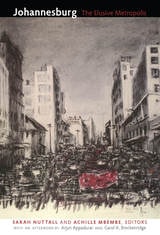
Johannesburg
The Elusive MetropolisSarah Nuttall and Achille Mbembe, eds.
Duke University Press, 2008
The volume’s essays include an investigation of representation and self-stylization in the city, an ethnographic examination of friction zones and practices of social reproduction in inner-city Johannesburg, and a discussion of the economic and literary relationship between Johannesburg and Maputo, Mozambique’s capital. One contributor considers how Johannesburg’s cosmopolitan sociability enabled the anticolonial projects of Mohandas Ghandi and Nelson Mandela. Journalists, artists, architects, writers, and scholars bring contemporary Johannesburg to life in ten short pieces, including reflections on music and megamalls, nightlife, built spaces, and life for foreigners in the city.
Contributors: Arjun Appadurai, Carol A. Breckenridge, Lindsay Bremner, David Bunn, Fred de Vries, Nsizwa Dlamini, Mark Gevisser, Stefan Helgesson, Julia Hornberger, Jonathan Hyslop, Grace Khunou, Frédéric Le Marcis, Xavier Livermon, John Matshikiza, Achille Mbembe, Robert Muponde, Sarah Nuttall, Tom Odhiambo, Achal Prabhala, AbdouMaliq Simone

Justice and the American Metropolis
Clarissa Rile Hayward
University of Minnesota Press, 2011
Today’s American cities and suburbs are the sites of “thick injustice”—unjust power relations that are deeply and densely concentrated as well as opaque and seemingly intractable. Thick injustice is hard to see, to assign responsibility for, and to change.
Identifying these often invisible and intransigent problems, this volume addresses foundational questions about what justice requires in the contemporary metropolis. Essays focus on inequality within and among cities and suburbs; articulate principles for planning, redevelopment, and urban political leadership; and analyze the connection between metropolitan justice and institutional design. In a world that is progressively more urbanized, and yet no clearer on issues of fairness and equality, this book points the way to a metropolis in which social justice figures prominently in any definition of success.
Contributors: Susan S. Fainstein, Harvard U; Richard Thompson Ford, Stanford U; Gerald Frug, Harvard U; Loren King, Wilfrid Laurier U; Margaret Kohn, U of Toronto; Stephen Macedo, Princeton U; Douglas W. Rae, Yale U; Clarence N. Stone, George Washington U; Margaret Weir, U of California, Berkeley; Thad Williamson, U of Richmond.