501 books match the query 'South' and 5 start with j
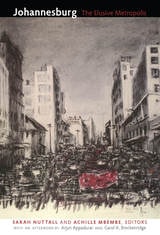
cover of Johannesburg: The Elusive Metropolis

Johannesburg

The Elusive Metropolis

Sarah Nuttall and Achille Mbembe, eds.

Duke University Press, 2008

Johannesburg: The Elusive Metropolis is a pioneering effort to insert South Africa’s largest city into urban theory, on its own terms. Johannesburg is Africa’s premier metropolis. Yet theories of urbanization have cast it as an emblem of irresolvable crisis, the spatial embodiment of unequal economic relations and segregationist policies, and a city that responds to but does not contribute to modernity on the global scale. Complicating and contesting such characterizations, the contributors to this collection reassess classic theories of metropolitan modernity as they explore the experience of “city-ness” and urban life in post-apartheid South Africa. They portray Johannesburg as a polycentric and international city with a hybrid history that continually permeates the present. Turning its back on rigid rationalities of planning and racial separation, Johannesburg has become a place of intermingling and improvisation, a city that is fast developing its own brand of cosmopolitan culture.

The volume’s essays include an investigation of representation and self-stylization in the city, an ethnographic examination of friction zones and practices of social reproduction in inner-city Johannesburg, and a discussion of the economic and literary relationship between Johannesburg and Maputo, Mozambique’s capital. One contributor considers how Johannesburg’s cosmopolitan sociability enabled the anticolonial projects of Mohandas Ghandi and Nelson Mandela. Journalists, artists, architects, writers, and scholars bring contemporary Johannesburg to life in ten short pieces, including reflections on music and megamalls, nightlife, built spaces, and life for foreigners in the city.

Contributors: Arjun Appadurai, Carol A. Breckenridge, Lindsay Bremner, David Bunn, Fred de Vries, Nsizwa Dlamini, Mark Gevisser, Stefan Helgesson, Julia Hornberger, Jonathan Hyslop, Grace Khunou, Frédéric Le Marcis, Xavier Livermon, John Matshikiza, Achille Mbembe, Robert Muponde, Sarah Nuttall, Tom Odhiambo, Achal Prabhala, AbdouMaliq Simone

[more]
cover of Johannesburg: The Elusive Metropolis, Volume 16

Johannesburg

The Elusive Metropolis, Volume 16

Sarah Nuttall and Achille Mbembe, eds.

Duke University Press, 0

This issue of Public Culture attempts to overturn perceptions that frame Africa as an object apart from the rest of the world. By placing the city of Johannesburg—the preeminent metropolis of the African continent and a city facing a complicated legacy of racial strife and wealth accumulation—at the heart of new critical urban theory, Johannesburg: The Elusive Metropolis broadens discussions of modernity, cosmopolitanism, and urban renewal to include Africa. The issue brings Johannesburg into direct dialogue with other world cities, creating a space for the interrogation and investigation of the metropolis in a properly global sense.

Contributors to this issue—a mix of scholars, urban planners, and artists, many of whom hail from South Africa—reveal Johannesburg to be a polycentric and international city that has developed its own cosmopolitan culture. In a detailed study of three streets in the modern precinct of Melrose Arch, one essay shows how the thoroughly commodified and marketed Johannesburg cityscape has shaped the cultural sensitivities, aesthetics, and urban subjectivities of its inhabitants, at times even overriding the historical memory of apartheid. Another essay, focusing on the emergence of a new urban culture, examines how the city itself becomes a crucial site for the remixing and reassembling of racial identities. By tracking the movement of people with AIDS to various locations in the city to seek relief and treatment, another essay reveals an urban geography very different from what is seen from the highways. Finally, through interviews and commentaries, journalists, artists, and architects of Johannesburg offer reflections on the geography and shifting culture of the city and its townships, on the complicated relationship between Johannesburg and other African cities, and on the search for an architectural style that adequately expresses the complexity of this cosmopolitan city.

Contributors. Lindsay Bremner, Nsizwa Dlamini, Mark Gevisser, Grace Khunou, Frédéric Le Marcis, John Matshikiza, Achille Mbembe, Sarah Nuttall, Rodney Place, AbdouMaliq Simone, Michael Watts
[more]
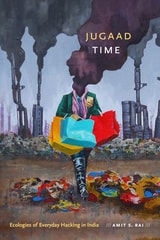
cover of Jugaad Time: Ecologies of Everyday Hacking in India

Jugaad Time

Ecologies of Everyday Hacking in India

Amit S. Rai

Duke University Press, 2019
In India, the practice of jugaad—finding workarounds or hacks to solve problems—emerged out of subaltern strategies of negotiating poverty, discrimination, and violence but is now celebrated in management literature as a disruptive innovation. In Jugaad Time Amit S. Rai explores how jugaad operates within contemporary Indian digital media cultures through the use of the mobile phone. Rai shows that despite being co-opted by capitalism to extract free creative labor from the workforce, jugaad is simultaneously a practice of everyday resistance, as workers and communities employ hacks to oppose corporate, caste, and gender power. Locating the tensions surrounding jugaad—as both premodern and postdigital, innovative and oppressive—Rai maps how jugaad can be used to undermine neoliberal capitalist media ecologies and nationalist politics.
[more]
cover of Just Being: A Memoir

Just Being

A Memoir

Romila Thapar

Seagull Books, 2026

Historian Romila Thapar reflects on a rich, path-breaking life—and the ideas, friendships, and journeys that shaped her.

In Just Being, historian Romila Thapar invites us into her illustrious world—a rich, extensive memoir from a scholar who has profoundly shaped our understanding of India’s past and present.

From her childhood growing up in British India, through her years of education in London, her extensive travels to archaeological sites across Asia and beyond, and her trailblazing role in shaping the Centre for Historical Studies at Jawaharlal Nehru University, Thapar reflects on a life lived in the service of inquiry and education. Composed over the past few years, Just Being is a testimony to Thapar’s ability to view herself within the larger flow of history, and to illumine it with a scholar’s depth and a storyteller’s sensitivity. It reveals not only an extraordinary, boundary-defying life but a profound conviction that understanding our past in the light of irrefutable evidence is essential to an insight into the present and to shaping a more thoughtful future.
[more]
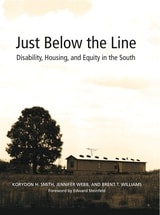
cover of Just Below the Line: Disability, Housing, and Equity in the South

Just Below the Line

Disability, Housing, and Equity in the South

Korydon H. Smith

University of Arkansas Press, 2010

With America on the brink of the largest number of older adults and persons with disabilities in the country’s history, the deceleration in housing production during the first decade of the twenty-first century, and a continued reliance on conventional housing policies and practices, a perfect storm has emerged in the housing industry. The lack of fit between the existing housing stock and the needs of the U.S. population is growing pronounced. Just as housing needed to be retooled at the end of WWII, the American housing industry is in dire need of change today. The South—with its high rates of poverty, older residents, residents with disabilities, extensive rural areas, and out-of-date housing policies and practices—serves as a “canary in the coal mine” for the impending, nationwide housing crisis. Just Below the Line discusses how reworking the policies and practices of the housing industry in the South can serve as a model for the rest of the nation in meeting the physical and social needs of persons with disabilities and aging boomers. Policy makers, designers, builders, realtors, advocates, and housing consumers will be able to use this book to promote the production of equitable housing nationwide.

Published in collaboration with the Fay Jones School of Architecture.
[more]