Results by title
418 books match the query 'Southern States' and 4 start with j
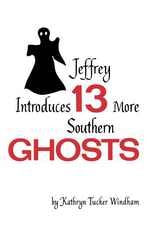
Jeffrey Introduces Thirteen More Southern Ghosts
Commemorative EditionKathryn Tucker Windham
University of Alabama Press, 2015
A commemorative edition of the beloved and best-selling second book in famed folklorist Kathryn Tucker Windham’s southern ghosts series.
Jeffrey was the resident apparition in the Selma, Alabama, home of nationally-known folklorist Kathryn Tucker Windham and the inspiration for Windham’s best-selling collection of macabre tales that reveal two hundred years of Alabama’s ghostly secrets, Thirteen Alabama Ghosts and Jeffrey. One of the most popular books ever published in the state, generations of Alabama children and students have been thrilled and chilled by Windham’s spectral legends.
Following the overwhelming success of Thirteen Alabama Ghosts and Jeffrey, Windham and Jeffrey began to journey across the South assembling a second collection of ghastly tales that repeat Windham’s winning combination of traditional folklore, Southern history and culture, and family-friendly story-telling. In Jeffrey Introduces Thirteen More Southern Ghosts, Windham’s disembodied friend roams the states of Kentucky, Tennessee, Georgia, Mississippi, Louisiana, and Florida to recall thirteen more timeless, spine-tingling tales of baneful and melancholy spirits that spook the most stoic heart.
Opening this volume is “The Girl Nobody Knew.” One midsummer night in the genteel Kentucky mineral spring resort of Harrodsburg, a beautiful lady arrived at the town’s grand hotel. The belle danced late into the night with the town’s smitten gallants only to expire suddenly with the notes of the last quadrille. The spooked residents of Harrodsburg guard a grave you can see to this day. Readers then visit the world-famous Bell Witch of Robinson County, Tennessee. Jeffrey also makes his first trip to old New Orleans to reveal a revenant in residence on Royal Street before continuing his ghostly progress across Dixie.
This new edition returns Jeffrey Introduces Thirteen More Southern Ghosts to its original format in jacketed cloth full of original, black-and-white illustrations in a handsome keepsake edition perfect for gift-giving and for families, folklorists of all ages, and libraries.

Jewish Roots in Southern Soil
A New HistoryEdited by Marcie Ferris and Mark I. Greenberg
Brandeis University Press, 2006
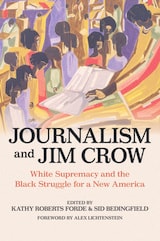
Journalism and Jim Crow
White Supremacy and the Black Struggle for a New AmericaEdited by Kathy Roberts Forde and Sid Bedingfield
University of Illinois Press, 2021
White publishers and editors used their newspapers to build, nurture, and protect white supremacy across the South in the decades after the Civil War. At the same time, a vibrant Black press fought to disrupt these efforts and force the United States to live up to its democratic ideals. Journalism and Jim Crow centers the press as a crucial political actor shaping the rise of the Jim Crow South. The contributors explore the leading role of the white press in constructing an anti-democratic society by promoting and supporting not only lynching and convict labor but also coordinated campaigns of violence and fraud that disenfranchised Black voters. They also examine the Black press’s parallel fight for a multiracial democracy of equality, justice, and opportunity for all—a losing battle with tragic consequences for the American experiment.
Original and revelatory, Journalism and Jim Crow opens up new ways of thinking about the complicated relationship between journalism and power in American democracy.
Contributors: Sid Bedingfield, Bryan Bowman, W. Fitzhugh Brundage, Kathy Roberts Forde, Robert Greene II, Kristin L. Gustafson, D'Weston Haywood, Blair LM Kelley, and Razvan Sibii

Just Enough to Put Him Away Decent
Death Care, Life Extension, and the Making of a Healthier South, 1900-1955Kristine M. McCusker
University of Illinois Press, 2023
Kristine McCusker charts the dramatic transformation that took place when southerners in particular and Americans in general changed their thinking about when one should die, how that death could occur, and what decent burial really means. As she shows, death care evolved from being a community act to a commercial one where purchasing a purple coffin and hearse ride to the cemetery became a political statement and the norm. That evolution also required interactions between perfect strangers, especially during the world wars as families searched for their missing soldiers. In either case, being put away decent, as southerners called burial, came to mean something fundamentally different in 1955 than it had just fifty years earlier.