Results by title
828 books match the query 'Study and teaching' and 5 start with j
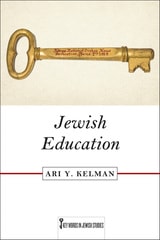
Jewish Education
Ari Y Kelman
Rutgers University Press, 2024
At the heart of Jewish Education is an innovative alphabetical primer of Jewish educational values, qualities, frameworks, catalysts, and technologies which explore the historical ways in which Jewish communities have produced and transmitted knowledge. The book examines the tension between Jewish education and Jewish Studies to argue that shifting the locus of inquiry from “what people ought to know” to “how do people learn” can provide an understanding of Jewish education that both draws on historical precedent and points to the future of Jewish knowledge.
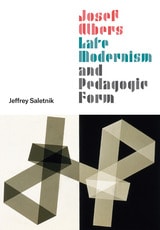
Josef Albers, Late Modernism, and Pedagogic Form
Jeffrey Saletnik
University of Chicago Press, 2022
An extraordinary teacher whose influence continues today, Josef Albers helped shape the Bauhaus school in Germany and established the art and design programs at Black Mountain College in North Carolina and Yale University. His books about color theory have informed generations, and his artworks are included in the canon of high-modernist non-representational art. The pedagogy Albers developed was a dynamic approach to teaching that transcended the modernist agendas and cultivated a material way of thinking among his students.
With this book, Jeffrey Saletnik explores the origins of Albers’s teaching practices and their significance in conveying attitudes about form, material, and sensory understanding to artists Eva Hesse and Richard Serra. He demonstrates how pedagogy is a framework that establishes the possibility for artistic discourse and how the methods through which artists learn are manifested in their individual practices. Tracing through lines from Albers’s training in German educational traditions to his influence on American postwar art, Josef Albers, Late Modernism, and Pedagogic Form positions Albers’s pedagogy as central to the life of modernism.
Joseph Smith
History, Methods, and MemoryRonald O. Barney
University of Utah Press, 2020
Ronald O. Barney, a former editor of the Joseph Smith Papers, applies new interpretations to Smith in history and memory, re-examining both his writings and contemporary accounts of him. The book explores the best methodologies for appraising the historical record, including a review of Smith’s world and its contextual background, an analysis of his foundational experiences, and a characterization of Smith as a man and prophet. Though the premise of re-evaluation may be unsettling to traditionalists, a modern reconsideration of the historical record’s entire range of sources is necessary to fashion a strategy for evaluating Smith and his enduring but complex legacy.
Journal Writing in Second Language Education
Christine Pearson Casanave
University of Michigan Press, 2011
Journal writing is not new--journals have been around for centuries. More recently, journals have been viewed as a means of scaffolding reflective teaching and encouraging reflectivity in research processes. As a result, some educators may ask, “What more do we need to know?” Those likely to raise this question are probably not thinking of the explosive growth of reflective writing enabled by social networking on the Web, the blogs and other interactive e-vehicles for reflection on experiences in our literate, “real,” and virtual lives This revisiting of journal writing from a 21st century perspective, informed by relevant earlier literature, is what Christine Pearson Casanave guides readers through in this first book-length treatment of the use of journal writing in the contexts of language learning, pre and in-service teaching, and research.
Casanave has put together existing ideas that haven't been put together before and has done it not as an edited collection, but as a single-authored book. She has done it in a way that will be especially accessible to teachers in language teacher education programs and to practicing teachers and researchers of writing in both second and foreign language settings, and in a way that will inspire all of us to think about, not just do, journal writing.
Those who have never attempted to use journals in their classes and own lives, as well as others who have used it with mixed results, will probably be tempted to try it in at least some of the venues Casanave provides guidance for. Those already committed to journal writing will very likely find in this book new reasons for expanding and enhancing their use of journals.
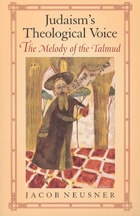
Judaism's Theological Voice
The Melody of the TalmudJacob Neusner
University of Chicago Press, 1995
In his attempt to answer these questions, Neusner sets forth the character and the form of the Torah as sung theology. Israel, the holy community, meets God in the synagogue, while at prayer, and in the yeshiva, when studying the Torah—at the moment in each setting when the Torah is received. In both circumstances people do not read but sing out its words. With the written part of the Torah sung in the synagogue, and the oral part declaimed in centers of sacred learning, music provides the medium for Judaism's theological voice.
Neusner identifies a reciprocal exchange between the holy community Israel and God: Israel sings to God when the Torah is studied, and God sings to Israel when the Torah is declaimed. Through the metaphor of music, Neusner offers an account of how he believes those faithful to the Torah meet God in the Torah, and how they should listen to the melody of God's self-revelation. The result is an original theological reflection that will interest all students of Judaism.