333 books match the query 'Television' and 4 start with j
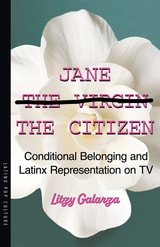
cover of Jane the Citizen: Conditional Belonging and Latinx Representation on TV

Jane the Citizen

Conditional Belonging and Latinx Representation on TV

Litzy Galarza

University of Arizona Press, 2027

What does it mean to belong in the United States—and what does it cost? Jane the Citizen confronts one of the most urgent questions in contemporary cultural life by turning to an unlikely archive: the CW’s celebrated telenovela-inspired series Jane the Virgin (2014–2019).

Litzy Galarza argues that beneath the show’s warmth and wit lies a sustained interrogation of citizenship’s limits. Building on Hector Amaya’s framework of citizenship excess and extending it to theorize reproductive citizenship excess and deficit, the book exposes the widening gap between citizenship as formal legal status and citizenship as livable, protected belonging—a gap that Jane the Virgin maps with extraordinary precision.

Across five seasons and two presidential administrations, Galarza demonstrates how the series tracks the lived costs of immigration policy, racial hierarchy, and gendered control over reproduction. She shows how Latinx characters experience belonging differently as political conditions shift in real time.
[more]
cover of John Logie Baird: Television pioneer

John Logie Baird

Television pioneer

Russell W. Burns

The Institution of Engineering and Technology, 2000
Professor Russell Burns attempts to offer a balanced biography of one of the twentieth century's outstanding inventors, published to coincide with the 75th anniversary of Baird's first public demonstration of a rudimentary television system. The author's meticulous treatment is based on primary source documents although many personal recollections are included to add humour, colour and context. A great deal of material regarding Baird's business partnerships in the early 1920s has only recently become available to researchers and is covered here for the first time.
[more]
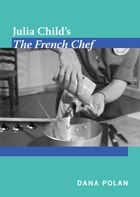
cover of Julia Child's The French Chef

Julia Child's The French Chef

Dana Polan

Duke University Press, 2011
Julia Child’s TV show, The French Chef, was extraordinarily popular during its broadcast from 1963 until 1973. Child became a cultural icon in the 1960s, and, in the years since, she and her show have remained enduring influences on American cooking, American television, and American culture. In this concise book, Dana Polan considers what made Child’s program such a success. It was not the first televised cooking show, but it did define and popularize the genre. Polan examines the development of the show, its day-to-day production, and its critical and fan reception. He argues that The French Chef changed the conventions of television’s culinary culture by rendering personality indispensable. Child was energetic and enthusiastic, and her cooking lessons were never just about food preparation, although she was an effective and unpretentious instructor. They were also about social mobility, the discovery of foreign culture, and a personal enjoyment and fulfillment that promised to transcend domestic drudgery. Polan situates Julia Child and The French Chef in their historical and cultural moment, while never losing sight of Child’s unique personality and captivating on-air presence.
[more]
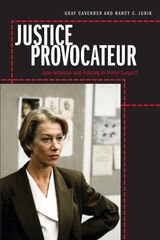
cover of Justice Provocateur: Jane Tennison and Policing in Prime Suspect

Justice Provocateur

Jane Tennison and Policing in Prime Suspect

Gray Cavender and Nancy C. Jurik

University of Illinois Press, 2012

Justice Provocateur focuses on Prime Suspect, a popular British television film series starring Oscar and Emmy award-winning actress Helen Mirren as fictional London policewoman Jane Tennison. Gray Cavender and Nancy C. Jurik examine the media constructions of justice, gender, and police work in the show, exploring its progressive treatment of contemporary social problems in which women are central protagonists. They argue that the show acts as a vehicle for progressive moral fiction--fiction that gives voice to victim experiences, locates those experiences within a larger social context, transcends traditional legal definitions of justice for victims, and offers insights into ways that individuals might challenge oppressive social and organizational arrangements.
 
Although Prime Suspect is often seen as a uniquely progressive, feminist-inspired example within the typically more conservative, male-dominated crime genre, Cavender and Jurik also address the complexity of the films' gender politics. Consistent with some significant criticisms of the films, they identify key moments in the series when Tennison's character appears to move from a successful woman who has it all to a post-feminist stereotype of a lonely, aging career woman with no strong family or friendship ties. Shrewdly interpreting the show as an illustration of the tensions and contradictions of women's experiences and their various relations to power, Justice Provocateur provides a framework for interrogating the meanings and implications of justice, gender, and social transformation both on and off the screen.
[more]