Results by title
660 books match the query 'Texas' and 9 start with j
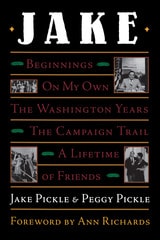
Jake
By Jake Pickle and Peggy Pickle
University of Texas Press, 1997
"My life has been given special purpose," Jake Pickle says. "Some men live to make money, drink, chase women, collect art, excel at a sport, or pursue other things that give them pleasure. The thing I got hooked on was helping people. And I've had the privilege of helping people by the thousands. Serving in Congress was the greatest honor of my life."
In this book, Jake Pickle tells the story of a lifetime in public service, including thirty-one years as Representative for Texas' Tenth Congressional District. Jake tells his story by telling stories—most of them humorous, some poignant—that add up to a warmly personal account of his life and career.
At the heart of the book are Jake's stories of political life in Washington, Austin, and on the campaign trail. These range from hilarious accounts of all that can and does happen at small-town Texas parades and rallies to clear, no-baloney explanations of some of the major legislation that Jake helped to pass. His stories about Social Security reform, tax-exempt organizations, and pension fund reform legislation make these complex topics easy to understand.
This book was written as a collaboration between Jake and his daughter, Peggy Pickle. It offers the fun of listening to a born raconteur spin his tales, while it reveals the ethics and integrity of a man who never forgot that the people elected him to serve them.

Jazz Mavericks of the Lone Star State
By Dave Oliphant
University of Texas Press, 2007
Jazz is one of America's greatest gifts to the arts, and native Texas musicians have played a major role in the development of jazz from its birth in ragtime, blues, and boogie-woogie to its most contemporary manifestation in free jazz. Dave Oliphant began the fascinating story of Texans and jazz in his acclaimed book Texan Jazz, published in 1996. Continuing his riff on this intriguing musical theme, Oliphant uncovers in this new volume more of the prolific connections between Texas musicians and jazz.
Jazz Mavericks of the Lone Star State presents sixteen published and previously unpublished essays on Texans and jazz. Oliphant celebrates the contributions of such vital figures as Eddie Durham, Kenny Dorham, Leo Wright, and Ornette Coleman. He also takes a fuller look at Western Swing through Milton Brown and his Musical Brownies and a review of Duncan McLean's Lone Star Swing. In addition, he traces the relationship between British jazz criticism and Texas jazz and defends the reputation of Texas folklorist Alan Lomax as the first biographer of legendary jazz pianist-composer Jelly Roll Morton. In other essays, Oliphant examines the links between jazz and literature, including fiction and poetry by Texas writers, and reveals the seemingly unlikely connection between Texas and Wisconsin in jazz annals. All the essays in this book underscore the important parts played by Texas musicians in jazz history and the significance of Texas to jazz, as also demonstrated by Oliphant's reviews of the Ken Burns PBS series on jazz and Alfred Appel Jr.'s Jazz Modernism.

Jerry Bywaters
A Life in ArtBy Francine Carraro
University of Texas Press, 1994
As an artist, art critic, museum director, and art educator, Jerry Bywaters reshaped the Texas art world and attracted national recognition for Texas artists. This first full-scale biography explores his life and work in the context of twentieth-century American art, revealing Bywaters' important role in the development of regionalist painting.
Francine Carraro delves into all aspects of Bywaters' career. As an artist, Bywaters became a central figure and spokesman for a group of young, energetic painters known as the Dallas Nine (Alexandre Hogue, Everett Spruce, Otis Dozier, William Lester, and others) who broke out of the limitations of provincialism and attained national recognition beginning in the 1930s.
As director of the Dallas Museum of Fine Arts, art critic for the Dallas Morning News, and professor of art and art history at Southern Methodist University, Bywaters became a champion of the arts in Texas. Carraro traces his strong supporting role in professionalizing art institutions in Texas and defendlng the right to display art considered "subversive" in the McCarthy era.
From these discussions emerges a finely drawn portrait of an artist who used a vocabulary of regional images to explore universal themes. It will be of interest to all students of American studies, national and regional art history, and twentieth-century biography.

John B. Denton
The Bigger-Than-Life Story of the Fighting Parson and Texas RangerMike Cochran
University of North Texas Press, 2021
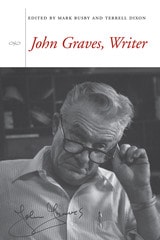
John Graves, Writer
Edited by Mark Busby and Terrell Dixon
University of Texas Press, 2007
Runner-up, Violet Crown Award, Writer's League of Texas, 2008
Renowned for Goodbye to a River, his now-classic meditation on the natural and human history of Texas, as well as for his masterful ability as a prose stylist, John Graves has become the dean of Texas letters for a legion of admiring readers and fellow writers. Yet apart from his own largely autobiographical works, including Hard Scrabble, From a Limestone Ledge, and Myself and Strangers, surprisingly little has been written about Graves's life or his work. John Graves, Writer seeks to fill that gap with interviews, appreciations, and critical essays that offer many new insights into the man himself, as well as the themes and concerns that animate his writing.
The volume opens with the transcript of a revealing, often humorous symposium session in which Graves responds to comments and stories from his old friend Sam Hynes, his former student and contemporary art critic Dave Hickey, and co-editor Mark Busby. Following this is a more formal interview of Graves by Dave Hamrick, who draws the author out on issues relating to each of his major works. John Graves's friends Bill Wittliff, Rick Bass, Bill Broyles, John R. Erickson, Bill Harvey, and James Ward Lee speak to the powerful influence that Graves has had on fellow writers.
In addition to these personal observations, nine scholars analyze essential aspects of Graves's work. These include the place of Goodbye to a River within environmental literature and how its writing was a rite of passage for its author; Graves as a prose stylist and a literary, rather than polemical, writer; the ways in which Graves's major works present different aspects of a single narrative about our relationship to the land; the question of gender in Graves's work; and Graves's sometimes contentious relationship with Texas Monthly magazine. Mark Busby introduces the volume with a critical overview of Graves's life and work, and Don Graham concludes it with a discussion of Graves's reception and literary reputation. A bibliography of works by and about Graves rounds out the book.
John Graves, Writer confirms Graves's stature not only within Texas letters, but also within American environmental writing, where Graves deserves to be more widely known.
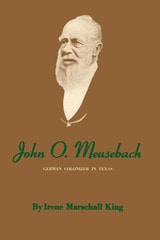
John O. Meusebach
German Colonizer in TexasBy Irene Marschall King
University of Texas Press, 1967
Otfried Hans Freiherr von Meusebach chose a life of hardship and freedom in Texas rather than a life of comfort and influence in his native Germany, where he had lived his formative years within a framework of unconstitutional government.
In 1845 the young liberal relinquished his hereditary German title, left behind his close family ties and his various intellectual and political associations, and arrived in Texas as John O. Meusebach, commissioner-general for the Society for the Protection of German Immigrants. His background enabled him to assume an enlightened leadership of fellow immigrants who were pouring in from Germany. Lacking adequate financial backing, he nevertheless led the settling of some five thousand people in a land that was largely occupied by Indians.
Irene Marschall King presents the full sweep of Meusebach's vigorous life: Meusebach as the young liberal in Germany, as the colonizer in the 1840s, as a Texas senator and, later, an observer of the Civil War, and as a Texan who devoted his later years to bringing the Texas soil to fruition—all set against a background of the immigration movement and frontier life.
"Freedom is not free; it is costly," Meusebach believed. In Texas he found for himself and others freedom worth the price he paid.
Rich in historic detail, King's story recounts the founding of Fredericksburg, the crippling effect of the Mexican War upon the mass of immigrants huddled in illness on the coast, the signing of the Indian Treaty, which opened to settlement over three million acres of land, and the final collapse of the Society for the Protection of German Immigrants. Also depicted is the colonists' influence on the land—the gardens and orchards of south central Texas, the "Easter Fires" that blaze on the hills surrounding Fredericksburg, the mixture of German custom with American necessity that created a unique culture. Throughout the narrative Mrs. King presents a fascinating cast of characters: the noble Prince Solms, who tries to establish a German military outpost in Texas; Henry Fisher, who attempts by devious methods to control the colonists and their land and finally incites a mob which tries to hang Meusebach; Philip Cappes, a special commissioner and Meusebach's assistant, who plots through intriguing correspondence with Count Castell, the executive secretary in Germany, to overthrow Meusebach; and the colorful and courageous Indian fighter and Texas Ranger, Colonel Jack Hays.
Primarily, however, this is the story of a man who found strength in his family's motto, "Perseverance in Purpose," and gave of his energies to build Texas.
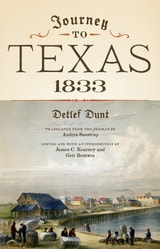
Journey to Texas, 1833
By Detlef Dunt. Translated by Anders Saustrup, edited and with an introduction by James C. Kearney and Geir Bentzen
University of Texas Press, 2015
In 1834, a German immigrant to Texas, D. T. F. (Detlef Thomas Friedrich) Jordt, aka Detlef Dunt, published Reise nach Texas, a delightful little book that praised Texas as “a land which puts riches in [the immigrant’s] lap, which can bring happiness to thousands and to their descendants.” Dunt’s volume was the first one written by an on-the-ground observer to encourage German immigration to Texas, and it provides an unparalleled portrait of Austin’s Colony from the lower Brazos region and San Felipe to the Industry and Frelsburg areas, where Dunt resided with Friedrich Ernst and his family.
Journey to Texas, 1833 offers the first English translation of Reise nach Texas. It brings to vivid life the personalities, scenic landscapes, and customs that Dunt encountered in colonial Texas on the eve of revolution, along with his many practical suggestions for Germans who intended to emigrate. The editors’ introduction describes the social, political, and economic conditions that prompted Europeans to emigrate to Texas and provides biographical background on Dunt and his connection with Friedrich Ernst. Also included in the volume are a bibliography of German works about Texas and an interpretive essay discussing all of the early German literature about Texas and Dunt’s place within it. Expanding our knowledge of German immigration to Texas beyond the more fully documented Hill Country communities, Journey to Texas, 1833 also adds an important chapter to the story of pre-Revolutionary Texas by a sophisticated commentator.
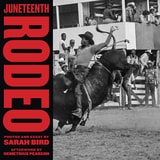
Juneteenth Rodeo
Photos and essay by Sarah Bird; Afterword by Demetrius Pearson
University of Texas Press, 2024
Award of Excellence — Communication Arts
Honorable Mention — The International Photography Awards 2024 Book Category
Jury Top 5 Selection — The International Photography Awards 2024 Book Category
Silver Winner in Zines And Photo Book/Culture— 2024 International Film Photography Award, Analog Sparks
Timeless photos offer a rare portrait of the jubilant, vibrant, vital, nearly hidden, and now all-but-vanished world of small-town Black rodeos.
Long before Americans began to officially commemorate Juneteenth, in the heat of East Texas, saddles were being cinched, buckles shined, and lassoes adjusted for a day on the Black rodeo circuit in honor of the holiday. In the late 1970s, as they had been doing for generations, Black communities across the region held local rodeos for the talented cowboys and cowgirls who were segregated from the mainstream circuit. It was to these vibrant community events that bestselling Texas writer Sarah Bird, then a young photojournalist, found herself drawn.
In Juneteenth Rodeo, Bird’s lens celebrates a world that was undervalued at the time, capturing everything, from the moment the pit master fired up his smoker, through the death-defying rides, to the last celebratory dance at a nearby honky-tonk. Essays by Bird and sports historian Demetrius Pearson reclaim the crucial role of Black Americans in the Western US and show modern rodeo riders—who still compete on today’s circuit—as “descendants” in a more than two-hundred-year lineage of Black cowboys. A gorgeous tribute to the ropers and riders—legends like Willie Thomas, Myrtis Dightman, Rufus Green, Bailey’s Prairie Kid, Archie Wycoff, and Calvin Greeley—as well as the secretaries, judges, and pick-up men and even the audience members who were as much family as fans, Juneteenth Rodeo ultimately seeks to put Black cowboys and cowgirls where they have always belonged: in the center of the frame.
Just As We Were
A Narrow Slice of Texas WomanhoodBy Prudence Mackintosh
University of Texas Press, 1996
When a Texas debutante bows her forehead to the floor in the famous "Texas dip," society columnists all across the country speculate interminably over what it is that sets Texas women apart. But really, how could they know? Even women born and bred in Texas can't always answer that question.
Prudence Mackintosh comes very close to an answer, though, in this endlessly entertaining book. Writing with both a wry sense of humor and an insider's compassion, she offers us a fascinating look into the world of privileged, educated, well-married, well-connected, and mostly wealthy white Texas women.
What really sets these women apart, Ms. Mackintosh tells us, is the comfortable yet demanding path they follow from their idyllic girlhoods to prominent positions in society. In thirteen essays, some of which originally appeared in Texas Monthly magazine, she charts the way stations that mark this path: summer camps in the Texas Hill Country, exclusive private schools like Dallas' Hockaday, sorority membership, and acceptance into the Junior League.
Prudence Mackintosh has been both an outsider and an insider in this privileged world, and her observations are shot through with wit and real insight. Just As We Were may not be the final word on elite Texas women, but no other book has described their world with greater irony or accuracy.