Results by title
248 books match the query 'Theology' and 8 start with j
Jesus Being Jesus
A Theological Interpretation of the Acts of the Apostles: Volume 1: Chapters 1-14Thomas G. Weinandy
Catholic University of America Press, 2026
Jewish Studies
A Theoretical IntroductionBush, Andrew
Rutgers University Press, 2011
Jewish Studies, the first volume in a groundbreaking new series, Key Words in Jewish Studies, introduces the basic approach of the series by organizing discussion around key concepts in the field that have emerged over the last two centuries: history and science, race and religion, self and community, identity and memory. The book is oriented by contemporary critical theory, especially feminist and postcolonial studies, and the multidisciplinary approaches of cultural studies.
By looking backward and forward—and across continents and disciplines—to unearth the evolution of the scholarly study of Jews, Andrew Bush provides a comprehensive introduction to the development of Jewish studies from the turn of the nineteenth century to the present. In the course of engaging scholarship on periods from the classical to the contemporary and from the disciplines of history, philosophy, sociology, anthropology, psychology, and literary studies, Bush questions male-dominated and Ashkenazi-centric visions of the field. He concludes with an experimental exposition of a new Jewish studies for a time where attention to difference has overtaken the security of canons and commonalities.
Jewish Universalisms
Mendelssohn, Cohen, and Humanity’s Highest GoodJeremy Fogel
Brandeis University Press, 2023
Any version of universalism relevant to a more attentive, pluralistic, and postcolonial outlook would balance the urgent current need for a universalistic perspective with the desire to maintain the richness of human diversity. The modern Jewish philosophers who sought to partake in the Enlightenment’s universalistic vision while maintaining their distinct identities as members of a religious minority within Europe offer insightful answers.
Jewish Universalisms analyzes how two major figures, Moses Mendelssohn and Hermann Cohen, dealt with the perceived tension between the universal values characteristic of the Enlightenment and aspects of Judaism often depicted as particularistic and parochial. Jeremy Fogel joins this lively debate in modern Jewish philosophy, offering a comparative examination of these thinkers and analyzing their worldviews from an innovative axiological perspective. Fogel writes that to gain a precise understanding of how Mendelssohn and Cohen argued for the concordance of Judaism and universalism, one must first seek out what they delineated as ultimately valuable. Then one can work out how that highest good, and the method of valuation it sustains, are universal.
John of St. Thomas [Poinsot] on Sacred Science
Cursus Theologicus I, Question 1, Disputation 2John Of St. Thomas
St. Augustine's Press, 2012
This volume offers an English translation of John of St. Thomas’s Cursus theologicus I, question I, disputation 2. In this particular text, the Dominican master raises questions concerning the scientific status and nature of theology. At issue, here, are a number of factors: namely, Christianity’s continual coming to terms with the “Third Entry” of Aristotelian thought into Western Christian intellectual culture – specifically the Aristotelian notion of ‘science’ and sacra doctrina’s satisfaction of those requirements – the Thomistic-commentary tradition, and the larger backdrop of the Iberian Peninsula’s flourishing “Second Scholasticism.”
In this latter context, John of St. Thomas applies the theological principles of Thomas Aquinas to the Scholastic disputes preoccupying Thomist, Franciscan, and Jesuit theologians, such as Cajetan, Bañez, Luis de Molina, Vazquez, Suárez – to name only a few – in a tour de force of theological thinking throughout the entire period of Scholasticism. In the process – and not insignificantly – the status quaestionis of theology’s scientific character is clearly framed and answered according to John’s satisfaction.
Key to John of St. Thomas’s resolution of the question is his understanding of the continuity of the power of human reason with the super-intelligibility of divine revelation spelled out in terms of what he calls “virtual revelation.” This text presented in this volume is a quintessential example of the deep and abiding harmony that flourished between faith and reason as well as grace and nature within the golden era of Baroque Scholasticism.
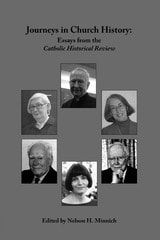
Journeys in Church History
Nelson Minnich
Catholic University of America Press, 2015
The contributors to this volume are: Elizabeth Clark, who pioneered studies of the role of women in the early Church. Caroline Bynum showed how Christians viewed gender and the human body. Jean Delumeau studies the religious attitudes (mentalité) of the ordinary faithful and how these were shaped during the medieval and early modern periods. John W. O'Mally documents that Renaissance humanism was not pagan but profoundly Christian. The promotion of institutions of higher education under the auspices of the Catholic Church in America has been studied by J. Philip Gleason. Margaret Lavinia Anderson was among the first to use computers to analyze voting patterns in modern Germany and thus determine the influence of the Center Party.
Judaism and Christianity in the Age of Constantine
History, Messiah, Israel, and the Initial ConfrontationJacob Neusner
University of Chicago Press, 1987
In a close analysis of texts by the Christian theologians Eusebius, Aphrahat, and Chrysostom on one hand, and of the central Jewish works the Talmud of the Land of Israel, the Genesis Rabbah, and the Leviticus Rabbah on the other, Neusner finds that both religious groups turned to the same corpus of Hebrew scripture to examine the same fundamental issues. Eusebius and Genesis Rabbah both address the issue of history, Chrysostom and the Talmud the issue of the Messiah, and Aphrahat and Leviticus Rabbah the issue of Israel. As Neusner demonstrates, the conclusions drawn shaped the dialogue between the two religions for the rest of their shared history in the West.
Judaism's Theological Voice
The Melody of the TalmudJacob Neusner
University of Chicago Press, 1995
In his attempt to answer these questions, Neusner sets forth the character and the form of the Torah as sung theology. Israel, the holy community, meets God in the synagogue, while at prayer, and in the yeshiva, when studying the Torah—at the moment in each setting when the Torah is received. In both circumstances people do not read but sing out its words. With the written part of the Torah sung in the synagogue, and the oral part declaimed in centers of sacred learning, music provides the medium for Judaism's theological voice.
Neusner identifies a reciprocal exchange between the holy community Israel and God: Israel sings to God when the Torah is studied, and God sings to Israel when the Torah is declaimed. Through the metaphor of music, Neusner offers an account of how he believes those faithful to the Torah meet God in the Torah, and how they should listen to the melody of God's self-revelation. The result is an original theological reflection that will interest all students of Judaism.
Judaism
The Genealogy of a Modern NotionBoyarin, Daniel
Rutgers University Press, 2019