Results by title
991 books match the query 'Writing' and 6 start with j
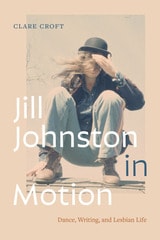
Jill Johnston in Motion
Dance, Writing, and Lesbian LifeClare Croft
Duke University Press, 2024
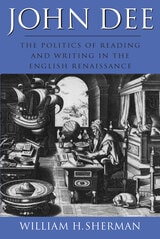
John Dee
The Politics of Reading and Writing in the English RenaissanceWilliam H. Sherman
University of Massachusetts Press, 1995
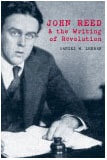
John Reed and the Writing of Revolution
Daniel W. Lehman
Ohio University Press, 2002
John Reed (1887-1920) is best known as the author of Ten Days That Shook the World and as champion of the communist movement in the United States. Still, Reed remains a writer almost systematically ignored by the literary critical establishment, even if alternately vilified and lionized by historians and by films like Warren Beatty’s Reds.
John Reed and the Writing of Revolution examines Reed’s writing from a different critical perspective—one informed by a theoretical and practical understanding of literary nonfiction. In both politics and writing, John Reed defied fashion. In his short career, Reed transcended the traditional creative arts of fiction, poetry, and drama in favor of deeply researched histories composed with the cadence of fiction and the power of fact. Reed thereby alienated literary critics who had idealized timeless artistry against the rough-and-tumble world of historical details and political implications.
Working from a close investigation of rare articles, manuscripts, and the Reed papers at Harvard as well as from Reed’s published work, Daniel W. Lehman offers the first detailed literary study of the man who followed Pancho Villa into battle; wrote literary profiles of such characters as Henry Ford, William Jennings Bryan, and Billy Sunday; explicated the Byzantine factionalism of Eastern Europe; and witnessed the storming of the Winter Palace and the birth of Soviet Russia.
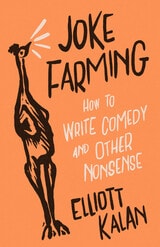
Joke Farming
How to Write Comedy and Other NonsenseElliott Kalan
University of Chicago Press, 2025
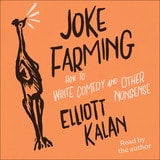
Philosophers may debate the meaning of comedy (thankfully keeping them too busy to fall into a life of crime), but the rest of us are more likely to wonder how we can make an audience laugh—or at least, how to entertain our friends and followers. According to award-winning comedy writer Elliott Kalan, we need to stop staring out the window, waiting for hilarious bits to stroll into view, fully formed. What we need is a process to plant their premises, tend to their structure and wording, and ultimately harvest them as funny material. In short, a farm. But for jokes.
In Joke Farming, Kalan explains that it’s easier to write jokes when you have a dependable method for doing so. All jokes, he argues, are built from the same elements: structure, premise, voice, tone, wording, and audience—and these elements can be applied to any comedic genre, from stand-up to sitcoms to satire. Kalan analyzes examples from his own career—including jokes that he wrote (and rewrote and rewrote and rewrote . . . ) as head writer for The Daily Show with Jon Stewart—as well as material from a diverse array of comedians, writers, and filmmakers, highlighting the phrasing, rhythm, and precise details that make their work so dang funny.
Drawing on his experiences in professional writers’ rooms as well as episodes from everyday life, Kalan’s guide to jokes will appeal to aspiring writers, their mentors, comedy fans, and anyone who has to speak at a wedding. Joke Farming points the way toward a writing process that lessens stress and agony and yields more reliable rewards: a surprising tagline, a hilarious word choice, and—most importantly—a bigger laugh from the audience, whoever they may be.
Joke Farming
How to Write Comedy and Other NonsenseElliott Kalan
University of Chicago Press, 2025
Philosophers may debate the meaning of comedy (thankfully keeping them too busy to fall into a life of crime), but the rest of us are more likely to wonder how we can make an audience laugh—or at least, how to entertain our friends and followers. According to award-winning comedy writer Elliott Kalan, we need to stop staring out the window, waiting for hilarious bits to stroll into view, fully formed. What we need is a process to plant their premises, tend to their structure and wording, and ultimately harvest them as funny material. In short, a farm. But for jokes.
In Joke Farming, Kalan explains that it’s easier to write jokes when you have a dependable method for doing so. All jokes, he argues, are built from the same elements: structure, premise, voice, tone, wording, and audience—and these elements can be applied to any comedic genre, from stand-up to sitcoms to satire. Kalan analyzes examples from his own career—including jokes that he wrote (and rewrote and rewrote and rewrote . . . ) as head writer for The Daily Show with Jon Stewart—as well as material from a diverse array of comedians, writers, and filmmakers, highlighting the phrasing, rhythm, and precise details that make their work so dang funny.
Drawing on his experiences in professional writers’ rooms as well as episodes from everyday life, Kalan’s guide to jokes will appeal to aspiring writers, their mentors, comedy fans, and anyone who has to speak at a wedding. Joke Farming points the way toward a writing process that lessens stress and agony and yields more reliable rewards: a surprising tagline, a hilarious word choice, and—most importantly—a bigger laugh from the audience, whoever they may be.
Journal Writing in Second Language Education
Christine Pearson Casanave
University of Michigan Press, 2011
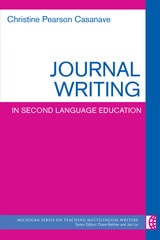
Journal writing is not new--journals have been around for centuries. More recently, journals have been viewed as a means of scaffolding reflective teaching and encouraging reflectivity in research processes. As a result, some educators may ask, “What more do we need to know?” Those likely to raise this question are probably not thinking of the explosive growth of reflective writing enabled by social networking on the Web, the blogs and other interactive e-vehicles for reflection on experiences in our literate, “real,” and virtual lives This revisiting of journal writing from a 21st century perspective, informed by relevant earlier literature, is what Christine Pearson Casanave guides readers through in this first book-length treatment of the use of journal writing in the contexts of language learning, pre and in-service teaching, and research.
Casanave has put together existing ideas that haven't been put together before and has done it not as an edited collection, but as a single-authored book. She has done it in a way that will be especially accessible to teachers in language teacher education programs and to practicing teachers and researchers of writing in both second and foreign language settings, and in a way that will inspire all of us to think about, not just do, journal writing.
Those who have never attempted to use journals in their classes and own lives, as well as others who have used it with mixed results, will probably be tempted to try it in at least some of the venues Casanave provides guidance for. Those already committed to journal writing will very likely find in this book new reasons for expanding and enhancing their use of journals.