Results by title
8642 books match the query '20th Century' and 111 start with j
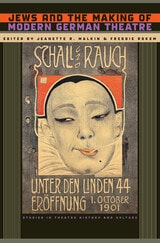
Jews and the Making of Modern German Theatre
Jeanette R. Malkin
University of Iowa Press, 2010
While it is common knowledge that Jews were prominent in literature, music, cinema, and science in pre-1933 Germany, the fascinating story of Jewish co-creation of modern German theatre is less often discussed. Yet for a brief time, during the Second Reich and the Weimar Republic, Jewish artists and intellectuals moved away from a segregated Jewish theatre to work within canonic German theatre and performance venues, claiming the right to be part of the very fabric of German culture. Their involvement, especially in the theatre capital of Berlin, was of a major magnitude both numerically and in terms of power and influence. The essays in this stimulating collection etch onto the conventional view of modern German theatre the history and conflicts of its Jewish participants in the last third of the nineteenth and first third of the twentieth centuries and illuminate the influence of Jewish ethnicity in the creation of the modernist German theatre.
The nontraditional forms and themes known as modernism date roughly from German unification in 1871 to the end of the Weimar Republic in 1933. This is also the period when Jews acquired full legal and trade equality, which enabled their ownership and directorship of theatre and performance venues. The extraordinary artistic innovations that Germans and Jews co-created during the relatively short period of this era of creativity reached across the old assumptions, traditions, and prejudices that had separated people as the modern arts sought to reformulate human relations from the foundations to the pinnacles of society.
The essayists, writing from a variety of perspectives, carve out historical overviews of the role of theatre in the constitution of Jewish identity in Germany, the position of Jewish theatre artists in the cultural vortex of imperial Berlin, the role played by theatre in German Jewish cultural education, and the impact of Yiddish theatre on German and Austrian Jews and on German theatre. They view German Jewish theatre activity through Jewish philosophical and critical perspectives and examine two important genres within which Jewish artists were particularly prominent: the Cabaret and Expressionist theatre. Finally, they provide close-ups of the Jewish artists Alexander Granach, Shimon Finkel, Max Reinhardt, and Leopold Jessner. By probing the interplay between “Jewish” and “German” cultural and cognitive identities based in the field of theatre and performance and querying the effect of theatre on Jewish self-understanding, they add to the richness of intercultural understanding as well as to the complex history of theatre and performance in Germany.
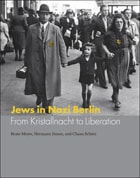
Jews in Nazi Berlin
From Kristallnacht to LiberationEdited by Beate Meyer, Hermann Simon, and Chana Schütz
University of Chicago Press, 2009
Though many of the details of Jewish life under Hitler are familiar, historical accounts rarely afford us a real sense of what it was like for Jews and their families to live in the shadow of Nazi Germany’s oppressive racial laws and growing violence. With Jews in Nazi Berlin, those individual lives—and the constant struggle they required—come fully into focus, and the result is an unprecedented and deeply moving portrait of a people.
Drawing on a remarkably rich archive that includes photographs, objects, official documents, and personal papers, the editors of Jews in Nazi Berlin have assembled a multifaceted picture of Jewish daily life in the Nazi capital during the height of the regime’s power. The book’s essays and images are divided into thematic sections, each representing a different aspect of the experience of Jews in Berlin, covering such topics as emigration, the yellow star, Zionism, deportation, betrayal, survival, and more. To supplement—and, importantly, to humanize—the comprehensive documentary evidence, the editors draw on an extensive series of interviews with survivors of the Nazi persecution, who present gripping first-person accounts of the innovation, subterfuge, resilience, and luck required to negotiate the increasing brutality of the regime.
A stunning reconstruction of a storied community as it faced destruction, Jews in Nazi Berlin renders that loss with a startling immediacy that will make it an essential part of our continuing attempts to understand World War II and the Holocaust.

Jews in the Center
Conservative Synagogues and Their MembersWertheimer, Jack
Rutgers University Press, 2000
Why do well-educated, highly Americanized, and financially secure Jews join a synagogue and participate in its religious life? This study of Conservative Jews examines the largest movement of synagogue-affiliated Jews in the United States, a group that outnumbers the combined membership of Reform and Orthodox congregations and a population that adheres to a centrist version of Judaism. The scholars who contribute to this study ask a series of provocative questions: How do these Jews negotiate the tensions between the traditional values of their religion and modern sensibilities? What meaning do they find in synagogue participation? How crucial are rabbis in the "success" of congregations?
Written by a team of scholars employing the tools of demography, ethnography, sociology, history, and comparative religious studies, Jews in the Center offers the most comprehensive view of any religious movement within American Judaism----and indeed, one of the most detailed studies of any denomination in American religious life.
Jews in the Center seeks to understand how synagogues function as congregations and to what extent they allow for individual self-expression. By focusing on a mainstream population, this book sheds light on religious people who generally receive the least attention----the broad center who neither retreat from society nor blur all boundaries between their religion and modern American culture.
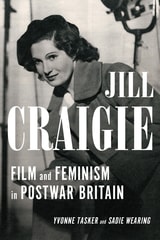
Jill Craigie
Film and Feminism in Postwar BritainYvonne Tasker and Sadie Wearing
University of Illinois Press, 2026
Tasker and Wearing reconsider Craigie’s place and reputation in the history of British Cinema. Craigie created work that showed a strong critical voice and at the same time challenged contemporary modes of filmmaking with both documentary and drama. Tasker and Wearing examine her feminist and working-class influences and also emphasize the democratic impulse that drove Craigie to include her subjects’ participation, and her commitment to representing them on screen. Throughout, Tasker and Wearing analyze Craigie’s work against the backdrop of postwar concerns and preoccupations.
Distinctive and nuanced, Jill Craigie reconsiders the career of a groundbreaking woman director.
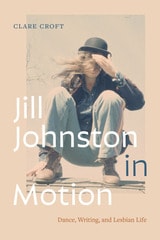
Jill Johnston in Motion
Dance, Writing, and Lesbian LifeClare Croft
Duke University Press, 2024
Jim Crow Networks
African American Periodical CulturesEurie Dahn
University of Massachusetts Press, 2021
As Eurie Dahn demonstrates, authors like James Weldon Johnson, Nella Larsen, William Faulkner, and Jean Toomer wrote in the context of interracial and black periodical networks, which shaped the literature they produced and their concerns about racial violence. This original study also explores the overlooked intersections between the black press and modernist and Harlem Renaissance texts, and highlights key sites where readers and writers worked toward bottom-up sociopolitical changes during a period of legalized segregation.
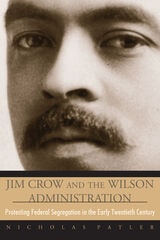
Jim Crow and the Wilson Administration
Protesting Federal Segregation in the Early Twentieth CenturyNicholas Patler
University Press of Colorado, 2007
This protest campaign, carried out on a level not seen since the abolitionist movement, galvanized a vast community of men and women. Blacks and whites, professionals and laymen, signed petitions, wrote protest letters, participated in organized mass meetings, lobbied public officials, directly confronted Wilson, made known their plight through publicity campaigns, and, in at least one case, marched to express their opposition. Patler provides a thorough examination of the two national organizations that led these protests efforts - the National Association for the Advancement of Colored People and William Monroe Trotter's National Equal Rights League - and deftly contextualizes the movement, while emphasizing the tragic, enduring consequences of the Wilson administration's actions.
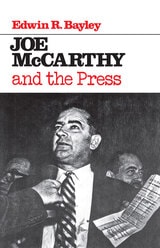
Joe McCarthy and the Press
Edwin R. Bayley
University of Wisconsin Press, 2003
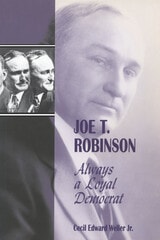
Joe T. Robinson
Always a Loyal DemocratCecil Weller
University of Arkansas Press, 1998
Senate majority leader Joseph Taylor Robinson was undoubtedly one of the most powerful U.S. senators of the early twentieth century. An important political figure in Arkansas from the time he was elected to the state legislature in 1895, Joe T., as he was popularly called became nationally prominent when he ascended to the Democratic leadership of the U.S. Senate in 1923.
Robinson’s career spanned momentous legislative debates in the chambers of the Senate, such as the League of Nations charter, the Teapot Dome Scandal, and FDR’s plan to “pack” the Supreme Court. His run for the vice-presidency in 1928, the first Southerner on a major ticket after the Civil War, and his three terms as chairman of the Democratic National Convention, in 1920, 1928, and 1936, are all covered in this perceptive study.

John Berryman and the Thirties
A MemoirE. M. Halliday
University of Massachusetts Press, 0
E. M. Halliday's "John Berryman and the Thirties: A Memoir" presents an intimate portrait of the celebrated poet during his formative years. Written by Berryman's Columbia College classmate and lifelong friend, the memoir traces Berryman's intellectual and personal development throughout the 1930s—a transformative decade that shaped his later career as one of America's most innovative poets.
Halliday offers rare firsthand insight into Berryman's early struggles, influences, and relationships during a period preceding his major publications and institutional recognition. The memoir explores the Depression-era intellectual landscape that molded Berryman's consciousness, his engagement with modernist poetry and criticism, and his complex personality navigating academic and artistic ambitions. Through personal anecdotes and literary analysis, Halliday documents Berryman's evolution from promising young poet to serious artist grappling with existential and aesthetic questions.
This work fills a crucial gap in Berryman scholarship, providing contextual understanding of the poet's formative years before his landmark works like "Homage to Mistress Bradstreet" and the Dream Songs. Essential for scholars of twentieth-century American poetry and biography, the memoir preserves irreplaceable memories of a major literary figure.
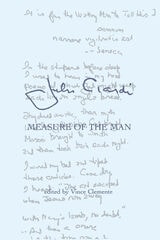
John Ciardi
Measure of the ManVince Clemente
University of Arkansas Press, 1989
Some men make so indelible a mark on the lives of others that a place in time is reserved for them. In this memorial volume, some whose lives have been touched by such a man share their thoughts and memories of the poet, translator, editor , teacher, student, father, son, and husband they knew as John Ciardi.
X.J. Kennedy and Lewis Turco discuss Lives of X, a neglected American classic, which chronicles the years Ciardi spent growing up in Medford, Massachusetts, studying at Tufts, and serving as a gunner in World War II.
Richard Eberhart remembers Ciardi’s unforgettable presence, while John Holmes and Roy W. Cowden remember him as a brilliant student and poet at Tufts and at Michigan, where he won the Avery Hopwood Award. Others remember him as a teacher at Harvard and Rutgers. Dan Jaffe writes, “If John Ciardi held to any cause, it was the notion of precision, to an uncompromising excellence, to the notion that to strive was in itself not enough that one needed to judge honestly, to assess courageously, and to respond without flinching.”
William Heyden and Norbert Krapf tell how the books I Marry You and How Does a Poem Mean? influenced them as young men. In “john Ciardi: the Many Lives of Poetry,” John Nims claims Ciardi as our Chaucer. John Williams, Maxine Kumin, Diane Wakoski, and John Stone write about the Ciardi they knew at the Bread Loaf Writers’ Conference.
Gay Wilson Allen describes the list of contributors to Measure of the Man as a “Who’s Who” in American literature. Certainly it is an impressive gathering of poets, critics, and friends who have been touched by John Ciardi. “We are all in his debt,” Norman Cousins writes in his essay “Ciardi at The Saturday Review,” “and it is important that we say so.”
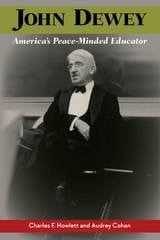
John Dewey, America's Peace-Minded Educator
Charles F. Howlett and Audrey Cohan
Southern Illinois University Press, 2016
In John Dewey, America’s Peace-Minded Educator, authors Charles F. Howlett and Audrey Cohan take a close look at John Dewey’s many undertakings on behalf of world peace. This volume covers Dewey’s support of, and subsequent disillusionment with, the First World War as well as his postwar involvement in trying to prevent another world war. Other topics include his interest in peace movements in education, his condemnation of American military intervention in Latin America and of armaments and munitions makers during the Great Depression, his defense of civil liberties during World War II, and his cautions at the start of the atomic age. The concluding epilogue discusses how Dewey fell out of favor with some academics and social critics in the 1950s and explores how Dewey’s ideas can still be useful to peace education today.
Exploring Dewey’s use of pragmatic philosophy to build a consensus for world peace, Howlett and Cohan illuminate a previously neglected aspect of his contributions to American political and social thought and remind us of the importance of creating a culture of peace through educational awareness.
John Fuller and the Sycamore Press
A Bibliographic HistoryRyan Roberts
Bodleian Library Publishing, 2010
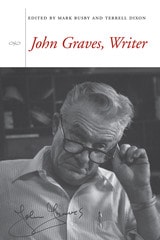
John Graves, Writer
Edited by Mark Busby and Terrell Dixon
University of Texas Press, 2007
Runner-up, Violet Crown Award, Writer's League of Texas, 2008
Renowned for Goodbye to a River, his now-classic meditation on the natural and human history of Texas, as well as for his masterful ability as a prose stylist, John Graves has become the dean of Texas letters for a legion of admiring readers and fellow writers. Yet apart from his own largely autobiographical works, including Hard Scrabble, From a Limestone Ledge, and Myself and Strangers, surprisingly little has been written about Graves's life or his work. John Graves, Writer seeks to fill that gap with interviews, appreciations, and critical essays that offer many new insights into the man himself, as well as the themes and concerns that animate his writing.
The volume opens with the transcript of a revealing, often humorous symposium session in which Graves responds to comments and stories from his old friend Sam Hynes, his former student and contemporary art critic Dave Hickey, and co-editor Mark Busby. Following this is a more formal interview of Graves by Dave Hamrick, who draws the author out on issues relating to each of his major works. John Graves's friends Bill Wittliff, Rick Bass, Bill Broyles, John R. Erickson, Bill Harvey, and James Ward Lee speak to the powerful influence that Graves has had on fellow writers.
In addition to these personal observations, nine scholars analyze essential aspects of Graves's work. These include the place of Goodbye to a River within environmental literature and how its writing was a rite of passage for its author; Graves as a prose stylist and a literary, rather than polemical, writer; the ways in which Graves's major works present different aspects of a single narrative about our relationship to the land; the question of gender in Graves's work; and Graves's sometimes contentious relationship with Texas Monthly magazine. Mark Busby introduces the volume with a critical overview of Graves's life and work, and Don Graham concludes it with a discussion of Graves's reception and literary reputation. A bibliography of works by and about Graves rounds out the book.
John Graves, Writer confirms Graves's stature not only within Texas letters, but also within American environmental writing, where Graves deserves to be more widely known.
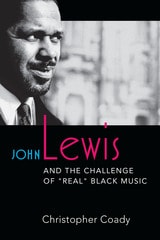
John Lewis and the Challenge of "Real" Black Music
Christopher Coady
University of Michigan Press, 2016
For critics and listeners, the reception of the 1950s jazz-classical hybrid Third Stream music has long been fraught. In John Lewis and the Challenge of “Real” Black Music, Christopher Coady explores the work of one of the form’s most vital practitioners, following Lewis from his role as an arranger for Miles Davis’s Birth of the Cool sessions to his leadership of the Modern Jazz Quartet, his tours of Europe, and his stewardship of the Lenox School of Jazz.
Along the way Coady shows how Lewis’s fusion works helped shore up a failing jazz industry in the wake of the 1940s big band decline, forging a new sound grounded in middle-class African American musical traditions. By taking into account the sociocultural milieu of the 1950s, Coady provides a wider context for understanding the music Lewis wrote for the Modern Jazz Quartet and sets up new ways of thinking about Cool Jazz and Third Stream music more broadly.
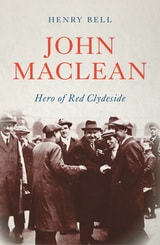
John Maclean
Hero of Red ClydesideHenry Bell
Pluto Press, 2018
Feared by the government, adored by workers, celebrated by Lenin and Trotsky. The head of British Military Intelligence called John Maclean (1879–1923) “the most dangerous man in Britain.”
This new biography explores the events that shaped the life of a momentous man—from the Great War and the Great Unrest to the Rent Strike and the Russian Revolution. It examines his work as an organizer and educator, his imprisonment and hunger strike, and his rise to the position of Britain’s most famous revolutionary. At a moment when radical politics is drawing renewed attention and support, Maclean’s example of activism and commitment is as timely as ever.
John Reed and the Writing of Revolution
Daniel W. Lehman
Ohio University Press, 2002
John Reed (1887-1920) is best known as the author of Ten Days That Shook the World and as champion of the communist movement in the United States. Still, Reed remains a writer almost systematically ignored by the literary critical establishment, even if alternately vilified and lionized by historians and by films like Warren Beatty’s Reds.
John Reed and the Writing of Revolution examines Reed’s writing from a different critical perspective—one informed by a theoretical and practical understanding of literary nonfiction. In both politics and writing, John Reed defied fashion. In his short career, Reed transcended the traditional creative arts of fiction, poetry, and drama in favor of deeply researched histories composed with the cadence of fiction and the power of fact. Reed thereby alienated literary critics who had idealized timeless artistry against the rough-and-tumble world of historical details and political implications.
Working from a close investigation of rare articles, manuscripts, and the Reed papers at Harvard as well as from Reed’s published work, Daniel W. Lehman offers the first detailed literary study of the man who followed Pancho Villa into battle; wrote literary profiles of such characters as Henry Ford, William Jennings Bryan, and Billy Sunday; explicated the Byzantine factionalism of Eastern Europe; and witnessed the storming of the Winter Palace and the birth of Soviet Russia.

John Steinbeck - American Writers 94
University of Minnesota Pamphlets on American WritersJames Gray
University of Minnesota Press, 1971
John Steinbeck - American Writers 94 was first published in 1971. Minnesota Archive Editions uses digital technology to make long-unavailable books once again accessible, and are published unaltered from the original University of Minnesota Press editions.
John Steinbeck Goes to War
The Moon is Down as PropagandaDonald V. Coers
University of Alabama Press, 2005
WINNER OF THE ELIZABETH AGEE PRIZE IN AMERICAN LITERATURE
When words became weapons—Steinbeck’s novel and the underground war for freedom.
In March 1942, a desperate period for the allies in World War II, John Steinbeck published his propaganda novel The Moon is Down—the story of ruthless invaders who overrun a militarily helpless country. Throughout the novel, Steinbeck underscored both the fatal weakness of the “invincible” unnamed aggressors and the inherent power of the human values shard by the “conquered” people.
The Moon is Down created an immediate sensation among American literary critics; fierce debate erupted over Steinbeck’s uncommonly sympathetic portrayal of the enemy and the novel’s power as a vehicle for propaganda. Fifty years later, Coers continues the debate, relying heavily on unpublished letters and personal interviews with the lawyers, book dealers, actors, publishers, and housewives associated with the resistance movements in Western Europe. Clandestine translations of The Moon Is Down quickly appeared and were widely circulated under the noses of the Gestapo. Coers documents the fate of Steinbeck’s novel in the hands of World War II resistance fighters and deepens our appreciation of Steinbeck’s unique ability to express the feelings of oppressed peoples.
John Steinbeck
The Years of Greatness, 1936-1939Tetsumaro Hayashi
University of Alabama Press, 1993
Revisiting the remarkable years that produced Steinbeck's greatest literary achievements.
John Steinbeck: The Years of Greatness, 1936–1939, edited by Tetsumaro Hayashi, offers a compelling scholarly exploration of the brief but extraordinary period during which John Steinbeck produced some of the most influential works in American literary history. Drawn from papers presented at the Third International Steinbeck Congress, this collection of essays examines the creative, intellectual, and social forces that shaped Steinbeck's remarkable achievements during the late 1930s.
The contributors investigate Steinbeck's major works of the period, including In Dubious Battle, Of Mice and Men, and The Grapes of Wrath, situating them within the social and economic realities of the Great Depression and the evolving landscape of twentieth-century American literature. Particular attention is given to Steinbeck's portrayal of labor, migration, community, social justice, and the experiences of working-class Americans. The volume also presents innovative studies of female characters and relationships in Steinbeck's fiction, drawing on newly available research materials and correspondence to illuminate previously overlooked dimensions of his work.
By combining historical context, literary analysis, and fresh critical perspectives, this collection deepens appreciation for Steinbeck's artistry and enduring cultural significance. An essential resource for scholars and students alike, it offers valuable insights into the years that established Steinbeck as one of America's most important and widely studied authors.
John Updike and the Cold War
Drawing the Iron CurtainD. Quentin Miller
University of Missouri Press, 2001
One of the most enduring and prolific American authors of the latter half of the twentieth century, John Updike has long been recognized by critics for his importance as a social commentator. Yet, John Updike and the Cold War is the first work to examine how Updike's views grew out of the defining context of American culture in his time—the Cold War. Quentin Miller argues that because Updike's career began as the Cold War was taking shape in the mid-1950s, the world he creates in his entire literary oeuvre—fiction, poetry, and nonfiction prose—reflects the optimism and the anxiety of that decade.
Miller asserts that Updike's frequent use of Cold War tension as a metaphor for domestic life and as a cultural reality that affects the psychological security of his characters reveals the inherent conflict of his fictional world. Consequently, this conflict helps explain some of the problematic relationships and aimless behavior of Updike's characters, as well as their struggles to attain spiritual meaning.
By examining Updike's entire career in light of the historical events that coincide with it, Miller shows how important the early Cold War mind-set was to Updike's thinking and to the development of his fiction. The changes in Updike's writing after the 1950s confirm the early Cold War era's influence on his ideology and on his celebrated style. By the Cold War's end in the late 1980s, Updike's characters look back fondly to the Eisenhower years, when their national identity seemed so easy to define in contrast to the Soviet Union. This nostalgia begins as early as his writings in the 1960s, when the breakdown of an American consensus disillusions Updike's characters and leaves them yearning for the less divisive 1950s.
While underscoring how essential history is to the study of literature, Miller demonstrates that Updike's writing relies considerably on the growth of the global conflict that defined his time. Cogent and highly readable, John Updike and the Cold War makes an important contribution to Updike scholarship.
John Vinci
Life and LandmarksText by Robert Sharoff, Photographs by William Zbaren
Northwestern University Press, 2017
This illustrated biography traces Vinci’s origins as a child of Italian immigrants on Chicago’s South Side and his coming of age at the Illinois Institute of Technology, which was then under the direction of the legendary Modernist architect Ludwig Mies van der Rohe. It follows his career through his subsequent immersion in the historic preservation movement and the work of such early Chicago architects as Louis Sullivan, Frank Lloyd Wright, and John Wellborn Root.
Vinci’s pioneering restoration projects include Frank Lloyd Wright’s Robie House and Home Studio, Sullivan’s Chicago Stock Exchange Trading Room and the Carson Pirie Scott Building, and Root’s Monadnock Building. His original work, meanwhile, includes notable buildings such as the Arts Club of Chicago, numerous award-winning residences, and more than fifty major exhibitions at the Art Institute of Chicago and other museums.
John Vinci: Life and Landmarks also features portraits and profiles of Vinci’s friends and mentors over the years, including the architectural photographer Richard Nickel, the landscape designer Alfred Caldwell, the Art Institute curators James Speyer and Anne Rorimer, the architects Crombie Taylor and Myron Goldsmith, and the City of Chicago’s cultural historian Tim Samuelson.
The book includes new photos of twenty projects by noted architectural photographer William Zbaren as well as more than one hundred vintage photos and floorplans from Vinci’s personal archives, many never before published. A comprehensive catalogue raisonné rounds out this handsome and definitive work.
John Wayne’s World
Transnational Masculinity in the FiftiesBy Russell Meeuf
University of Texas Press, 2013
In a film career that spanned five decades, John Wayne became a U.S. icon of heroic individualism and rugged masculinity. His widespread popularity, however, was not limited to the United States: he was beloved among moviegoers in Asia, Africa, Latin America, and Europe. In John Wayne’s World, Russell Meeuf considers the actor’s global popularity and makes the case that Wayne’s depictions of masculinity in his most popular films of the 1950s reflected the turbulent social disruptions of global capitalism and modernization taking place in that decade.
John Wayne’s World places Wayne at the center of gender- and nation-based ideologies, opening a dialogue between film history, gender studies, political and economic history, and popular culture. Moving chronologically, Meeuf provides new readings of Fort Apache, Red River, Hondo, The Searchers, Rio Bravo, and The Alamo and connects Wayne’s characters with a modern, transnational masculinity being reimagined after World War II. Considering Wayne’s international productions, such as Legend of the Lost and The Barbarian and the Geisha, Meeuf shows how they resonated with U.S. ideological positions about Africa and Asia. Meeuf concludes that, in his later films, Wayne’s star text shifted to one of grandfatherly nostalgia for the past, as his earlier brand of heroic masculinity became incompatible with the changing world of the 1960s and 1970s. The first academic book-length study of John Wayne in more than twenty years, John Wayne’s World reveals a frequently overlooked history behind one of Hollywood’s most iconic stars.
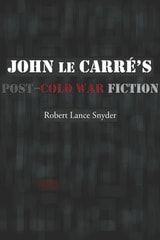
John le Carré’s Post–Cold War Fiction
Robert Lance Snyder
University of Missouri Press, 2017
This is an analysis of the first 10 post—Cold War novels of one of the most significant ethicists in contemporary fiction.
This book challenges distinctions between “popular” and “serious” literature by recognizing le Carré as one of the most significant ethicists in contemporary fiction, contributing to an overdue reassessment of his literary stature. Le Carré’s ten post–Cold War novels constitute a distinctive subset of his espionage fiction in their response to the momentous changes in geopolitics that began in the 1990s. Through a close reading of these novels, Snyder traces how—amid the “War on Terror” and transnationalism—le Carré weighs what is at stake in this conflict of deeply invested ideologies.
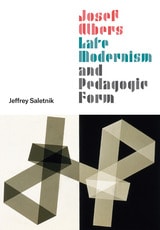
Josef Albers, Late Modernism, and Pedagogic Form
Jeffrey Saletnik
University of Chicago Press, 2022
An extraordinary teacher whose influence continues today, Josef Albers helped shape the Bauhaus school in Germany and established the art and design programs at Black Mountain College in North Carolina and Yale University. His books about color theory have informed generations, and his artworks are included in the canon of high-modernist non-representational art. The pedagogy Albers developed was a dynamic approach to teaching that transcended the modernist agendas and cultivated a material way of thinking among his students.
With this book, Jeffrey Saletnik explores the origins of Albers’s teaching practices and their significance in conveying attitudes about form, material, and sensory understanding to artists Eva Hesse and Richard Serra. He demonstrates how pedagogy is a framework that establishes the possibility for artistic discourse and how the methods through which artists learn are manifested in their individual practices. Tracing through lines from Albers’s training in German educational traditions to his influence on American postwar art, Josef Albers, Late Modernism, and Pedagogic Form positions Albers’s pedagogy as central to the life of modernism.
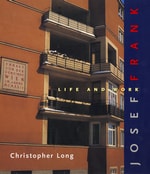
Josef Frank
Life and WorkChristopher Long
University of Chicago Press, 2002
Educated in Vienna just after the turn of the century, Frank became the leader of the younger generation of architects in Austria after the First World War. But Frank fell from grace when he emerged as a forceful critic of the extremes of modern architecture and design during the early 1930s. Dismissing the demands for a unified modern style, Frank insisted that it was pluralism, not uniformity, that most characterized life in the new machine age. He called instead for a more humane modernism, one that responded to people's everyday needs and left room for sentimentality and historical influences. He was able to put these ideas into practice when, in 1933, he was forced to leave Vienna for Sweden. There his work came to define Swedish (or Scandinavian) modern design. For more than thirty years he was the chief designer for the Stockholm furnishings firm Svenskt Tenn, producing colorful, cozy, and eclectic designs that provided a refreshing alternative to the architectural mainstream of the day and presaged the coming revolt against modernism in the 1960s.
In this sensitive study of one of the twentieth century's seminal architects and thinkers, Christopher Long offers new insight into Josef Frank's work and ideas and provides an important contribution to the understanding of modernist culture and its history.

Josef Guttmann
The Fates of Central Europe Between Hitler and Stalin: Selected WritingEdited by Jacques Rupnik
Karolinum Press, 2026
Two lives, two names, two perspectives on Soviet communism and its postwar expansion into Eastern Europe.
In the 1930s, Guttmann was a leader of the Communist Party of Czechoslovakia before he broke with the party over the Comintern's strategy of helping Hitler to power. A harsh critic of Stalin's dictatorship and foreign policy, Guttmann became a prominent leftist opponent, outcast by the Party. To escape nazism, he exiled and settled in New York, where he worked under a pseudonym as a leading expert on events in the Soviet bloc and a critic of totalitarianism. Featured in this book are his Czech texts from the 1930s as well as studies and essays he later wrote on the nature of communist regimes, genocide, and anti-Semitism.

Joseph Conrad
Martin Ray
University of Iowa Press, 1990

Joseph Fielding Smith
A Mormon TheologianMatthew Bowman
University of Illinois Press, 2024
Incisive and illuminating, Joseph Fielding Smith examines the worldview and development of an influential theologian and his place in American religious and intellectual history.
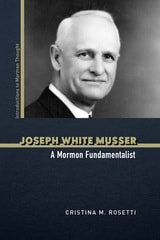
Joseph White Musser
A Mormon FundamentalistCristina M. Rosetti
University of Illinois Press, 2024
Musser’s devotion to Joseph Smith’s vision and the faith’s foundational texts reflected a widespread uneasiness with, and reaction against, changes taking place across society. Rosetti analyzes how Musser’s writing and thought knit a disparate group of outcast LDS believers into a movement. She also places Musser’s eventful life against the backdrop of a difficult period in LDS history, when the Church strained to disentangle itself from plural marriage and leaders like Musser emerged to help dissident members make sense of their lives outside the mainstream.
The first book-length account of the Mormon thinker, Joseph White Musser reveals the figure whose teachings helped mold a movement.
Josie Mpama/Palmer
Get Up and Get MovingRobert R. Edgar
Ohio University Press, 2020
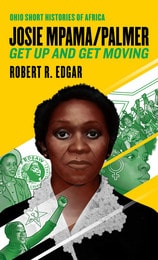
While African National Congress narratives dominate much of the scholarship on South Africa’s freedom struggle, Josie Mpama/Palmer’s political life offers a different perspective. Highly critical of the patriarchal attitudes that hindered black women from actively participating in politics, Mpama/Palmer was an outspoken advocate for women’s social equality and encouraged black women to become more involved in national conversations. The first black woman to join the Communist Party of South Africa and an antiapartheid activist, Josie Mpama/Palmer remained involved in critical issues all her life, especially protests against Bantu Education and other forms of racial and sexist discrimination. She was an integral figure in establishing the Federation of South African Women, an organization open to women of all races. Mpama/Palmer’s activism and political legacy would become an inspiring example for women in South Africa and around the world to get up and get moving.
Journal of the Fictive Life
Howard Nemerov
University of Chicago Press, 1981
"He often shows bravery and shrewdness; the book is full of fine criticism and psychological insight. As always, his prose has that ease and transparency that make one forget one is reading; one seems simply to hear a voice speaking. Nemerov's improvised self-analysis has weaknesses, but few that he himself doesn't eventually recognize."—New York Times Book Review
"In an age of explicitness, Nemerov's Journal of the Fictive Life is explicitly without vulgarity; in an age of revelation, it reveals only what counts. More then a book about creativity, it is a beautiful creation."—Richard G. Stern
Journalism 1908
Birth of a ProfessionEdited by Betty Houchin Winfield
University of Missouri Press, 2008
Journalism—1908 opens a window on mass communication a century ago. It tells how the news media in the United States were fundamentally changed by the creation of academic departments and schools of journalism, by the founding of the National Press Club, and by exciting advances that included early newsreels, the introduction of halftones to print, and even changes in newspaper design.
Journalism educator Betty Houchin Winfield has gathered a team of well-known media scholars, all specialists in particular areas of journalism history, to examine the status of their profession in 1908: news organizations, business practices, media law, advertising, forms of coverage from sports to arts, and more. Various facets of journalism are explored and situated within the country’s history and the movement toward reform and professionalism—not only formalized standards and ethics but also labor issues concerning pay, hours, and job differentiation that came with the emergence of new technologies.
This overview of a watershed year is national in scope, examining early journalism education programs not only at Missouri but also at such schools as Colgate, Washington and Lee, Wisconsin, and Columbia. It also reviews the status of women in the profession and looks beyond big-city papers to Progressive Era magazines, the immigrant press, and African American publications.
Journalism—1908 commemorates a century of progress in the media and, given the place of Missouri’s School of Journalism in that history, is an appropriate celebration of that school’s centennial. It is a lode of information about journalism education history that will surprise even many of those in the field and marks a seminal year with lasting significance for the profession.
Journalism and Jim Crow
White Supremacy and the Black Struggle for a New AmericaEdited by Kathy Roberts Forde and Sid Bedingfield
University of Illinois Press, 2021
White publishers and editors used their newspapers to build, nurture, and protect white supremacy across the South in the decades after the Civil War. At the same time, a vibrant Black press fought to disrupt these efforts and force the United States to live up to its democratic ideals. Journalism and Jim Crow centers the press as a crucial political actor shaping the rise of the Jim Crow South. The contributors explore the leading role of the white press in constructing an anti-democratic society by promoting and supporting not only lynching and convict labor but also coordinated campaigns of violence and fraud that disenfranchised Black voters. They also examine the Black press’s parallel fight for a multiracial democracy of equality, justice, and opportunity for all—a losing battle with tragic consequences for the American experiment.
Original and revelatory, Journalism and Jim Crow opens up new ways of thinking about the complicated relationship between journalism and power in American democracy.
Contributors: Sid Bedingfield, Bryan Bowman, W. Fitzhugh Brundage, Kathy Roberts Forde, Robert Greene II, Kristin L. Gustafson, D'Weston Haywood, Blair LM Kelley, and Razvan Sibii

Journey
The Gateway Theatre Building and Company, 1884-1965Ian Brown
Intellect Books, 2013
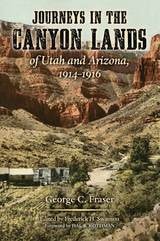
Journeys in the Canyon Lands of Utah and Arizona, 1914-1916
George C. Fraser; Edited by Frederick H. Swanson; Foreword by Hal K. Rothman
University of Arizona Press, 2005
Frederick H. Swanson has edited Fraser’s voluminous journals into a single volume covering three trips taken from 1914 to 1916. As Fraser wades the bone-chilling waters of the Zion Narrows, crosses the Grand Canyon in midsummer heat, and rides through the trackless forest of the Aquarius Plateau, he conveys impressions of the land that will fascinate any reader who wonders what the canyon country was like before it became a popular tourist destination—and one that will inform historians interested in early accounts of the region. Accompanied by a selection of photographs taken by Fraser and his fellow travelers, Journeys in the Canyon Lands brings to life the Southwest’s breathtaking backcountry on the brink of discovery.
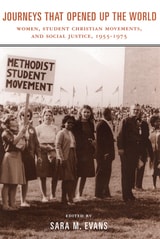
Journeys that Opened up the World
Women, Student Christian Movements, and Social Justice, 1955-1975Evans, Sara M.
Rutgers University Press, 2003
For thousands of young women in the 1950s and 1960s, involvement with the student Christian movement (SCM) changed their worldviews. Religious organizations fostered women’s leadership at a time when secular groups like Students for a Democratic Society, and the Left in general, relegated most female participants to stereotypical roles.
The SCM introduced young women to activism in other parts of the country and around the world. As leaders, thinkers, and organizers, they encountered the social realities of poverty and racial prejudice and worked to combat them. The SCM took women to Selma and Montgomery, to Africa and Latin America, and to a lifelong commitment to work for social justice.
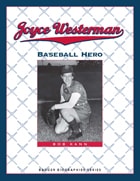
Joyce Westerman
Baseball HeroBob Kann
Wisconsin Historical Society Press, 2012
Joyce Westerman grew up on a farm in Pleasant Prairie, Wisconsin. As a kid, she cleaned the barn, picked vegetables, and helped her father cut down trees. But what she really loved to do was play baseball. Joyce played ball at recess and with friends whenever she could. She even joined her aunt’s adult softball team when she was only twelve.
As Joyce got older, she went to work at a factory in Kenosha. But when World War II broke out, she got a chance to try out for the All American Girls Professional Baseball League. Women from all over the country signed up to show off their skills. Only a few were good enough, and Joyce was one of them. For eight years, Joyce travelled around the United Stated playing ball, winning the league championship in her last season.
This addition to the Badger Biographies series for young readers tells the story of a woman who lived her dream of becoming a professional athlete. In a time when women had few opportunities for careers, and next to none in professional sports, Joyce and her teammates showed that women have what it takes.
Joyce and the Two Irelands
By Willard Potts
University of Texas Press, 2001
Uniting Catholic Ireland and Protestant Ireland was a central idea of the "Irish Revival," a literary and cultural manifestation of Irish nationalism that began in the 1890s and continued into the early twentieth century. Yet many of the Revival's Protestant leaders, including W. B. Yeats, Lady Gregory, and John Synge, failed to address the profound cultural differences that made uniting the two Irelands so problematic, while Catholic leaders of the Revival, particularly the journalist D. P. Moran, turned the movement into a struggle for greater Catholic power.
This book fully explores James Joyce's complex response to the Irish Revival and his extensive treatment of the relationship between the "two Irelands" in his letters, essays, book reviews, and fiction up to Finnegans Wake. Willard Potts skillfully demonstrates that, despite his pretense of being an aloof onlooker, Joyce was very much a part of the Revival. He shows how deeply Joyce was steeped in his whole Catholic culture and how, regardless of the harsh way he treats the Catholic characters in his works, he almost always portrays them as superior to any Protestants with whom they appear. This research recovers the historical and cultural roots of a writer who is too often studied in isolation from the Irish world that formed him.
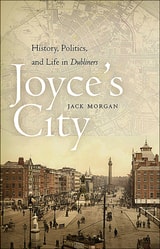
Joyce's City
History, Politics, and Life in DUBLINERSJack Morgan
University of Missouri Press, 2014
Joyce's Web
The Social Unraveling of ModernismBy Margot Norris
University of Texas Press, 1992
James Joyce has long been viewed as a literary modernist who helped define and uphold modernism's fundamental concepts of the artist as martyr to bourgeois sensibilities and of an idealistic faith in artistic freedom. In this revolutionary work, however, Margot Norris proposes that Joyce's art actually critiques these modernist tenets by revealing an awareness of the artist's connections to and constraints within bourgeois society.
In sections organized around three mythologized and aestheticized figures in Joyce's works—artist, woman, and child—Norris' readings "unravel the web" of Joyce's early and late stories, novels, and experimental texts. She shows how Joyce's texts employ multiple mechanisms to expose their own distortions, silences, and lies and reveal connections between art and politics, and art and society.
This ambitious new reading not only repositions Joyce within contemporary debates about the ideological assumptions behind modernism and postmodernism, but also urges reconsideration of the phenomenon of modernism itself. It will be of interest and importance to all literary scholars.
Joyce, Bakhtin, and the Literary Tradition
Toward a Comparative Cultural PoeticsM. Keith Booker
University of Michigan Press, 1997

Joyce, Chaos, and Complexity
Thomas Jackson Rice
University of Illinois Press, 1997
Placing Joyce in his cultural context, Rice first traces the influence of Euclidean and non-Euclidean geometries on Dubliners and A Portrait of the Artist as a Young Man. He then demonstrates that, when later innovations in science transformed entire worldviews, Joyce recognized conventional literary modes of representation as offering only arbitrary constructions of this reality. Joyce responded in Ulysses by experimenting with perspective, embedding design, and affirming the existence of reality. Rice contends that Ulysses presages the multiple tensions of chaos theory; likewise, chaos theory can serve as a model for understanding Ulysses. In Finnegans Wake Joyce consummates his vision and anticipates the theories of complexity science through a dynamic approximation of reality.
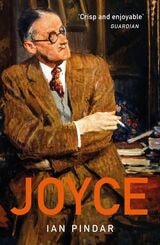
Joyce
Second EditionIan Pindar
Haus Publishing, 2025
James Joyce (1882–1941) is hailed as one of the greatest writers of the twentieth century. Rejecting his homeland and its religion as a young man, Joyce went on to reinvent the Dublin of his youth in his fiction. His masterpiece, Ulysses—once banned in Britain and the United States—redefined the modern novel and has become a canonical classic. Finnegans Wake, written as Joyce’s eyesight deteriorated, cemented his legacy as one of the founding figures of modernist literature.
In a revised edition of this lucid and compelling biography, containing a new foreword from the author, crucial events in Joyce’s life, from his self-imposed exile to his creative triumphs, are explored vividly. Ian Pindar reveals how Joyce’s work carefully blends the abstract and the mundane, capturing the great human comedy of which we are all part.

Judith Resnik
Unsung AstronautMarlene Targ Brill
Ohio University Press, 0
Judith Resnik didn’t grow up dreaming of space, but when NASA opened its doors to women astronauts in the late 1970s, she stepped forward—and soared. One of the first six women ever accepted into NASA’s space shuttle astronaut-training program, Resnik brought her sharp mind, determination, and creativity to a field that had long been closed to women. Although she wasn’t the first American woman in space, she became one of the most accomplished astronauts of her time.
Resnik’s journey wasn’t easy. She faced challenges at home and in school, but she never let obstacles stop her. A gifted student, she excelled in math, science, and music—she even considered becoming a concert pianist before choosing a career in engineering. Her hard work paid off: She earned multiple degrees and helped design improvements for the space shuttle itself. She proved that astronauts aren’t just pilots—they’re problem solvers, inventors, and explorers.
In 1984, Resnik launched into space for the first time aboard the shuttle Discovery. Two years later, she joined the crew of Challenger. Tragically, that mission ended in disaster, cutting her life short. While the world focused on the loss of teacher Christa McAuliffe, who was a passenger on that flight, Resnik’s story was often overlooked. Yet her contributions to science and space exploration live on through programs, schools, and scholarships that bear her name.
This inspiring biography brings Resnik’s remarkable life to light. Readers will discover how a girl from Ohio became a trailblazer in space and how her courage and brilliance continue to inspire new generations. Her story reminds us that even if you’re not first, you can still make history—and that reaching for the stars starts with believing in yourself.

Julia Child's The French Chef
Dana Polan
Duke University Press, 2011
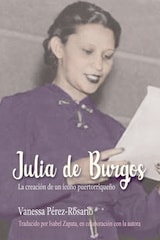
Julia de Burgos
La creación de un ícono puertorriqueñoVanessa Pérez-Rosario. Traducido por Isabel Zapata, en colaboración con la autora
University of Illinois Press, 2021
Disponible por primera vez en español, Julia de Burgos cuenta la destacada historia de la poeta y activista puertorriqueña.
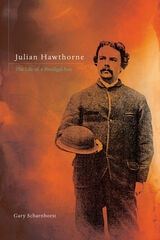
Julian Hawthorne
The Life of a Prodigal SonGary Scharnhorst
University of Illinois Press, 2014
Julian Hawthorne (1846-1934), Nathaniel Hawthorne's only son, lived a long and influential life marked by bad circumstances and worse choices. Raised among luminaries such as Thoreau, Emerson, and the Beecher family, Julian became a promising novelist in his twenties, but his writing soon devolved into mediocrity.
What talent the young Hawthorne had was spent chasing across the changing literary and publishing landscapes of the period in search of a paycheck, writing everything from potboilers to ad copy. Julian was consistently short of funds because--as biographer Gary Scharnhorst is the first to reveal--he was supporting two households: his wife in one and a longtime mistress in the other.
The younger Hawthorne's name and work ethic gave him influence in spite of his haphazard writing. Julian helped to found Cosmopolitan and Collier's Weekly. As a Hearst stringer, he covered some of the era's most important events: McKinley's assassination, the Galveston hurricane, and the Spanish-American War, among others.
When Julian died at age 87, he had written millions of words and more than 3,000 pieces, out-publishing his father by a ratio of twenty to one. Gary Scharnhorst, after his own long career including works on Mark Twain, Oscar Wilde, and other famous writers, became fascinated by the leaps and falls of Julian Hawthorne. This biography shows why.
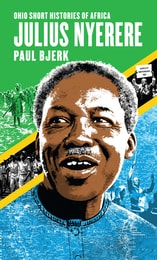
Julius Nyerere
Paul Bjerk
Ohio University Press, 2017
With vision, hard-nosed judgment, and biting humor, Julius Nyerere confronted the challenges of nation building in modern Africa. Constructing Tanzania out of a controversial Cold War union between Tanganyika and Zanzibar, Nyerere emerged as one of independent Africa’s most influential leaders. He pursued his own brand of African socialism, called Ujamaa, with unquestioned integrity, and saw it profoundly influence movements to end white minority rule in Southern Africa. Yet his efforts to build a peaceful nation created a police state, economic crisis, and a war with Idi Amin’s Uganda. Eventually—unlike most of his contemporaries—Nyerere retired voluntarily from power, paving the way for peaceful electoral transitions in Tanzania that continue today.
Based on multinational archival research, extensive reading, and interviews with Nyerere’s family and colleagues, as well as some who suffered under his rule, Paul Bjerk provides an incisive and accessible biography of this African leader of global importance. Recognizing Nyerere’s commitment to participatory government and social equality while also confronting his authoritarian turns and policy failures, Bjerk offers a portrait of principled leadership under the difficult circumstances of postcolonial Africa.
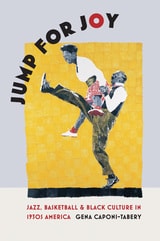
Jump for Joy
Jazz, Basketball, and Black Culture in 1930s AmericaGena Caponi-Tabery
University of Massachusetts Press, 2008
If the 1930s was the Swing Era, then the years from 1937 on might well be called the Jump Era. That summer Count Basie recorded “Jumping at the Woodside,” and suddenly jump tunes seemed to be everywhere. Along with the bouncy beat came a new dance step—the high-flying aerials of the jitterbuggers—and the basketball games that took place in the dance halls of African America became faster, higher, and flashier. Duke Ellington and a cast of hundreds put the buoyant spirit of the era on stage with their 1941 musical revue, Jump for Joy, a title that captured the momentum and direction of the new culture of exuberance.
Several high-profile public victories accompanied this increasing optimism: the spectacular successes of African American athletes at the 1936 Olympics, the 1937 union victory of the Brotherhood of Sleeping Car Porters, and Joe Louis's 1937 and 1938 heavyweight championship fights. For the first time in history, Black Americans emerged as cultural heroes and ambassadors, and many felt a new pride in citizenship.
In this book, Gena Caponi-Tabery chronicles these triumphs and shows how they shaped American music, sports, and dance of the 1930s and beyond. But she also shows how they emboldened ordinary African Americans to push for greater recognition and civil liberties—how cultural change preceded and catalyzed political action.
Tracing the path of one symbolic gesture—the jump—across cultural and disciplinary boundaries, Caponi-Tabery provides a unique political, intellectual, and artistic analysis of the years immediately preceding World War II.