Results by title
4413 books match the query 'Anthropology' and 57 start with j
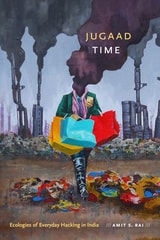
Jugaad Time
Ecologies of Everyday Hacking in IndiaAmit S. Rai
Duke University Press, 2019
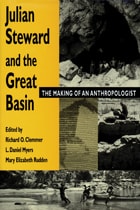
Julian Steward and the Great Basin
The Making of an AnthropologistRichard O Clemmer
University of Utah Press, 1999
Julian Steward and the Great Basin is a critical assessment of Steward’s work, the factors that influenced him, and his deep effect on American anthropology. Steward (1902–1972) was one of the foremost American exponents of cultural ecology, the idea that societies evolve in adaptation to their human and natural environments. He was also central in shaping basic anthropological constructs such as "hunter-gatherer" and "adaptation." But his fieldwork took place almost entirely in the Great Basin.
In one sense, the phases of Steward’s career epitomize the successive schools of anthropological theory and practice. Each chapter explores a different aspect of his work ranging from early efforts at documenting trait distributions to his later role in the development of social transformation theory, area studies, and applied anthropology.
Julian Steward and the Great Basin also corrects long-standing misperceptions that originated with Steward about lifeways of the Indians living between the Great Plains and California. It charts new directions for research, demanding a more exacting study of environmental conditions, material adaptations, and organizational responses, as well as an appreciation of the ideological and humanistic dimensions of Basin Life.
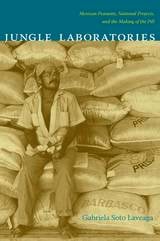
Jungle Laboratories
Mexican Peasants, National Projects, and the Making of the PillGabriela Soto Laveaga
Duke University Press, 2009
Soto Laveaga traces the political, economic, and scientific development of the global barbasco industry from its emergence in the 1940s, through its appropriation by a populist Mexican state in 1970, to its obsolescence in the mid-1990s. She focuses primarily on the rural southern region of Tuxtepec, Oaxaca, where the yam grew most freely and where scientists relied on local, indigenous knowledge to cultivate and harvest the plant. Rural Mexicans, at first unaware of the pharmaceutical and financial value of barbasco, later acquired and deployed scientific knowledge to negotiate with pharmaceutical companies, lobby the Mexican government, and ultimately transform how urban Mexicans perceived them. By illuminating how the yam made its way from the jungles of Mexico, to domestic and foreign scientific laboratories where it was transformed into pills, to the medicine cabinets of millions of women across the globe, Jungle Laboratories urges us to recognize the ways that Mexican peasants attained social and political legitimacy in the twentieth century, and positions Latin America as a major producer of scientific knowledge.
Just Schools
Pursuing Equality in Societies of DifferenceMartha Minow
Russell Sage Foundation, 2008
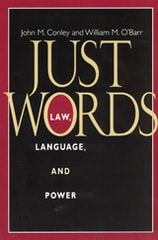
Just Words
Law, Language, and PowerJohn M. Conley and William M. O'Barr
University of Chicago Press, 1998
Conley and O'Barr show how the microdynamics of the legal process and the largest questions of justice can be fruitfully explored through the field of linguistics. Each chapter covers a language-based approach to a different area of the law, from the cross-examinations of victims and witnesses to the inequities of divorce mediation. Combining analysis of common legal events with a broad range of scholarship on language and law, Just Words seeks the reality of power in the everyday practice and application of the law. As the only study of its type, the book is the definitive treatment of the topic that will be welcomed by students and specialists alike.
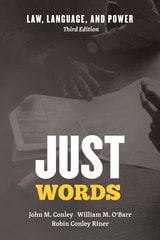
Just Words
Law, Language, and Power, Third EditionJohn M. Conley, William M. O'Barr, and Robin Conley Riner
University of Chicago Press, 2019
John M. Conley, William M. O'Barr, and Robin Conley Riner show how the microdynamics of the legal process and the largest questions of justice can be fruitfully explored through the field of linguistics. Each chapter covers a language-based approach to a different area of the law, from the cross-examinations of victims and witnesses to the inequities of divorce mediation. Combining analysis of common legal events with a broad range of scholarship on language and law, Just Words seeks the reality of power in the everyday practice and application of the law. As the only study of its type, the book is the definitive treatment of the topic and will be welcomed by students and specialists alike. This third edition brings this essential text up to date with new chapters on nonverbal, or “multimodal,” communication in legal settings and law, language, and race.
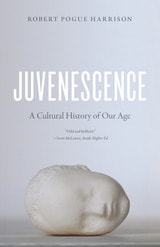
Juvenescence
A Cultural History of Our AgeRobert Pogue Harrison
University of Chicago Press, 2014
Like all of Robert Pogue Harrison's books, Juvenescence ranges brilliantly across cultures and history, tracing the ways that the spirits of youth and age have inflected each other from antiquity to the present. Drawing on the scientific concept of neotony, or the retention of juvenile characteristics through adulthood, and extending it into the cultural realm, Harrison argues that youth is essential for culture’s innovative drive and flashes of genius. At the same time, however, youth—which Harrison sees as more protracted than ever—is a luxury that requires the stability and wisdom of our elders and the institutions. “While genius liberates the novelties of the future,” Harrison writes, “wisdom inherits the legacies of the past, renewing them in the process of handing them down.”
A heady, deeply learned excursion, rich with ideas and insights, Juvenescence could only have been written by Robert Pogue Harrison. No reader who has wondered at our culture's obsession with youth should miss it.