Results by title
593 books match the query 'Jews' and 58 start with j
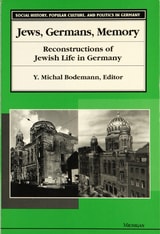
Jews, Germans, Memory
Reconstructions of Jewish Life in GermanyY. Michal Bodemann, Editor
University of Michigan Press, 1996

Jews, Sports, and the Rites of Citizenship
Edited by Jack Kugelmass
University of Illinois Press, 2006
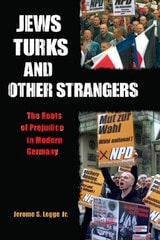
Jews, Turks, and Other Strangers
Roots of Prejudice in Modern GermanyJerome S. Legge, Jr.
University of Wisconsin Press, 2003
Scholarly, objective, insightful, and analytical, Jews, Turks, and Other Strangers studies the causes of prejudice against Jews, foreign workers, refugees, and emigrant Germans in contemporary Germany. Using survey material and quantitative analyses, Legge convincingly challenges the notion that German xenophobia is rooted in economic causes. Instead, he sees a more complex foundation for German prejudice, particularly in a reunified Germany where perceptions of the "other" sometimes vary widely between east and west, a product of a traditional racism rooted in the German past. By clarifying the foundations of xenophobia in a new German state, Legge offers a clear and disturbing picture of a conflicted country and a prejudice that not only affects Jews but also fuels a larger, anti-foreign sentiment.
Judah in the Neo-Babylonian Period
The Archaeology of DesolationAvraham Faust
SBL Press, 2012
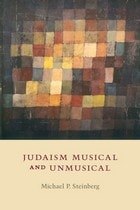
Judaism Musical and Unmusical
Michael P. Steinberg
University of Chicago Press, 2008
Engaging the work of such figures as Sigmund Freud, Walter Benjamin, Hannah Arendt, Charlotte Salomon, Arnaldo Momigliano, Leonard Bernstein, and Daniel Libeskind, Michael Steinberg shows how modern Jews advanced cosmopolitanism and multiplicity by helping to loosen—whether by choice or by necessity—the ties that bind any culture to accounts of its origins. In the process, Steinberg composes a mosaic of texts and events, often distant from one another in time and place, that speak to his theme of musicality. As both a literal value and a metaphorical one, musicality opens the possibility of a fusion of aesthetics and analysis—a coupling analogous to European modernity’s twin concerns of art and politics.
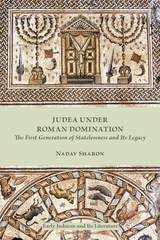
Judea under Roman Domination
The First Generation of Statelessness and Its LegacyNadav Sharon
SBL Press, 2017
Investigate a relatively neglected but momentous period in Judean history
Nadav Sharon closely examines a critical period in Judean history, which saw the end of the Hasmonean dynasty and the beginning of Roman domination of Judea leading up to the kingship of Herod (67-37 BCE). In this period renowned Roman figures such as Pompey the Great, Julius Caesar, Gaius Cassius (a conspirator against Caesar), and Mark Anthony, led the Roman Republic on the eve of its transformation into an Empire, each having his own dealings with—and holding sway over—Judea at different times. This volume explores the impact of the Roman conquest on the authors of the Dead Sea Scrolls, enhances the understanding of later Judean-Roman relations and the roots of the Great Revolt, and examines how this early period of Roman domination had on impact on later developments in Judean society and religion.
Features:
- Part one dedicating to reconstructing Judean history from the death of Alexander to the reign of King Herod
- Part two examining the effects of Roman domination on Judean society
- Maps, illustrations, and appendices
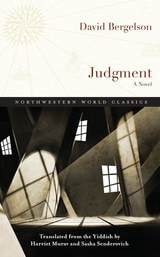
Judgment
A NovelDavid Bergelson, Translated from the Yiddish by Harriet Murav and Sasha Senderovich
Northwestern University Press, 2017
Originally published in 1929 and set in 1920 during the Russian civil war, Judgment traces the death of the shtetl and the birth of the “new, harsher world” created by the 1917 revolution. Jews and non-Jews smuggle people, goods, and anti-Bolshevik literature back and forth across the new political border. Filipov acts as the arbiter of "judgment" to prisoners in a Bolshevik outpost, who include Spivak, a counterrevolutionary; Lemberger, a pious and wealthy Jew; a seductive woman referred to as "the blonde"; and a memorable cast of smugglers and criminals.
Ordinary people, depicted in a grotesque and modernist style—comparable to Isaac Babel’s Red Cavalry—confront the overwhelming forces of history, whose ultimate outcome remains unknown.

Justyna's Narrative
Gusta Davidson Draenger
University of Massachusetts Press, 1996
Written during World War II, Justyna's Narrative is a compelling account of the Krakow Jewish resistance. From February through April 1943, Gusta Davidson Draenger (aka “Justyna”) composed the narrative on scraps of paper smuggled into her prison cell. Between sessions of torture and interrogation at the hands of the Gestapo, she recorded the activities and spiritual aspirations of the clandestine group of young Jewish idealists who forged documents, acquired weapons, and committed acts of defiance against the Nazis.