Results by title
8642 books match the query '20th century' and 111 start with j
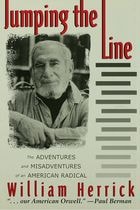
Jumping the Line
The Adventures and Misadventures of an American RadicalWilliam Herrick
University of Wisconsin Press, 1998
An eye-opening account of time served in the great battles of our century— for workers’ rights, against Fascism, Communism, and racism—Jumping the Line is the life story of an American original. William Herrick chronicles his adventures and misadventures on the front lines of the Spanish Civil War, in (and very much out of) the Communist Party, driving a tractor on a communal farm in Michigan, jumping the line as a hobo, organizing African American sharecroppers in Georgia, at work with Orson Welles, and immersed in his own writing.
Herrick chronicles a life of great conviction and great disillusion. He went to Spain in 1936 to fight against the Fascists and there witnessed the horrifying acts that Fascists and Communists alike committed, before he was felled by a near-fatal wound. Here he tells about the life that led him, a working-class Jewish kid from New York, into the idealism and then the murky politics of this internecine conflict. From the bloody fight in Spain he takes us to the battlefields of the Communist movement in the U.S., where he found himself parading up and down the garment district of Manhattan, denouncing his former comrades.
When Paul Berman interviewed Herrick in the Village Voice in 1986, for the fiftieth anniversary of the Spanish Civil War, Herrick’s remarks so incensed other veterans of the Abraham Lincoln battalion that they picketed the paper. What William Herrick has to say doesn’t always go down easily. But for those who like the truth, with a dash of wit and a healthy dose of history, it can be exhilarating.
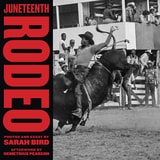
Juneteenth Rodeo
Photos and essay by Sarah Bird; Afterword by Demetrius Pearson
University of Texas Press, 2024
Award of Excellence — Communication Arts
Honorable Mention — The International Photography Awards 2024 Book Category
Jury Top 5 Selection — The International Photography Awards 2024 Book Category
Silver Winner in Zines And Photo Book/Culture— 2024 International Film Photography Award, Analog Sparks
Timeless photos offer a rare portrait of the jubilant, vibrant, vital, nearly hidden, and now all-but-vanished world of small-town Black rodeos.
Long before Americans began to officially commemorate Juneteenth, in the heat of East Texas, saddles were being cinched, buckles shined, and lassoes adjusted for a day on the Black rodeo circuit in honor of the holiday. In the late 1970s, as they had been doing for generations, Black communities across the region held local rodeos for the talented cowboys and cowgirls who were segregated from the mainstream circuit. It was to these vibrant community events that bestselling Texas writer Sarah Bird, then a young photojournalist, found herself drawn.
In Juneteenth Rodeo, Bird’s lens celebrates a world that was undervalued at the time, capturing everything, from the moment the pit master fired up his smoker, through the death-defying rides, to the last celebratory dance at a nearby honky-tonk. Essays by Bird and sports historian Demetrius Pearson reclaim the crucial role of Black Americans in the Western US and show modern rodeo riders—who still compete on today’s circuit—as “descendants” in a more than two-hundred-year lineage of Black cowboys. A gorgeous tribute to the ropers and riders—legends like Willie Thomas, Myrtis Dightman, Rufus Green, Bailey’s Prairie Kid, Archie Wycoff, and Calvin Greeley—as well as the secretaries, judges, and pick-up men and even the audience members who were as much family as fans, Juneteenth Rodeo ultimately seeks to put Black cowboys and cowgirls where they have always belonged: in the center of the frame.
Jungle Fever
Exploring Madness and Medicine in Twentieth-Century Tropical NarrativesCharlotte Rogers
Vanderbilt University Press, 2012
The canonical works of authors such as Joseph Conrad, Andre Malraux, Jose Eustasio Rivera, and others present jungles and wildernesses as fundamentally corrupting and dangerous. Rogers explores how the methods these authors use to communicate the physical and psychological maladies that afflict their characters evolved symbiotically with modern medicine. While the wilderness challenges Conrad's and Malraux's European travelers to question their civility and mental stability, Latin American authors such as Alejo Carpentier deftly turn pseudoscientific theories into their greatest asset, as their characters transform madness into an essential creative spark.
Ultimately, Jungle Fever suggests that the greatest horror of the jungle is the unknown regions of the character's own mind.
Just Around The Corner
The Paradox Of The Jobless RecoveryStanley Aronowitz
Temple University Press, 2005
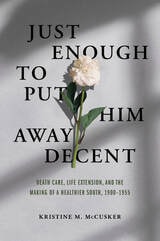
Just Enough to Put Him Away Decent
Death Care, Life Extension, and the Making of a Healthier South, 1900-1955Kristine M. McCusker
University of Illinois Press, 2023
Kristine McCusker charts the dramatic transformation that took place when southerners in particular and Americans in general changed their thinking about when one should die, how that death could occur, and what decent burial really means. As she shows, death care evolved from being a community act to a commercial one where purchasing a purple coffin and hearse ride to the cemetery became a political statement and the norm. That evolution also required interactions between perfect strangers, especially during the world wars as families searched for their missing soldiers. In either case, being put away decent, as southerners called burial, came to mean something fundamentally different in 1955 than it had just fifty years earlier.

Just Language
Walter Benjamin, German-Jewish Exile, and the Critique of Linguistic ViolenceDennis Johannßen
University of Michigan Press, 2026
Just Language revisits the Weimar period and its representation in the postwar years to explore narratives of linguistic resistance in the works of Walter Benjamin, Theodor W. Adorno, Hannah Arendt, and Paul Celan. How did this generation of exile writers grapple with their experiences of oppression and persecution? How did they create a language of resistance during the decades that prepared the Third Reich and the Shoah?
Facing the devastations of World War I, the book explores how Walter Benjamin analyzed language’s ability to radically break the cyclical violence of war and examines his opposition to expansionism and imperialism in Weimar education and culture. Based on Benjamin’s analysis, Johannßen traces the postwar responses of Hannah Arendt and Paul Celan. While Arendt proposed strategies of metaphorical thinking to counteract the formation of totalitarianism, Celan mobilized silence as a poetic counterforce against oppression and erasure. Just Language argues that every linguistic act and practice, no matter how small or marginalized, entails the ethical task of opposing the normalization and institutionalization of political violence. By tracing how Benjamin and his interlocutors struggled against German fascism, Johannßen presents a memory-based critique of linguistic violence, opening a dialogue between German-Jewish writers and today’s debates on nondiscrimination, propaganda, and social justice.
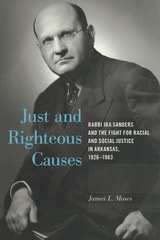
Just and Righteous Causes
Rabbi Ira Sanders and the Fight for Racial and Social Justice in Arkansas, 1926-1963James L. Moses
University of Arkansas Press, 2018
Winner, 2019 Booker Worthen Prize from the Central Arkansas Library System.
A dedicated advocate for social justice long before the term entered everyday usage, Rabbi Ira Sanders began striving against the Jim Crow system soon after he arrived in Little Rock from New York in 1926. Sanders, who led Little Rock’s Temple B’nai Israel for nearly forty years, was a trained social worker as well as a rabbi and his career as a dynamic religious and community leader in Little Rock spanned the traumas of the Great Depression, World War II and the Holocaust, and the social and racial struggles of the 1950s and 1960s.
Just and Righteous Causes—a full biographical study of this bold social-activist rabbi—examines how Sanders expertly navigated the intersections of race, religion, and gender to advocate for a more just society. It joins a growing body of literature about the lives and histories of Southern rabbis, deftly balancing scholarly and narrative tones to provide a personal look into the complicated position of the Southern rabbi and the Jewish community throughout the political struggles of the twentieth-century South.
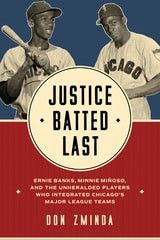
Justice Batted Last
Ernie Banks, Minnie Miñoso, and the Unheralded Players Who Integrated Chicago's Major League TeamsDon Zminda
University of Illinois Press, 2025
Don Zminda’s account looks at these interconnected events alongside the little-known chronicle of Chicago’s slow track to integrating major league baseball. By the early 1950s, the Cubs and White Sox organizations had become rich in Black and Afro-Latino stars and talented prospects. Unlike Miñoso and Banks, however, most of these minor leaguers never advanced to the majors or, if they did, it was for little more than a cup of coffee. Zminda also profiles these players, from Charles Pope, the Cubs’ first Black signee, to larger-than-life fireballer Blood Burns.
Essential and dramatic, Justice Batted Last uses the lives and careers of two Chicago legends to tell a story of integration on and off the diamond.
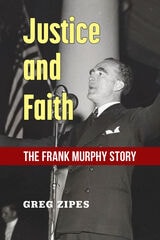
Justice and Faith
The Frank Murphy StoryGreg Zipes
University of Michigan Press, 2021
Murphy is best remembered for his immense legal contributions supporting individual liberty and fighting discrimination, particularly discrimination against the most vulnerable. Despite being a loyal ally of Franklin Delano Roosevelt, when FDR ordered the removal of Japanese Americans during World War II, Supreme Court Justice Murphy condemned the policy as “racist” in a scathing dissent to the Korematsu v. United States decision—the first use of the word in a Supreme Court opinion. Every American, whether arriving by first class or in chains in the galley of a slave ship, fell under Murphy’s definition of those entitled to the full benefits of the American dream.
Justice and Faith explores Murphy’s life and times by incorporating troves of archive materials not available to previous biographers, including local newspaper records from across the country. Frank Murphy is proof that even in dark times, the United States has extraordinary resilience and an ability to produce leaders of morality and courage.
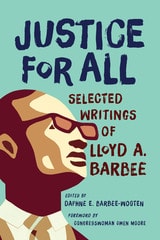
Justice for All
Selected Writings of Lloyd A. BarbeeLloyd A Barbee
Wisconsin Historical Society Press, 2017
Civil rights leader and legislator Lloyd A. Barbee frequently signed his correspondence with "Justice for All," a phrase that embodied his life’s work of fighting for equality and fairness. An attorney most remembered for the landmark case that desegregated Milwaukee Public Schools in 1972, Barbee stood up for justice throughout his career, from defending University of Wisconsin students who were expelled after pushing the school to offer black history courses, to representing a famous comedian who was arrested after stepping out of a line at a protest march. As the only African American in the Wisconsin legislature from 1965 to 1977, Barbee advocated for fair housing, criminal justice reform, equal employment opportunities, women’s rights, and access to quality education for all, as well as being an early advocate for gay rights and abortion access.
This collection features Barbee’s writings from the front lines of the civil rights movement, along with his reflections from later in life on the challenges of legislating as a minority, the logistics of coalition building, and the value of moving the needle on issues that would outlast him. Edited by his daughter, civil rights lawyer Daphne E. Barbee-Wooten, these documents are both a record of a significant period of conflict and progress, as well as a resource on issues that continue to be relevant to activists, lawmakers, and educators.
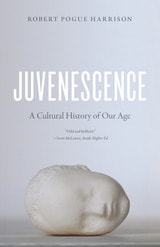
Juvenescence
A Cultural History of Our AgeRobert Pogue Harrison
University of Chicago Press, 2014
Like all of Robert Pogue Harrison's books, Juvenescence ranges brilliantly across cultures and history, tracing the ways that the spirits of youth and age have inflected each other from antiquity to the present. Drawing on the scientific concept of neotony, or the retention of juvenile characteristics through adulthood, and extending it into the cultural realm, Harrison argues that youth is essential for culture’s innovative drive and flashes of genius. At the same time, however, youth—which Harrison sees as more protracted than ever—is a luxury that requires the stability and wisdom of our elders and the institutions. “While genius liberates the novelties of the future,” Harrison writes, “wisdom inherits the legacies of the past, renewing them in the process of handing them down.”
A heady, deeply learned excursion, rich with ideas and insights, Juvenescence could only have been written by Robert Pogue Harrison. No reader who has wondered at our culture's obsession with youth should miss it.