Results by title
471 books match the query 'Aesthetics' and 6 start with k

Kamikaze, Cherry Blossoms, and Nationalisms
The Militarization of Aesthetics in Japanese HistoryEmiko Ohnuki-Tierney
University of Chicago Press, 2002
Why did almost one thousand highly educated "student soldiers" volunteer to serve in Japan's tokkotai (kamikaze) operations near the end of World War II, even though Japan was losing the war? In this fascinating study of the role of symbolism and aesthetics in totalitarian ideology, Emiko Ohnuki-Tierney shows how the state manipulated the time-honored Japanese symbol of the cherry blossom to convince people that it was their honor to "die like beautiful falling cherry petals" for the emperor.
Drawing on diaries never before published in English, Ohnuki-Tierney describes these young men's agonies and even defiance against the imperial ideology. Passionately devoted to cosmopolitan intellectual traditions, the pilots saw the cherry blossom not in militaristic terms, but as a symbol of the painful beauty and unresolved ambiguities of their tragically brief lives. Using Japan as an example, the author breaks new ground in the understanding of symbolic communication, nationalism, and totalitarian ideologies and their execution.
Drawing on diaries never before published in English, Ohnuki-Tierney describes these young men's agonies and even defiance against the imperial ideology. Passionately devoted to cosmopolitan intellectual traditions, the pilots saw the cherry blossom not in militaristic terms, but as a symbol of the painful beauty and unresolved ambiguities of their tragically brief lives. Using Japan as an example, the author breaks new ground in the understanding of symbolic communication, nationalism, and totalitarian ideologies and their execution.
[more]

Karl Rahner's Theological Aesthetics
Peter Joseph Fritz
Catholic University of America Press, 2014
This innovative book discloses Karl Rahner's foremost achievement: discovering and delineating an ethos of Catholicism, a multi-faceted and comprehensive approach to life in Christ. Karl Rahner's Theological Aesthetics does so by placing the German Jesuit and his teacher, philosopher Martin Heidegger, into a richly detailed dialogue on aesthetics. The book treats classic Rahner topics such as anthropology and Christology. But it breaks new ground by exploring themes such as angels, Mary, and the apocalypse, juxtaposed with analogous philosophical topics in Heidegger.
[more]

Kierkegaard, Literature, and the Arts
Edited by Eric Ziolkowski
Northwestern University Press, 2018
In this volume fifteen eminent scholars illuminate the broad and often underappreciated variety of the nineteenth‑century Danish thinker Søren Kierkegaard’s engagements with literature and the arts.
The essays in Kierkegaard, Literature, and the Arts, contextualized with an insightful introduction by Eric Ziolkowski, explore Kierkegaard’s relationship to literature (poetry, prose, and storytelling), the performing arts (theater, music, opera, and dance), and the visual arts, including film. The collection is rounded out with a comparative section that considers Kierkegaard in juxtaposition with a romantic poet (William Blake), a modern composer (Arnold Schoenberg), and a contemporary singer‑songwriter (Bob Dylan). Kierkegaard was as much an aesthetic thinker as a philosopher, and his philosophical writings are complemented by his literary and music criticism.
Kierkegaard, Literature, and the Arts will offer much of interest to scholars concerned with Kierkegaard as well as teachers, performers, and readers in the various aesthetic fields discussed.
CONTRIBUTORS: Christopher B. Barnett, Martijn Boven, Anne Margrete Fiskvik, Joakim Garff, Ronald M. Green, Peder Jothen, Ragni Linnet, Jamie A. Lorentzen, Edward F. Mooney, George Pattison, Nils Holger Petersen, Howard Pickett, Marcia C. Robinson, James Rovira
[more]

Kierkegaard
Construction of the AestheticTheodor Adorno
University of Minnesota Press, 1989
[more]
Kinaesthetic Knowing
Aesthetics, Epistemology, Modern DesignZeynep Çelik Alexander
University of Chicago Press, 2017
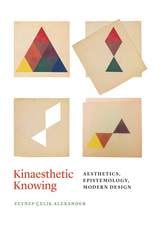
Is all knowledge the product of thought? Or can the physical interactions of the body with the world produce reliable knowledge? In late-nineteenth-century Europe, scientists, artists, and other intellectuals theorized the latter as a new way of knowing, which Zeynep Çelik Alexander here dubs “kinaesthetic knowing.”
In this book, Alexander offers the first major intellectual history of kinaesthetic knowing and its influence on the formation of modern art and architecture and especially modern design education. Focusing in particular on Germany and tracing the story up to the start of World War II, Alexander reveals the tension between intellectual meditation and immediate experience to be at the heart of the modern discourse of aesthetics, playing a major part in the artistic and teaching practices of numerous key figures of the period, including Heinrich Wölfflin, Hermann Obrist, August Endell, László Moholy-Nagy, and many others. Ultimately, she shows, kinaesthetic knowing did not become the foundation of the human sciences, as some of its advocates had hoped, but it did lay the groundwork—at such institutions as the Bauhaus—for modern art and architecture in the twentieth century.
In this book, Alexander offers the first major intellectual history of kinaesthetic knowing and its influence on the formation of modern art and architecture and especially modern design education. Focusing in particular on Germany and tracing the story up to the start of World War II, Alexander reveals the tension between intellectual meditation and immediate experience to be at the heart of the modern discourse of aesthetics, playing a major part in the artistic and teaching practices of numerous key figures of the period, including Heinrich Wölfflin, Hermann Obrist, August Endell, László Moholy-Nagy, and many others. Ultimately, she shows, kinaesthetic knowing did not become the foundation of the human sciences, as some of its advocates had hoped, but it did lay the groundwork—at such institutions as the Bauhaus—for modern art and architecture in the twentieth century.
[more]
Kwaito's Promise
Music and the Aesthetics of Freedom in South AfricaGavin Steingo
University of Chicago Press, 2016
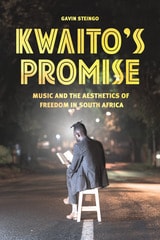
In mid-1990s South Africa, apartheid ended, Nelson Mandela was elected president, and the country’s urban black youth developed kwaito—a form of electronic music (redolent of North American house) that came to represent the post-struggle generation. In this book, Gavin Steingo examines kwaito as it has developed alongside the democratization of South Africa over the past two decades. Tracking the fall of South African hope into the disenchantment that often characterizes the outlook of its youth today—who face high unemployment, extreme inequality, and widespread crime—Steingo looks to kwaito as a powerful tool that paradoxically engages South Africa’s crucial social and political problems by, in fact, seeming to ignore them.
Politicians and cultural critics have long criticized kwaito for failing to provide any meaningful contribution to a society that desperately needs direction. As Steingo shows, however, these criticisms are built on problematic assumptions about the political function of music. Interacting with kwaito artists and fans, he shows that youth aren’t escaping their social condition through kwaito but rather using it to expand their sensory realities and generate new possibilities. Resisting the truism that “music is always political,” Steingo elucidates a music that thrives on its radically ambiguous relationship with politics, power, and the state.
Politicians and cultural critics have long criticized kwaito for failing to provide any meaningful contribution to a society that desperately needs direction. As Steingo shows, however, these criticisms are built on problematic assumptions about the political function of music. Interacting with kwaito artists and fans, he shows that youth aren’t escaping their social condition through kwaito but rather using it to expand their sensory realities and generate new possibilities. Resisting the truism that “music is always political,” Steingo elucidates a music that thrives on its radically ambiguous relationship with politics, power, and the state.
[more]