Results by title
664 books match the query 'Ancient & Classical' and 4 start with k
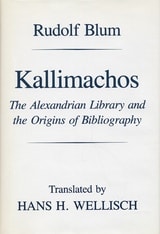
Kallimachos
The Alexandrian Library and the Origins of BibliographyRudolf Blum
University of Wisconsin Press, 1991
The famous library of Alexandria, founded around 295 BCE by Ptolemaios I, housed the greatest collection of texts in the ancient world and was a fertile site of Hellenistic scholarship. Rudolf Blum’s landmark study, originally published in German in 1977, argues that Kallimachos of Kyrene was not only the second director of the Alexandrian library but also the inventor of two essential scholarly tools still in use to this day: the library catalog and the “biobibliographical” reference work. Kallimachos expanded the library’s inventory lists into volumes called the Pinakes, which extensively described and categorized each work and became in effect a Greek national bibliography and the source and paradigm for most later bibliographic lists of Greek literature. Though the Pinakes have not survived, Blum attempts a detailed reconstruction of Kallimachos’s inventories and catalogs based on a careful analysis of surviving sources, which are presented here in full translation.
Keeping the Feast
Metaphors of Sacrifice in 1 Corinthians and PhilippiansJane Lancaster Patterson
SBL Press, 2015
Develop a keener ear for Paul’s rhetorical strategy
Patterson uses cognitive metaphor theory to trace the apostle Paul’s use of metaphors from the Jewish sacrificial system in his moral counsels to the Philippians and the Corinthians. In these letters, Paul moves from the known (the practice of sacrifice) to the unknown (how to live in accord with the life, death, and resurrection of Jesus Christ). Patterson illustrates that the significant sacrificial metaphors in 1 Corinthians and Philippians are not derived from Jewish sacrifices of atonement, but rather from the Passover and sacrifices of thanksgiving. Attention to these metaphors demonstrates that imagery drawn from these sacrifices shapes the overall moral counsel of the letters, reveals more varied and nuanced interpretations of sacrificial references in Paul’s letters, and sheds light on Paul’s continuity with Jewish cultic practice.
Features
- Clarification of the strategic function of metaphors as a means of establishing an imaginative framework for ethical deliberation
- Evidence of Paul’s active processes of theological reflection
- Exploration of the intertwining of Jewish cultic practice with the rhetoric of moral commitment within early Christian churches
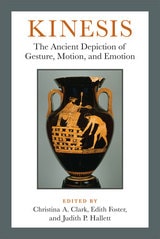
Kinesis
The Ancient Depiction of Gesture, Motion, and EmotionChristina A. Clark, Edith Foster, and Judith P. Hallett, editors
University of Michigan Press, 2015
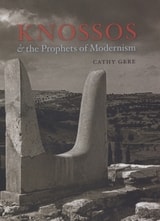
Knossos and the Prophets of Modernism
Cathy Gere
University of Chicago Press, 2009
In the spring of 1900, British archaeologist Arthur Evans began to excavate the palace of Knossos on Crete, bringing ancient Greek legends to life just as a new century dawned amid far-reaching questions about human history, art, and culture. With Knossos and the Prophets of Modernism, Cathy Gere relates the fascinating story of Evans’s excavation and its long-term effects on Western culture. After the World War I left the Enlightenment dream in tatters, the lost paradise that Evans offered in the concrete labyrinth—pacifist and matriarchal, pagan and cosmic—seemed to offer a new way forward for writers, artists, and thinkers such as Sigmund Freud, James Joyce, Giorgio de Chirico, Robert Graves, and Hilda Doolittle.
Assembling a brilliant, talented, and eccentric cast at a moment of tremendous intellectual vitality and wrenching change, Cathy Gere paints an unforgettable portrait of the age of concrete and the birth of modernism.