Results by title
3258 books match the query 'Art' and 21 start with k
Kabbalah and Art
Léo Bronstein
University Press of New England, 2002
Kachina Dolls
The Art of Hopi CarversHelga Teiwes
University of Arizona Press, 1991
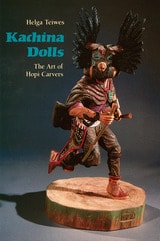
Teiwes explains the role of the Katsina spirit in Hopi religion and that of the kachina doll—the carved representation of a Katsina—in the ritual and economic life of the Hopis. In tracing the history of the kachina doll in Hopi culture, she shows how these wooden figures have changed since carvers came to be influenced by their marketability among Anglos and how their carving has been characterized by increasingly refined techniques. Unique to this book are Teiwes's description of the most recent trends in kachina doll carving and her profiles of twenty-seven modern carvers, including such nationally known artists as Alvin James Makya and Cecil Calnimptewa. Enhancing the text are more than one hundred photographs, including twenty-five breathtaking color plates that bring to life the latest examples of this popular art form.

Kartoon Kings
The Graphic Work of Simon Grennan and Christopher SperandioPaul Krainak
West Virginia University Press, 2007
Kartoon Kings is the first monographic and comprehensive analysis of the graphic artwork of Simon Grennan and Christopher Sperandio. This work showcases a collection of full-color images excerpted from comic book projects, videos, billboards, and more of the artists’ collaborative public contributions created over the past fifteen years. To supplement the images an interview with the artists by Kristina Olson is included, along with essays by Joshua Decter and Paul Krainak. Grennan and Sperandio work together by conspiring about their creative ideas on the Internet. Their teamwork must be done this way because Grennan lives in England, while Sperandio lives in the United States.
More of Sperandio and Grennan’s work can be seen at www.kartoonkings.com.

Kazimir Malevich
The Climax of DisclosureRainer Crone and David Moos
University of Chicago Press, 1991
Against the historical background of distinctly Russian progressive cultural and scientific movements, the authors define affinities between Malevich's work and other nonpolitical revolutions: relativity and quantum theory in physics; the work of Roman Jakobson and the "Prague School" in linguistics; and the exploration of language in the writings of the poet Velimir Khlebnikov. They situate the artist within the fundamental epistemological shift from nineteenth-century objectivity to an all-pervasive modernist subjectivity, relying upon Malevich's contribution to illustrate the ways cultural production is mediated through various modes of transmission.
Keep It Moving?
Conserving Kinetic ArtRachel Rivenc
J. Paul Getty Trust, The, 2018
Professionals responsible for conserving contemporary art are in the midst of rethinking the concept of authenticity and solving the dichotomy often felt between original materials and functionality of the work of art. The contrast is especially acute with kinetic art when a compromise between the two often seems impossible. Also to be considered are issues of technological obsolescence and the fact that an artist’s chosen technology often carries with it strong sociological and historical information and meanings.
Keith Haring's Line
Race and the Performance of DesireRicardo Montez
Duke University Press, 2020
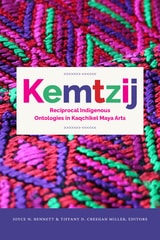
Kemtzij
Reciprocal Indigenous Ontologies in Kaqchikel Maya ArtsEdited by Joyce N. Bennett and Tiffany D. Creegan Miller
Amherst College Press, 2027
Kemtzij: Weaving Reciprocal Indigenous Ontologies in Kaqchikel Maya Arts focuses on the artistic contributions of contemporary Kaqchikel Mayas in Guatemala and their diasporas. Rather than representing Kaqchikel Mayas as exclusively existing in their pre-Hispanic past, the contributors to this edited volume—Kaqchikel and non-Kaqchikel scholars—demonstrate the distinct interdisciplinary ways that contemporary Kaqchikels engage with present-day Maya aesthetics and artistic initiatives in Guatemala and abroad. With a focus on the key concepts of reciprocity and duality, the chapters in this book consider the myriad ways in which Kaqchikel Mayas express their identities, through poetry, textiles, community street art, and digital photo collages. Kemtzij is unique in being published bilingually in Kaqchikel and English, making it one of few texts to consider Kaqchikel lives and artistic production—and the ontological implications of that work—in and through the Kaqchikel language.

Kill for Peace
American Artists Against the Vietnam WarBy Matthew Israel
University of Texas Press, 2013
The Vietnam War (1964–1975) divided American society like no other war of the twentieth century, and some of the most memorable American art and art-related activism of the last fifty years protested U.S. involvement. At a time when Pop Art, Minimalism, and Conceptual Art dominated the American art world, individual artists and art collectives played a significant role in antiwar protest and inspired subsequent generations of artists. This significant story of engagement, which has never been covered in a book-length survey before, is the subject of Kill for Peace.
Writing for both general and academic audiences, Matthew Israel recounts the major moments in the Vietnam War and the antiwar movement and describes artists’ individual and collective responses to them. He discusses major artists such as Leon Golub, Edward Kienholz, Martha Rosler, Peter Saul, Nancy Spero, and Robert Morris; artists’ groups including the Art Workers’ Coalition (AWC) and the Artists Protest Committee (APC); and iconic works of collective protest art such as AWC’s Q. And Babies? A. And Babies and APC’s The Artists Tower of Protest. Israel also formulates a typology of antiwar engagement, identifying and naming artists’ approaches to protest. These approaches range from extra-aesthetic actions—advertisements, strikes, walk-outs, and petitions without a visual aspect—to advance memorials, which were war memorials purposefully created before the war’s end that criticized both the war and the form and content of traditional war memorials.
Killing Poetry
Blackness and the Making of Slam and Spoken Word CommunitiesJohnson, Javon
Rutgers University Press, 2017
Co-winner of the 2018 Ethnography Division’s Best Book from the NCA
In recent decades, poetry slams and the spoken word artists who compete in them have sparked a resurgent fascination with the world of poetry. However, there is little critical dialogue that fully engages with the cultural complexities present in slam and spoken word poetry communities, as well as their ramifications.
In Killing Poetry, renowned slam poet, Javon Johnson unpacks some of the complicated issues that comprise performance poetry spaces. He argues that the truly radical potential in slam and spoken word communities lies not just in proving literary worth, speaking back to power, or even in altering power structures, but instead in imagining and working towards altogether different social relationships. His illuminating ethnography provides a critical history of the slam, contextualizes contemporary black poets in larger black literary traditions, and does away with the notion that poetry slams are inherently radically democratic and utopic.
Killing Poetry—at times autobiographical, poetic, and journalistic—analyzes the masculine posturing in the Southern California community in particular, the sexual assault in the national community, and the ways in which related social media inadvertently replicate many of the same white supremacist, patriarchal, and mainstream logics so many spoken word poets seem to be working against. Throughout, Johnson examines the promises and problems within slam and spoken word, while illustrating how community is made and remade in hopes of eventually creating the radical spaces so many of these poets strive to achieve.
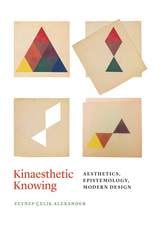
Kinaesthetic Knowing
Aesthetics, Epistemology, Modern DesignZeynep Çelik Alexander
University of Chicago Press, 2017
In this book, Alexander offers the first major intellectual history of kinaesthetic knowing and its influence on the formation of modern art and architecture and especially modern design education. Focusing in particular on Germany and tracing the story up to the start of World War II, Alexander reveals the tension between intellectual meditation and immediate experience to be at the heart of the modern discourse of aesthetics, playing a major part in the artistic and teaching practices of numerous key figures of the period, including Heinrich Wölfflin, Hermann Obrist, August Endell, László Moholy-Nagy, and many others. Ultimately, she shows, kinaesthetic knowing did not become the foundation of the human sciences, as some of its advocates had hoped, but it did lay the groundwork—at such institutions as the Bauhaus—for modern art and architecture in the twentieth century.

Kinesthetic Empathy in Creative and Cultural Practices
Edited by Dee Reynolds and Matthew Reason
Intellect Books, 2012
A key interdisciplinary concept in our understanding of social interaction across creative and cultural practices, kinesthetic empathy describes the ability to experience empathy merely by observing the movements of another human being. Encouraging readers to sidestep the methodological and disciplinary boundaries associated with the arts and sciences, Kinesthetic Empathy in Creative and Cultural Practices offers innovative and critical perspectives on topics ranging from art to sport, film to physical therapy.

King of Hearts
Drag Kings in the American SouthBaker A. Rogers
Rutgers University Press, 2022
King of Hearts shows how drag king performers are thriving in an unlikely location: Southern Bible Belt states like Tennessee, Georgia, and South Carolina. Based on observations and interviews with sixty Southern drag kings, this study reveals how they are challenging the region’s gender norms while creating a unique community with its own distinctive Southern flair. Reflecting the region’s racial diversity, it profiles not only white drag kings, but also those who are African American, multiracial, and Hispanic.
Queer scholar Baker A. Rogers—who has also performed as drag king Macon Love—takes you on an insider’s tour of Southern drag king culture, exploring its history, the communal bonds that unite it, and the controversies that have divided it. King of Hearts offers a groundbreaking look at a subculture that presents a subversion of gender norms while also providing a vital lifeline for non-gender-conforming Southerners.
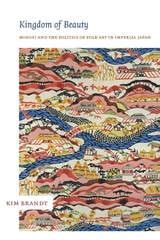
Kingdom of Beauty
Mingei and the Politics of Folk Art in Imperial JapanKim Brandt
Duke University Press, 2007
Kingdom of Beauty shows that the discovery of mingei (folk art) by Japanese intellectuals in the 1920s and 1930s was central to the complex process by which Japan became both a modern nation and an imperial world power. Kim Brandt’s account of the mingei movement locates its origins in colonial Korea, where middle-class Japanese artists and collectors discovered that imperialism offered them special opportunities to amass art objects and gain social, cultural, and even political influence. Later, mingei enthusiasts worked with (and against) other groups—such as state officials, fascist ideologues, rival folk art organizations, local artisans, newspaper and magazine editors, and department store managers—to promote their own vision of beautiful prosperity for Japan, Asia, and indeed the world. In tracing the history of mingei activism, Brandt considers not only Yanagi Muneyoshi, Hamada Shōji, Kawai Kanjirō, and other well-known leaders of the folk art movement but also the often overlooked networks of provincial intellectuals, craftspeople, marketers, and shoppers who were just as important to its success. The result of their collective efforts, she makes clear, was the transformation of a once-obscure category of pre-industrial rural artifacts into an icon of modern national style.
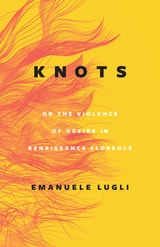
Knots, or the Violence of Desire in Renaissance Florence
Emanuele Lugli
University of Chicago Press, 2023
In this innovative cultural history, hair is the portal through which Emanuele Lugli accesses the cultural production of Lorenzo il Magnifico’s Florence. Lugli reflects on the ways writers, doctors, and artists expressed religious prejudices, health beliefs, and gender and class subjugation through alluring works of art, in medical and political writings, and in poetry. He considers what may have compelled Sandro Botticelli, the young Leonardo da Vinci, and dozens of their contemporaries to obsess over braids, knots, and hairdos by examining their engagement with scientific, philosophical, and theological practices.
By studying hundreds of fifteenth-century documents that engage with hair, Lugli foregrounds hair’s association to death and gathers insights about human life at a time when Renaissance thinkers redefined what it meant to be human and to be alive. Lugli uncovers overlooked perceptions of hair when it came to be identified as a potential vector for liberating culture, and he corrects a centuries-old prejudice that sees hair as a trivial subject, relegated to passing fashion or the decorative. He shows hair, instead, to be at the heart of Florentine culture, whose inherent violence Lugli reveals by prompting questions about the entanglement of politics and desire.
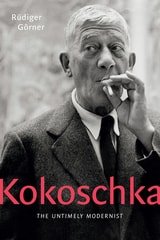
Kokoschka
The Untimely ModernistRüdiger Görner
Haus Publishing, 2024
The Austrian artist Oskar Kokoschka (1886–1980) achieved global fame with his intense expressionistic portraits and landscapes. In this first English-language biography, Rüdiger Görner depicts the artist in all his fascinating and contradictory complexity. He traces Kokoschka’s path from bête noire of the bourgeoisie and “hunger artist” who had to flee the Nazis to a wealthy and cosmopolitan political and critical artist who played a significant role in shaping the European art scene of the twentieth century and whose relevance is undiminished to this day.
In Kokoschka: A Life in Art, Görner emphasizes the artist’s versatility. Kokoschka, although best known for his expressionistic portraits and landscapes, was more than a mere visual artist: his achievements as a playwright, essayist, and poet bear witness to a remarkable literary talent. Music, too, played a central role in his work, and a passion for teaching led him to establish in 1953 the School of Seeing, an unconventional art school intended to revive humanist ideals in the horrific aftermath of war. This biography shows brilliantly how all the pieces of Kokoschka’s disparate interests and achievements cohered in the richly creative life of a singular artist.
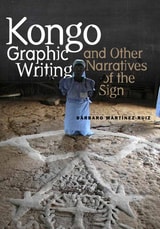
Kongo Graphic Writing and Other Narratives of the Sign
Barbaro Martinez-Ruiz
Temple University Press, 2013
Author Bárbaro Martínez-Ruiz, a practitioner of the Palo Monte devotional arts, illustrates with graphics and rock art how the Bakongo’s ideographic and pictographic signs are used to organize daily life, enable interactions between humans and the natural and spiritual worlds, and preserve and transmit cosmological and cosmogonical belief systems.
Exploring cultural diffusion and exchange, collective memory and identity, Kongo Graphic Writing and Other Narratives of the Sign artfully brings together analyses of the complex interconnections among Kongo traditions of religion, philosophy and visual/gestural communication on both sides of the African Atlantic world.

Korea Letters in the William Elliot Griffis Collection
An Annotated SelectionYoung-mee Yu Cho
Rutgers University Press, 2024
The Korean materials in the Griffis Collection at Rutgers University consist of journals, correspondence, articles, maps, prints, photos, postcards, manuscripts, scrapbooks, and ephemera. These papers reflect Griffis's interests and activities in relation to Korea as a historian, scholar, and theologian. They provide a rare window into the turbulent period of late nineteenth- and twentieth-century Korea, witnessed and evaluated by Griffis and early American missionaries in East Asia. The Korea Letters in the William Elliot Griffis Collection are divided into two parts: letters from missionaries and letters from Japanese and Korean political figures. Newly available and accessible through this collection, these letters develop a multifaceted history of early American missionaries in Korea, the Korean independence movement, and Griffis's views on Korean culture.
Korean Treasures Volume 2
Rare Books, Manuscripts and Artefacts in the Bodleian Libraries and Museums of Oxford UniversityMinh Chung
Bodleian Library Publishing, 2019
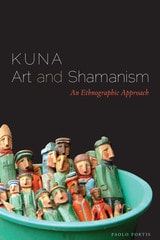
Kuna Art and Shamanism
An Ethnographic ApproachBy Paolo Fortis
University of Texas Press, 2013
Known for their beautiful textile art, the Kuna of Panama have been scrutinized by anthropologists for decades. Perhaps surprisingly, this scrutiny has overlooked the magnificent Kuna craft of nuchukana—wooden anthropomorphic carvings—which play vital roles in curing and other Kuna rituals. Drawing on long-term fieldwork, Paolo Fortis at last brings to light this crucial cultural facet, illuminating not only Kuna aesthetics and art production but also their relation to wider social and cosmological concerns.
Exploring an art form that informs birth and death, personhood, the dream world, the natural world, religion, gender roles, and ecology, Kuna Art and Shamanism provides a rich understanding of this society’s visual system, and the ways in which these groundbreaking ethnographic findings can enhance Amerindian scholarship overall. Fortis also explores the fact that to ask what it means for the Kuna people to carve the figure of a person is to pose a riddle about the culture’s complete concept of knowing.
Also incorporating notions of landscape (islands, gardens, and ancient trees) as well as cycles of life, including the influence of illness, Fortis places the statues at the center of a network of social relationships that entangle people with nonhuman entities. As an activity carried out by skilled elderly men, who possess embodied knowledge of lifelong transformations, the carving process is one that mediates mortal worlds with those of immortal primordial spirits. Kuna Art and Shamanism immerses readers in this sense of unity and opposition between soul and body, internal forms and external appearances, and image and design.
Kurt Kren
Structural FilmsEdited by Nicky Hamlyn, Simon Payne, and A. L. Rees
Intellect Books, 2016
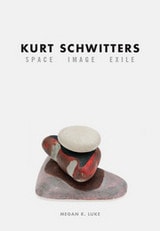
Kurt Schwitters
Space, Image, ExileMegan R. Luke
University of Chicago Press, 2014