Results by title
198 books match the query 'Campaigns' and 5 start with k

Kearney's Own
The History of the First New Jersey Brigade in the Civil WarGottfried, Bradley M
Rutgers University Press, 2005
From the first battle at Bull Run to the surrender of Lee's army at Appomattox four years later, only one federal infantry brigade experienced the entire Civil War as a cohesive unit. While most units were composed of regiments from different states that were disbanded after three years, the First New Jersey Brigade was the enduring exception.
Despite the group's remarkable coherency, it started as many military units did during the early stages of the war-a disorganized ragtag outfit that was poorly trained and ill-prepared for battle. This quickly changed, however, with the appointment of General Philip Kearny in the fall of 1861. Kearny transformed the troops, making them among the most disciplined and effective commands in the Army of the Potomac. A series of notable victories earned the soldiers an impressive reputation and, with it, thousands of others voluntarily came forward to enlist. Even when they suffered heavy losses, the New Jersey regiments fought exceptionally well and served key roles in dozens of battles, including the Peninsula, Seven Days, Second Bull Run, Antietam, Chancellorsville, Wilderness, Spotsylvania, Cold Harbor, Early's Valley, and the Petersburg Campaigns.
In Kearny's Own, Bradley M. Gottfried weaves together compelling accounts of battles fought with a wealth of letters and diaries to tell the story of this famous brigade from a uniquely personal perspective. The hopes, fears, and sorrows of the men come through vividly as accounts reveal how civilians were physically and emotionally transformed into soldiers. Primary sources also provide insight to what the war meant to the men who fought for the Union.
Fourteen maps illustrate the battles and marches, while detailed appendices include statistical breakdowns of losses and outline the fates of the men whose letters and diaries are used as sources. In this first book published on the subject, Gottfried not only provides a long-overdue history of the First New Jersey Brigade, he offers a human window into the turbulent and trying experiences of war.

Key Command
Ulysses S. Grant's District of CairoT. K. Kionka
University of Missouri Press, 2006
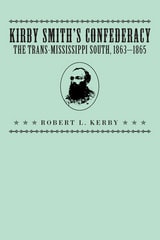
Kirby Smith's Confederacy
The TransMississippi South, 1863-1865Robert L. Kerby
University of Alabama Press, 1991
Cut off, but not surrendered—one region’s desperate stand in the twilight of the Confederacy.
With the surrender of Vicksburg in July 1863, the Confederacy’s TransMississippi Department, which included Texas, Arkansas, Missouri, western Louisiana, and Indian Territory, was cut off from the remainder of the South. Robert Kerby’s insightful volume, originally published in 1972, “has gone far toward filling one of the most conspicuous gaps in the literature on the Confederacy,” according to The Journal of Southern History.
Kerby investigates the many factors that led to the Department’s disintegrating and offers a case study of a segment of American society that consumed itself by surrendering everything, including its principles and ideals, in pursuit of an unattainable military victory.
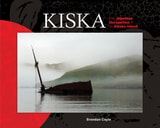
Kiska
The Japanese Occupation of an Alaska IslandBrendan Coyle
University of Alaska Press, 2014
The bastion of Japan’s possessions in Alaska, Kiska was soon fortified with 7,500 enemy troops, their equipment, and a labyrinth of tunnels. For thirteen months Japanese troops withstood constant bombardment from American forces while retaining a tenuous hold on the island. Finally forced to abandon their position, the Japanese occupiers evacuated without their equipment and personal effects, leaving behind a trail of artifacts.
Brendan Coyle spent fifty-one days on the island searching out the tunnels, the equipment, and the objects, all frozen in time. Kiska brings together the images Coyle amassed during his exploration and his archival research. Accompanying explanations put the images in historical perspective, opening a window on a little-known battlefield and shining a rare light on a shadowy occupation.
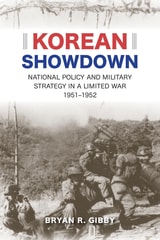
Korean Showdown
National Policy and Military Strategy in a Limited War, 1951–1952Bryan R. Gibby
University of Alabama Press, 2021
WINNER OF THE 2023 ANDREW F. KREPINEVICH JR. WRITING AWARD
A historical analysis of the policies and military strategies applied during the Korean War stalemate period.
Korean Showdown: National Policy and Military Strategy in a Limited War, 1951–1952 takes a holistic and integrative approach to strategy, operations, and tactics during the Korean War’s stalemate period and demonstrates how these matters shaped each other and influenced, or were influenced by, political and strategic policy decision-making. Bryan R. Gibby offers an analysis of the major political and military decisions affecting how the war was conducted operationally and diplomatically by examining American, Chinese, North Korean, and South Korean operations in the context of fighting a limited war with limited means, but for objectives that were not always limited in scope or ambition. The foundational political decision was Harry Truman’s voluntary repatriation policy, which extended the war by up to eighteen months. Its military counterpart was the American-led Operation Showdown, the last deliberate military offensive to coerce concessions at the negotiation table. Showdown’s failure (and the Communists’ own equally disappointing military efforts) opened up new avenues for solving the war short of a militarily imposed solution.
Gibby’s research draws on primary sources from American, Korean, and Chinese archives and publications. Many of these sources have not yet been mined in diplomatic and military histories of the Korean War. This innovative book also addresses a significant gap in the study of Korean military operations—the linkage between ground and air pressure campaigns, as well as the many Chinese and American operations conducted to establish negotiation positions. Gibby also explores many political and propagandist developments that assumed great importance in the summer of 1952, such as prisoner of war riots, the bombing of hydroelectric dams, and the South Korean constitutional crisis, which significantly influenced American and Chinese military decision-making.
Ultimately, this volume serves as a cautionary analysis of the limits of force, the necessity to understand an adversary, and the importance of strategic consensus. It also offers an effective case study on an underappreciated period of civil-military tension during the Cold War and on how civilian politicians and military leaders must collaborate to determine a realistic and effective strategy.