Results by title
851 books match the query 'Congresses' and 3 start with k
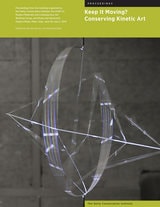
Keep It Moving?
Conserving Kinetic ArtRachel Rivenc
J. Paul Getty Trust, The, 2018
Kinetic art not only includes movement but often depends on it to produce an intended effect and therefore fully realize its nature as art. It can take a multiplicity of forms and include a wide range of motion, from motorized and electrically driven movement to motion as the result of wind, light, or other sources of energy. Kinetic art emerged throughout the twentieth century and had its major developments in the 1950s and 1960s.
Professionals responsible for conserving contemporary art are in the midst of rethinking the concept of authenticity and solving the dichotomy often felt between original materials and functionality of the work of art. The contrast is especially acute with kinetic art when a compromise between the two often seems impossible. Also to be considered are issues of technological obsolescence and the fact that an artist’s chosen technology often carries with it strong sociological and historical information and meanings.
Professionals responsible for conserving contemporary art are in the midst of rethinking the concept of authenticity and solving the dichotomy often felt between original materials and functionality of the work of art. The contrast is especially acute with kinetic art when a compromise between the two often seems impossible. Also to be considered are issues of technological obsolescence and the fact that an artist’s chosen technology often carries with it strong sociological and historical information and meanings.
[more]
Key Concepts of Romanian History
Alternative Approaches to Socio-Political LanguagesVictor Neumann
Central European University Press, 2013
The theoretical analyses and interpretations contained in the studies of this volume focus on key-concepts such as: politics, politician, democracy, Europe, liberalism, constitution, property, progress, kinship, nation, national character and specificity, homeland, patriotism, education, totalitarianism, democracy, democratic, democratization, transition. The essays unveil specific aspects belonging to Romania's past and present. They also offer alternative perspectives on the Romanian culture through the relationship between the elite and society, and novel reflections on the delayed and unfinished modernization processes within the society and the state. The editors articulate the results coming from various sciences, such as history, linguistics, sociology, political sciences, and philosophy with the aim that the past and present profiles of Romania are better understood.
[more]
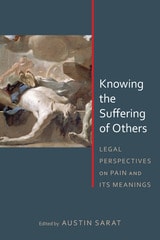
Knowing the Suffering of Others
Legal Perspectives on Pain and Its MeaningsAustin Sarat
University of Alabama Press, 2014
In Knowing the Suffering of Others, legal scholar Austin Sarat brings together essays that address suffering as it relates to the law, highlighting the ways law imagines suffering and how pain and suffering become jurisprudential facts.
From fetal imaging to end-of-life decisions, torts to international human rights, domestic violence to torture, and the law of war to victim impact statements, the law is awash in epistemological and ethical problems associated with knowing and imagining suffering. In each of these domains we might ask: How well do legal actors perceive and understand suffering in such varied domains of legal life? What problems of representation and interpretation bedevil efforts to grasp the suffering of others? What historical, political, literary, cultural, and/or theological resources can legal actors and citizens draw on to understand the suffering of others?
In Knowing the Suffering of Others, Austin Sarat presents legal scholarship that explores these questions and puts the problem of suffering at the center of thinking about law. The contributors to this volume do not regard pain and suffering as objective facts of a universe remote from law; rather they examine how both are discursively constructed in and by law. They examine how pain and suffering help construct and give meaning to the law as we know it. The authors attend to the various ways suffering appears in law as well as the different forms of suffering that require the law’s attention.
Throughout this book law is regarded as a domain in which the meanings of pain and suffering are contested, and constituted, as well as an instrument for inflicting suffering or for providing or refusing its relief. It challenges scholars, lawyers, students, and policymakers to ask how various legal actors and audiences understand the suffering of others.
Contributors
Montré D. Carodine / Cathy Caruth / Alan L. Durham / Bryan K.Fair / Steven H. Hobbs / Gregory C. Keating
/ Linda Ross Meyer / Meredith M. Render / Jeannie Suk / John Fabian Witt
[more]