Results by title
65 books match the query 'Czech Republic' and 2 start with k
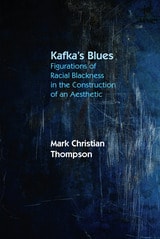
Kafka’s Blues
Figurations of Racial Blackness in the Construction of an AestheticMark Christian Thompson
Northwestern University Press, 2016
Kafka's Blues proves the startling thesis that many of Kafka's major works engage in a coherent, sustained meditation on racial transformation from white European into what Kafka refers to as the "Negro" (a term he used in English). Indeed, this book demonstrates that cultural assimilation and bodily transformation in Kafka's work are impossible without passage through a state of being "Negro." Kafka represents this passage in various ways—from reflections on New World slavery and black music to evolutionary theory, biblical allusion, and aesthetic primitivism—each grounded in a concept of writing that is linked to the perceived congenital musicality of the "Negro," and which is bound to his wider conception of aesthetic production. Mark Christian Thompson offers new close readings of canonical texts and undervalued letters and diary entries set in the context of the afterlife of New World slavery and in Czech and German popular culture.
[more]
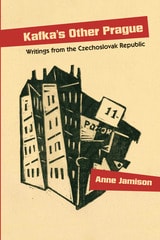
Kafka’s Other Prague
Writings from the Czechoslovak RepublicAnne Jamison
Northwestern University Press, 2018
Kafka’s Other Prague: Writings from the Czechoslovak Republic examines Kafka’s late writings from the perspective of the author’s changing relationship with Czech language, culture, and literature—the least understood facet of his meticulously researched life and work.
Franz Kafka was born in Prague, a bilingual city in the Habsburg Empire. He died a citizen of Czechoslovakia. Yet Kafka was not Czech in any way he himself would have understood. He could speak Czech, but, like many Prague Jews, he was raised and educated and wrote in German. Kafka critics to date have had little to say about the majority language of his native city or its “minor literature,” as he referred to it in a 1913 journal entry. Kafka’s Other Prague explains why Kafka’s later experience of Czech language and culture matters.
Bringing to light newly available archival material, Anne Jamison’s innovative study demonstrates how Czechoslovakia’s founding and Kafka’s own dramatic political, professional, and personal upheavals altered his relationship to this “other Prague.” It destabilized Kafka’s understanding of nationality, language, gender, and sex—and how all these issues related to his own writing.
Kafka’s Other Prague juxtaposes Kafka’s German-language work with Czechoslovak Prague’s language politics, intellectual currents, and print culture—including the influence of his lover and translator, the journalist Milena Jesenská—and shows how this changed cultural and linguistic landscape transformed one of the great literary minds of the last century.
[more]