Results by title
304 books match the query 'Death' and 5 start with k
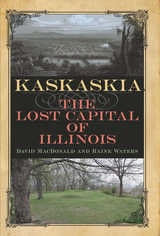
Kaskaskia
The Lost Capital of IllinoisDavid MacDonald and Raine Waters
Southern Illinois University Press, 2019
At the outset the Kaskaskia tribe, along with Jesuit missionaries and French traders, settled near the confluence of the Kaskaskia and Mississippi rivers, about sixty miles south of modern-day St. Louis. The town quickly became the largest French town and most prosperous settlement in the Illinois Country. After French control ended, Kaskaskia suffered under corrupt British and then inept American rule. In the 1790s the town revived and became the territorial capital, and in 1818 it became the first state capital. Along the way Kaskaskia was beset by disasters: crop failures, earthquakes, tornadoes, floods, epidemics, and the loss of the capital-city title to Vandalia. Likewise, human activity and industry eroded the river’s banks, causing the river to change course and eventually wash away the settlement. All that remains of the state’s first capital today is a village several miles from the original site.
MacDonald and Waters focus on the town’s growth, struggles, prosperity, decline, and obliteration, providing an overview of its domestic architecture to reveal how its residents lived. Debunking the notion of a folklore tradition about a curse on the town, the authors instead trace those stories to late nineteenth-century journalistic inventions. The result is a vibrant, heavily illustrated, and highly readable history of Kaskaskia that sheds light on the entire early history of Illinois.
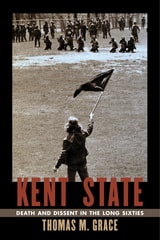
Kent State
Death and Dissent in the Long SixtiesThomas M. Grace
University of Massachusetts Press, 2016
On May 4, 1970, National Guard troops opened fire on unarmed antiwar protesters at Kent State University in Ohio, killing four students and wounding nine others, including the author of this book. The shootings shocked the American public and triggered a nationwide wave of campus strikes and protests. To many at the time, Kent State seemed an unlikely site for the bloodiest confrontation in a decade of campus unrest—a sprawling public university in the American heartland, far from the coastal epicenters of political and social change.
Yet, as Thomas M. Grace shows, the events of May 4 were not some tragic anomaly but were grounded in a tradition of student political activism that extended back to Ohio's labor battles of the 1950s. The vast expansion of the university after World War II brought in growing numbers of working-class enrollees from the industrial centers of northeast Ohio, members of the same demographic cohort that eventually made up the core of American combat forces in Vietnam. As the war's rising costs came to be felt acutely in the home communities of Kent's students, tensions mounted between the growing antiwar movement on campus, the university administration, and the political conservatives who dominated the surrounding county as well as the state government.
The deadly shootings at Kent State were thus the culmination of a dialectic of radicalization and repression that had been building throughout the decade. In the years that followed, the antiwar movement continued to strengthen on campus, bolstered by an influx of returning Vietnam veterans. After the war ended, a battle over the memory and meaning of May 4 ensued. It continues to the present day.

Kindred Specters
Death, Mourning, and American AffinityChristopher Peterson
University of Minnesota Press, 2007
The refusal to recognize kinship relations among slaves, interracial couples, and same-sex partners is steeped in historical and cultural taboos. In Kindred Specters, Christopher Peterson explores the ways in which non-normative relationships bear the stigma of death that American culture vehemently denies.
Probing Derrida’s notion of spectrality as well as Orlando Patterson’s concept of “social death,” Peterson examines how death, mourning, and violence condition all kinship relations. Through Charles Chesnutt’s The Conjure Woman, Peterson lays bare concepts of self-possession and dispossession, freedom and slavery. He reads Toni Morrison’s Beloved against theoretical and historical accounts of ethics, kinship, and violence in order to ask what it means to claim one’s kin as property. Using William Faulkner’s Absalom, Absalom! he considers the political and ethical implications of comparing bans on miscegenation and gay marriage.
Tracing the connections between kinship and mourning in American literature and culture, Peterson demonstrates how racial, sexual, and gender minorities often resist their social death by adopting patterns of affinity that are strikingly similar to those that govern normative relationships. He concludes that socially dead “others” can be reanimated only if we avow the mortality and mourning that lie at the root of all kinship relations.
Christopher Peterson is visiting assistant professor of literature at Claremont McKenna College.
Kiss Of Death
Joseph Bastien
University of Utah Press, 1998
Kiss of Death
Contagion, Contamination, and FolkloreAndrea Kitta
Utah State University Press, 2019
Using ethnographic, media, and narrative analysis, this book explores the vernacular explanatory models used in decisions concerning contagion to better understand the real fears, risks, concerns, and doubts of the public. Kitta explores immigration and patient zero, zombies and vampires, Slender Man, HPV, and the kiss of death legend, as well as systematic racism, homophobia, and misogyny in North American culture, to examine the nature of contagion and contamination.
Conversations about health and risk cannot take place without considering positionality and intersectionality. In The Kiss of Death, Kitta isolates areas that require better communication and greater cultural sensitivity in the handling of infectious disease, public health, and other health-related disciplines and industries.