Results by title
91 books match the query 'Desire' and 2 start with k
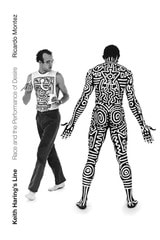
Keith Haring's Line
Race and the Performance of DesireRicardo Montez
Duke University Press, 2020
In the thirty years since his death, Keith Haring—a central presence on the New York downtown scene of the 1980s—has remained one of the most popular figures in contemporary American art. In one of the first book-length treatments of Haring’s artistry, Ricardo Montez traces the drawn and painted line that was at the center of Haring’s artistic practice and with which the artist marked canvases, subway walls, and even human flesh. Keith Haring’s Line unites performance studies, critical race studies, and queer theory in an exploration of cross-racial desire in Haring’s life and art. Examining Haring’s engagements with artists such as dancer and choreographer Bill T. Jones, graffiti artist LA II, and iconic superstar Grace Jones, Montez confronts Haring’s messy relationships to race-making and racial imaginaries, highlighting scenes of complicity in order to trouble both the positive connotations of inter-racial artistic collaboration and the limited framework of appropriation.
[more]
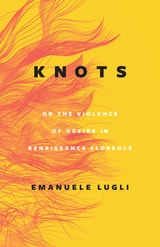
Knots, or the Violence of Desire in Renaissance Florence
Emanuele Lugli
University of Chicago Press, 2023
An interdisciplinary study of hair through the art, philosophy, and science of fifteenth-century Florence.
In this innovative cultural history, hair is the portal through which Emanuele Lugli accesses the cultural production of Lorenzo il Magnifico’s Florence. Lugli reflects on the ways writers, doctors, and artists expressed religious prejudices, health beliefs, and gender and class subjugation through alluring works of art, in medical and political writings, and in poetry. He considers what may have compelled Sandro Botticelli, the young Leonardo da Vinci, and dozens of their contemporaries to obsess over braids, knots, and hairdos by examining their engagement with scientific, philosophical, and theological practices.
By studying hundreds of fifteenth-century documents that engage with hair, Lugli foregrounds hair’s association to death and gathers insights about human life at a time when Renaissance thinkers redefined what it meant to be human and to be alive. Lugli uncovers overlooked perceptions of hair when it came to be identified as a potential vector for liberating culture, and he corrects a centuries-old prejudice that sees hair as a trivial subject, relegated to passing fashion or the decorative. He shows hair, instead, to be at the heart of Florentine culture, whose inherent violence Lugli reveals by prompting questions about the entanglement of politics and desire.
[more]