Results by title
603 books match the query 'Discrimination (incl. Prejudice, Racism, Colorism, etc.)' and 2 start with k
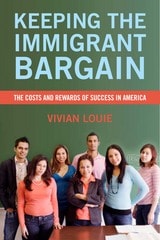
Keeping the Immigrant Bargain
The Costs and Rewards of Success in AmericaVivian Louie
Russell Sage Foundation, 2012
Most nineteenth and early-twentieth-century European immigrants arrived in the United States with barely more than the clothes on their backs. They performed menial jobs, spoke little English, and often faced a hostile reception. But two or more generations later, the overwhelming majority of their descendants had successfully integrated into American society. Today's immigrants face many of the same challenges, but some experts worry that their integration, especially among Latinos, will not be as successful as their European counterparts. Keeping the Immigrant Bargain examines the journey of Dominican and Colombian newcomers whose children have achieved academic success one generation after the arrival of their parents. Sociologist Vivian Louie provides a much-needed comparison of how both parents and children understand the immigrant journey toward education, mobility, and assimilation. Based on Louie's own survey and interview study, Keeping the Immigrant Bargain examines the lives of thirty-seven foreign-born Dominican and Colombian parents and their seventy-six young adult offspring—the majority of whom were enrolled in or had graduated from college. The book shows how they are adapting to American schools, jobs, neighborhoods, and culture. Louie discovers that before coming to the United States, some of these parents had already achieved higher levels of education than the average foreign-born Dominican or Colombian, and after arrival many owned their own homes. Significantly, most parents in each group expressed optimism about their potential to succeed in the United States, while also expressing pessimism about whether they would ever be accepted as Americans. In contrast to the social exclusion experienced by their parents, most of the young adults had assimilated linguistically and believed themselves to be full participants in American society. Keeping the Immigrant Bargain shows that the offspring of these largely working-class immigrants had several factors in common that aided their mobility. Their parents were highly engaged in their lives and educational progress, although not always in ways expected by schools or their children, and the children possessed a strong degree of self-motivation. Equally important was the availability of key institutional networks of support, including teachers, peers, afterschool and other enrichment programs, and informal mentors outside of the classroom. These institutional networks gave the children the guidance they needed to succeed in school, offering information the parents often did not know themselves. While not all immigrants achieve such rapid success, this engrossing study shows how powerful the combination of self-motivation, engaged families, and strong institutional support can be. Keeping the Immigrant Bargain makes the case that institutional relationships—such as teachers and principals who are trained to accommodate cultural difference and community organizations that help parents and children learn how to navigate the system—can bear significantly on immigrant educational success.
[more]
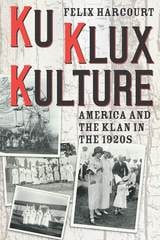
Ku Klux Kulture
America and the Klan in the 1920sFelix Harcourt
University of Chicago Press, 2017
In popular understanding, the Ku Klux Klan is a hateful white supremacist organization. In Ku Klux Kulture, Felix Harcourt argues that in the 1920s the self-proclaimed Invisible Empire had an even wider significance as a cultural movement.
Ku Klux Kulture reveals the extent to which the KKK participated in and penetrated popular American culture, reaching far beyond its paying membership to become part of modern American society. The Klan owned radio stations, newspapers, and sports teams, and its members created popular films, pulp novels, music, and more. Harcourt shows how the Klan’s racist and nativist ideology became subsumed in sunnier popular portrayals of heroic vigilantism. In the process he challenges prevailing depictions of the 1920s, which may be best understood not as the Jazz Age or the Age of Prohibition, but as the Age of the Klan. Ku Klux Kulture gives us an unsettling glimpse into the past, arguing that the Klan did not die so much as melt into America’s prevailing culture.
Ku Klux Kulture reveals the extent to which the KKK participated in and penetrated popular American culture, reaching far beyond its paying membership to become part of modern American society. The Klan owned radio stations, newspapers, and sports teams, and its members created popular films, pulp novels, music, and more. Harcourt shows how the Klan’s racist and nativist ideology became subsumed in sunnier popular portrayals of heroic vigilantism. In the process he challenges prevailing depictions of the 1920s, which may be best understood not as the Jazz Age or the Age of Prohibition, but as the Age of the Klan. Ku Klux Kulture gives us an unsettling glimpse into the past, arguing that the Klan did not die so much as melt into America’s prevailing culture.
[more]