Results by title
300 books match the query 'Economic Development' and 5 start with k
Keeping Faith, Losing Faith
Religious Belief and Political Economy, Volume 40Bradley W. Bateman and H. Spencer Banzhaf, eds.
Duke University Press, 0
Two of the essays examine the antagonism between Christianity and utilitarianism in postrevolutionary French economics and the rising influence of the materialism of the market vis-à-vis the declining authority of the Roman Catholic Church in eighteenth-century Europe. Other topics explored include the work of the great American neoclassicist Frank Knight, the combination of utility analysis and Christian principles among the “clerical economists” in America, and the effect of a crisis of personal faith on the theories of the English philosopher and economist Henry Sidgwick.
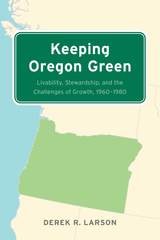
Keeping Oregon Green
Livability, Stewardship, and the Challenges of Growth, 1960–1980Derek R. Larson
Oregon State University Press, 2016
Keeping Oregon Green is a new history of the signature accomplishments of Oregon’s environmental era: the revitalization of the polluted Willamette River, the Beach Bill that preserved public access to the entire coastline, the Bottle Bill that set the national standard for reducing roadside litter, and the nation’s first comprehensive land use zoning law, colloquially known as LDCD. To these case studies is added the largely forgotten tale of what would have been Oregon’s second National Park, intended to preserve the Oregon Dunes as one of the country’s first National Seashores.
Through the detailed study of the historical, political, and cultural contexts of these environmental conflicts the author uncovers new dimensions in familiar stories linked to the concepts of “livability” and environmental stewardship. Linking events in Oregon to the national environmental awakening of the 1960s-1970s, the innovative environmental policies that carried Oregon to a position of national leadership are shown to be products of place and culture as much as politics. While political leaders played critical roles in framing new laws, the advocacy of ordinary citizens-- farmers, students, business leaders, and factory workers --drove a movement that crossed partisan, geographic, and class lines to make Oregon the nation’s environmental showplace of the 1970s.
Drawing on extensive archival research, source materials ranging from poetry to congressional hearings, and firmly rooted in the cultural, economic, and political history of the Pacific Northwest, Keeping Oregon Green argues that the state’s environmental legacy is not just the product of visionary leadership, but rather a complex confluence of events, trends, and personalities that could only have happened when and where it did. The linked concepts of livability and stewardship behind Oregon’s success were not transferrable to other places or times, dooming efforts to repeat the state’s signature achievements elsewhere to failure.

Kicking Off the Bootstraps
Environment, Development, and Community Power in Puerto RicoDéborah Berman Santana
University of Arizona Press, 1996
Kicking Off the Bootstraps is a powerful case history of such an effort. It describes a grassroots activist movement that emerged in the Puerto Rican community of Salinas to counter the poverty and economic dependence experienced by its citizens in the wake of "Operation Bootstrap," a post-World War II industrial development program. Déborah Berman Santana examines the efforts of the community to develop its own economic strategy based primarily on environmentally and socially responsible uses of local natural and human resources.
Berman Santana shows how local activists are seeking to empower the Salinas community to make decisions concerning economic development. She evaluates present-day efforts to develop positive alternatives, examining the motivations of the activists, the nature of their projects, their efforts to mobilize the community, their dealings with government and other organizations, and the obstacles they face. In a closing chapter, she addresses the potential roles of community leaders, outside activists, local businesses, and government in actualizing these alternatives.
A testimony to one community's efforts to determine its own future, Kicking Off the Bootstraps deals with real issues such as control over productive resources, quality of life, and environmental health. It also extends an examination of community-directed activism to an exploration of policy implications for sustainable development. While this concept is often too vague to be applied to real strategies, the Salinas experience provides a clear idea of what sustainable development can—and should—mean in actual practice.

Knowledge Sovereignty Among African Cattle Herders
Zeremariam Fre
University College London, 2018
In this book, the first to study Beni-Amer practices, Zeremariam Fre argues for the importance of their knowledge, challenging the preconceptions that regard it as untrustworthy when compared to scientific knowledge from more developed regions. Empirical evidence suggests that there is much one could learn from the other, since elements of pastoralist technology, such as those related to animal production and husbandry, make a direct contribution to our knowledge of livestock production. It is this potential for hybridization, as well as the resilience of the herders, at the core of the indigenous knowledge system.
Fre also argues that indigenous knowledge can be viewed as a stand-alone science, and that a community’s rights over ownership should be defended by government officials, development planners and policy makers, making the case for a celebration of the knowledge sovereignty of pastoralist communities
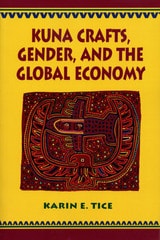
Kuna Crafts, Gender, and the Global Economy
By Karin E. Tice
University of Texas Press, 1995