Results by title
157 books match the query 'English' and 6 start with k
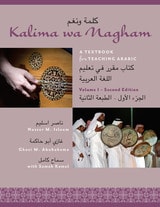
Kalima wa Nagham
A Textbook for Teaching Arabic, Volume 1By Nasser M. Isleem and Ghazi M. Abuhakema
University of Texas Press, 2020
Presenting a new Teaching Arabic as a Foreign Language (TAFL) curriculum that can be used in secondary and postsecondary educational settings, Kalima wa Nagham (Volume I) is a textbook that uniquely and simultaneously introduces Modern Standard Arabic (MSA) and salient aspects of Educated Spoken Arabic (ESA) to beginning language students. Students who fully utilize this book should be able to develop the different language skills: listening, speaking, reading, writing, and expressing deep cultural knowledge.
Written by Arabic language teaching practitioners and experienced educators who are certified language testers, Volume I of Kalima wa Nagham employs a threaded story that introduces language concepts along with music to enhance vocabulary retention and recall. At the core of the textbook are dialogues that present students and teachers with examples of Arabic grammatical concepts and important cultural aspects, as well as related vocabulary. These are supplemented by drills and activities that can be used in a classroom setting or pursued individually. Dialogues, pronunciation and listening drills, and charts to accompany the lessons are available on the UT Press website. This volume is student-centered in content and methodology, which will enable learners to meet and exceed linguistic and cultural proficiency expectations.
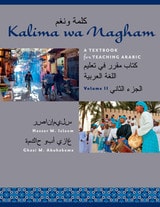
Kalima wa Nagham
A Textbook for Teaching Arabic, Volume 2By Nasser M. Isleem and Ghazi M. Abuhakema
University of Texas Press, 2016
Presenting a new Teaching Arabic as a Foreign Language (TAFL) curriculum that can be used in secondary and postsecondary educational settings, Kalima wa Nagham, Volume 2, is a textbook that uniquely and simultaneously introduces Modern Standard Arabic (MSA) and salient aspects of Educated Spoken Arabic (ESA) to level two language students. Students who fully utilize this book should be able to develop important language skills: listening, speaking, reading, writing, and expressing deep cultural knowledge.
Written by Arabic language teaching practitioners and experienced educators who are certified language testers, Kalima wa Nagham employs a threaded story that introduces language concepts along with music to enhance vocabulary retention and recall. At the core of the textbook are dialogues that present students and teachers with examples of Arabic grammatical concepts and important cultural aspects, as well as related vocabulary. These are supplemented by drills and activities that can be used in a classroom setting or pursued individually. Volume 2 incorporates media language to help students understand news reports and other media texts as well as original cartoons that demonstrate the meaning and significance of idiomatic expressions in a refreshing way. Dialogues and pronunciation and listening drills to accompany the lessons are available on the University of Texas Press website. This volume is student-centered in content and methodology, which will enable learners to meet and exceed linguistic and cultural proficiency expectations.
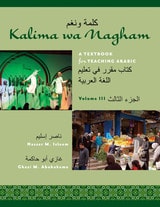
Kalima wa Nagham
A Textbook for Teaching Arabic, Volume 3By Nasser M. Isleem and Ghazi M. Abuhakema
University of Texas Press, 2020
Presenting a new Teaching Arabic as a Foreign Language (TAFL) curriculum that can be used in secondary and postsecondary educational settings, Kalima wa Nagham, volume 3, is a textbook that uniquely and simultaneously introduces Modern Standard Arabic (MSA) and salient aspects of Educated Spoken Arabic (ESA) to students whose proficiency level is at least intermediate high according to ACTFL’s rating scale. Students who fully use this book should be able to develop important language skills—listening, speaking, reading, writing, and expressing deep cultural knowledge—and reach the advanced high proficiency level by the end of the book.
Written by Arabic language teaching practitioners and experienced educators who are certified language testers, Kalima wa Nagham employs a threaded story that introduces language concepts along with music to enhance vocabulary retention and recall. At the core of the textbook are written and oral texts that present students and teachers with examples of Arabic grammatical concepts and important cultural aspects, as well as related vocabulary. These are supplemented by drills and activities that can be used in a classroom setting or pursued individually. Dialogues and pronunciation and listening drills that accompany the lessons are available on the University of Texas Press website. This volume is student-centered in content and methodology, which will enable learners to meet and exceed linguistic and cultural proficiency expectations.

Kibler's Medical Terms for Interpreters
English to JapaneseJeanette Kibler and Karl T. Rew
Michigan Publishing Services, 2018
通訳者は状況に合わせて的確な言葉を発することが非常に重要であることを承知しています。 医療通訳者にとって専門分野に特有の言葉を素早く探すことが困難な場合もあるでしょう。 「キブラーの通訳者向け医学用語集」は目的の擁護へ素早くたどりつくための実際に役立つ資料です。
• Speeds up your word-finding. Unlike a typical dictionary, Kibler’s Medical Terms for Interpreters is organized in sections by medical specialty, so you can quickly locate the specific words that will be useful for a patient encounter.
• Makes medical words easily accessible, from common terms to highly technical jargon.
• Reduces the need to search a dictionary for individual words while interpreting.
• Has proved to be a valuable resource for both beginning and veteran interpreters.
• Is easily used while interpreting or when preparing prior to an appointment.
• 用語の検索が速くなります。典型的な辞書とは異なり「キブラーの通訳者向け医学用語集」は専門分野ごとに分類されており、患者さんの診察時に特定の単語を素早く見つけることができます。
• 一般的な言葉から高度な専門用語まで様々な医療用語を簡単に利用することができます。
• 通訳中に特定の言葉を辞書で調べる手間が省けます。
• 初級の通訳者にも、ベテランの通訳者にも価値のある参考資料であることが実証されています。
• 通訳の途中でも事前の予習時でも簡単に使うことができます。
Kibler's Medical Terms for Interpreters
Japanese to EnglishJeanette Kibler and Karl T. Rew
Michigan Publishing Services, 2018
通訳者は状況に合わせて的確な言葉を発することが非常に重要であることを承知しています。 医療通訳者にとって専門分野に特有の言葉を素早く探すことが困難な場合もあるでしょう。 「キブラーの通訳者向け医学用語集」は目的の擁護へ素早くたどりつくための実際に役立つ資料です。
• Speeds up your word-finding. Unlike a typical dictionary, Kibler’s Medical Terms for Interpreters is organized in sections by medical specialty, so you can quickly locate the specific words that will be useful for a patient encounter.
• Makes medical words easily accessible, from common terms to highly technical jargon.
• Reduces the need to search a dictionary for individual words while interpreting.
• Has proved to be a valuable resource for both beginning and veteran interpreters.
• Is easily used while interpreting or when preparing prior to an appointment.
• 用語の検索が速くなります。典型的な辞書とは異なり「キブラーの通訳者向け医学用語集」は専門分野ごとに分類されており、患者さんの診察時に特定の単語を素早く見つけることができます。
• 一般的な言葉から高度な専門用語まで様々な医療用語を簡単に利用することができます。
• 通訳中に特定の言葉を辞書で調べる手間が省けます。
• 初級の通訳者にも、ベテランの通訳者にも価値のある参考資料であることが実証されています。
• 通訳の途中でも事前の予習時でも簡単に使うことができます。
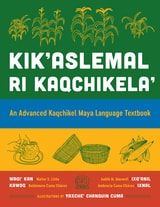
Kik’aslemal ri Kaqchikela’
An Advanced Kaqchikel Maya Language TextbookWaqi’ Kan (Walter E. Little), Ixq’anil (Judith M. Maxwell), Kawoq (Baldomero Cuma Chávez), Ixnal (Ambrocia Cuma Chávez). Illustrations: Yaxche’ Chanquin Cuma
University of Texas Press, 2026
An advanced Kaqchikel textbook that blends language learning with Maya culture.
About half a million Maya in the highlands of Guatemala speak Kaqchikel, making it one of the most widely used Mayan languages. Following the 2006 publication of ¿La ütz awäch?, an introduction to Kaqchikel, Kik’aslemal ri Kaqchikela’ offers guidance for advanced students. Unlike many language textbooks, it is designed with not only fluency but also cultural competency in mind.
Inspired by conversations with native speakers, Kaqchikel teachers, and anthropologists focused on Maya communities, Kik’aslemal ri Kaqchikela’ supports language learning through readings on topics important to speakers in Guatemala, including Maya’ Nimab’äl K’u’x (Maya cosmology); Ri Tiko’n (agriculture); Yab’il rik’in Aq’om (disease and medicine); Samaj pa Jay, pa Tinamït (work at home and in town); and more. Chapters present readings on each theme, alongside worksheets, discussion questions framed around Maya history and culture, and a contextualizing essay in English. A Kaqchikel/Spanish/English glossary, extensive grammar appendix, and English translations of the readings support learning. The result is not the usual explanation of language mechanics but instead a nuanced lesson in communication across porous boundaries of cultural difference.