1832 books match the query 'Essays' and 7 start with k
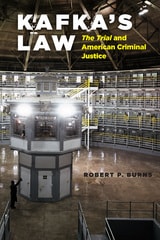
cover of Kafka's Law: "The Trial" and American Criminal Justice

Kafka's Law

"The Trial" and American Criminal Justice

Robert P. Burns

University of Chicago Press, 2014

The Trial is actually closer to reality than fantasy as far as the client’s perception of the system. It’s supposed to be a fantastic allegory, but it’s reality. It’s very important that lawyers read it and understand this.” Justice Anthony Kennedy famously offered this assessment of the Kafkaesque character of the American criminal justice system in 1993. While Kafka’s vision of the “Law” in The Trial appears at first glance to be the antithesis of modern American legal practice, might the characteristics of this strange and arbitrary system allow us to identify features of our own system that show signs of becoming similarly nightmarish?
           
With Kafka’s Law, Robert P. Burns shows how The Trial provides an uncanny lens through which to consider flaws in the American criminal justice system today. Burns begins with the story, at once funny and grim, of Josef K., caught in the Law’s grip and then crushed by it. Laying out the features of the Law that eventually destroy K., Burns argues that the American criminal justice system has taken on many of these same features. In the overwhelming majority of contemporary cases, police interrogation is followed by a plea bargain, in which the court’s only function is to set a largely predetermined sentence for an individual already presumed guilty. Like Kafka’s nightmarish vision, much of American criminal law and procedure has become unknowable, ubiquitous, and bureaucratic. It, too, has come to rely on deception in dealing with suspects and jurors, to limit the role of defense, and to increasingly dispense justice without the protection of formal procedures. But, while Kennedy may be correct in his grim assessment, a remedy is available in the tradition of trial by jury, and Burns concludes by convincingly arguing for its return to a more central place in American criminal justice.
[more]
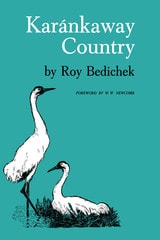
cover of Karánkaway Country

Karánkaway Country

By Roy Bedichek

University of Texas Press, 1974

Roy Bedichek spent most of his life working in the educational field in Texas, but his main interest was always the great outdoors. His first book, Adventures with a Texas Naturalist, was published when he was almost seventy, and his second, Karánkaway Country, appeared three years later. Both were the result of a lifetime of exploring a beloved land, of searching observation, of discussion, debate, wide reading, and reflection. Long out of print, Karánkaway Country is now available in a handsome second edition with a new Foreword by W. W. Newcomb, Jr.

Karánkaway Country focuses on the natural history of a strip of coastal prairie lying roughly between Corpus Christi and Galveston and once inhabited by the poorly known and much maligned Karankawa Indians. It serves as home base for an exposition of Bedichek's philosophy, providing a convenient local setting for richly tailored essays on wildlife, soil, human skin, and a variety of other topics suggested by a wide-ranging intellect. Bedichek's philosophy, if it can be reduced to a few words, is essentially that humans must learn to live on peaceful and conciliatory terms with our natural environment.

[more]
cover of Keepin' It Real: Essays on Race in Contemporary America

Keepin' It Real

Essays on Race in Contemporary America

Elwood David Watson

Intellect Books, 2019

The past decade has been one of the most racially turbulent periods in the modern era, as the complicated breakthrough of the Obama presidency gave way to the racially charged campaigning and eventual governing of Donald Trump. Keepin’ It Real presents a wide-ranging group of essays that take on key aspects of the current landscape surrounding racial issues in America, including the place of the Obamas, the rise of the alt-right and White nationalism, Donald Trump, Colin Kaepernick and the backlash against his protests, Black Lives Matter, sexual politics in the black community, and much more. 
America’s racial problems aren’t going away any time soon. Keepin’ It Real will serve as a marker of the arguments we’re having right now, and an argument for the changes we need to make to become the better nation we’ve long imagined ourselves to be.
 
[more]
cover of Kept Secret: The Half-Truth in Nonfiction

Kept Secret

The Half-Truth in Nonfiction

Jen Hirt

Michigan State University Press, 2017
Creative nonfiction writers wrestle constantly with the boundaries of creative license—what to reveal, when to reveal it, and how best to do it. While the truth may inspire us to make confident assertions, secrets, lies, and half-truths inspire us to delve further into our own writing to discover the heart of the story. The pieces in this collection feature essayists who do this type of detective work. Each essay contains a secret, lie, or half-truth—some of these are revealed by the author, but others remain buried. Ranging from the deep family secret to the little white lie, from the shocking to the humorous, and from the straightforward revelation to the slanted half-truth, these essays ask us to appreciate the magnitude of keeping a secret. They also ask us to consider the obstacles writers must overcome if they want to write about secrets in their own lives and the lives of others. In short interviews following each essay the contributors discuss craft, ethics, creativity, and how they eventually decided to reveal—or not reveal—a secret.
 
[more]
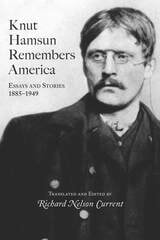
cover of Knut Hamsun Remembers America: Essays and Stories, 1885-1949

Knut Hamsun Remembers America

Essays and Stories, 1885-1949

Knut Hamsun, Edited & Translated by Richard Nelson Current

University of Missouri Press, 2003
When Americans remember him at all, they no doubt think of Knut Hamsun (1859–1952) as the author of Hunger or as the Norwegian who, along with Vidkun Quisling, betrayed his country by supporting the Nazis during World War II. Yet Hamsun, winner of the Nobel Prize in 1920 for his novel The Growth of the Soil, was and remains one of the most important and influential novelists of his time. Knut Hamsun Remembers America is a collection of thirteen essays and stories based largely on Hamsun’s experiences during the four years he spent in the United States when he was a young man. Most of these pieces have never been published before in an English translation, and none are readily available.
Hamsun’s feelings about America and American ways were complex. For the most part, they were more negative than positive, and they found expression in many of his writings—directly in his reminiscences and indirectly in his fiction. In On the Cultural Life of Modern America, his first major book, he portrayed the United States as a land of gross and greedy materialism, populated by illiterates who were utterly lacking in artistic originality or refinement. Although the pieces in this collection are not all anti-American, most of them emphasize the strangeness and unpleasantness, as the author saw it, of life in what he called Yankeeland.
Arranged chronologically, the pieces fall into three categories: Critical Reporting, Memory and Fantasy, and Mellow Reminiscence. The Critical Reporting section includes articles that appeared in Norwegian or Danish newspapers soon after each of Hamsun’s two visits to America and that give his views on a variety of American subjects, and includes an essay devoted to Mark Twain. Memory and Fantasy comprises narratives of life in America, most of which are presented as personal experiences but which actually are blends of fact and fiction. Mellow Reminiscence includes later and fonder recollections and impressions of the United States.
The pieces in this collection provide variations on a theme that runs through much of American history—European criticism of American ways. They give vivid, at times distorted, pictures of life as it was in the United States. They tell us something about the development of the worldview of a man who became a great writer, only to jeopardize his reputation by defending the Nazi oppressors of his own people. Knut Hamsun Remembers America will appeal to anyone interested in the history of American civilization or, more specifically, in the history of anti-Americanism.
[more]
cover of Koviashuvik: Making a Home in the Brooks Range

Koviashuvik

Making a Home in the Brooks Range

Sam Wright

University of Arizona Press, 1997
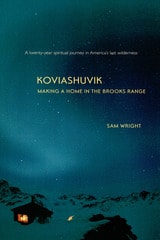
On a slope above a mountain lake in Alaska’s Brooks Range, Sam and Billie Wright built a twelve-by-twelve-foot log cabin with hand tools and named it Koviashuvik—an Eskimo word meaning "living in the present moment with quiet joy and happiness." Sam’s account of the twenty years they spent there is both a tale of wilderness survival and an inspiring meditation on the natural world and humanity’s relationship to it.
[more]
cover of Kurt Wolff: A Portrait in Essays and Letters

Kurt Wolff

A Portrait in Essays and Letters

Kurt Wolff

University of Chicago Press, 1991

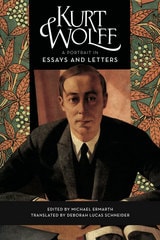
Kurt Wolff (1887-1963) was a singular presence in the literary world of the twentieth century, a cultural force shaping modern literature itself and pioneering significant changes in publishing. During an intense, active career that spanned two continents and five decades, Wolff launched seven publishing houses and nurtured an extraordinary array of writers, among them Franz Kafka, Lou Andreas-Salomé, Boris Pasternak, Günter Grass, Robert Musil, Paul Valéry, Julian Green, Lampedusa, and Anne Morrow Lindbergh.
[more]