Results by title
496 books match the query 'Ethnic identity' and 4 start with k
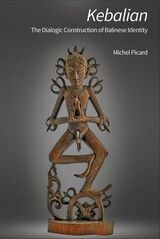
Kebalian
The Dialogic Construction of Balinese IdentityMichel Picard
National University of Singapore Press, 2024
Over the past one hundred years, the Balinese have been challenged by colonial occupation, political turbulence, and, most recently, tourism. In response, they have come to rely on the idea of “Kebalian,” or Balinese-ness. Kebalian is likened to a tree whose roots are religion (agama), the trunk is tradition (adat), and the fruits, Balinese culture (budaya). To understand how this sense of Balinese-ness came to be, Michel Picard examines the dialogues that the Balinese have engaged in both among themselves and with outsiders by conducting over a hundred interviews with Balinese opinion leaders, officials, and religious reformers. A key throughline in the construction of Kebalian is what Picard identifies as a twofold process of “religionization” and “Hinduization.” This process began with the first years of the incorporation of Bali into the Dutch East Indies and became more urgent with Indonesia’s independence. Kebalian today encompasses the tension between those Balinese eager to defend their customary ritual practices and advocates of Hinduism who deny that such local traditions qualify as agama. Kebalian presents a fascinating picture of religious change, identities in motion, and culture. Scholars of religion, cultural change, and Southeast Asian area studies will find this to be a fascinating and important book.

Khanty, People of the Taiga
Surviving the 20th CenturyAndrew Wiget and Olga Balalaeva
University of Alaska Press, 2011
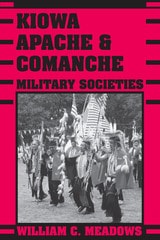
Kiowa, Apache, and Comanche Military Societies
Enduring Veterans, 1800 to the PresentBy William C. Meadows
University of Texas Press, 1999
A CHOICE Outstanding Academic Book
For many Plains Indians, being a warrior and veteran has long been the traditional pathway to male honor and status. Men and boys formed military societies to celebrate victories in war, to perform community service, and to prepare young men for their role as warriors and hunters. By preserving cultural forms contained in song, dance, ritual, language, kinship, economics, naming, and other semireligious ceremonies, these societies have played an important role in maintaining Plains Indian culture from the pre-reservation era until today.
In this book, Williams C. Meadows presents an in-depth ethnohistorical survey of Kiowa, Apache, and Comanche military societies, drawn from extensive interviews with tribal elders and military society members, unpublished archival sources, and linguistic data. He examines their structure, functions, rituals, and martial symbols, showing how they fit within larger tribal organizations. And he explores how military societies, like powwows, have become a distinct public format for cultural and ethnic continuity.
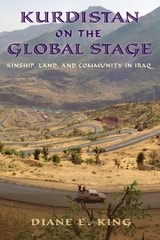
Kurdistan on the Global Stage
Kinship, Land, and Community in IraqKing, Diane E
Rutgers University Press, 2014
Anthropologist Diane E. King has written about everyday life in the Kurdistan Region of Iraq, which covers much of the area long known as Iraqi Kurdistan. Following the overthrow of Saddam Hussein’s Ba’thist Iraqi government by the United States and its allies in 2003, Kurdistan became a recognized part of the federal Iraqi system. The Region is now integrated through technology, media, and migration to the rest of the world.
Focusing on household life in Kurdistan’s towns and villages, King explores the ways that residents connect socially, particularly through patron-client relationships and as people belonging to gendered categories. She emphasizes that patrilineages (male ancestral lines) seem well adapted to the Middle Eastern modern stage and viceversa. The idea of patrilineal descent influences the meaning of refuge-seeking and migration as well as how identity and place are understood, how women and men interact, and how “politicking” is conducted.
In the new Kurdistan, old values may be maintained, reformulated, or questioned. King offers a sensitive interpretation of the challenges resulting from the intersection of tradition with modernity. Honor killings still occur when males believe their female relatives have dishonored their families, and female genital cutting endures. Yet, this is a region where modern technology has spread and seemingly everyone has a mobile phone. Households may have a startling combination of illiterate older women and educated young women. New ideas about citizenship coexist with older forms of patronage.
King is one of the very few scholars who conducted research in Iraq under extremely difficult conditions during the Saddam Hussein regime. How she was able to work in the midst of danger and in the wake of genocide is woven throughout the stories she tells. Kurdistan on the Global Stage serves as a lesson in field research as well as a valuable ethnography.