Results by title
338 books match the query 'Ethnology' and 2 start with k
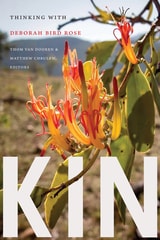
Kin
Thinking with Deborah Bird RoseThom van Dooren and Matthew Chrulew, editors
Duke University Press, 2022
The contributors to Kin draw on the work of anthropologist Deborah Bird Rose (1946–2018), a foundational voice in environmental humanities, to examine the relationships of interdependence and obligation between human and nonhuman lives. Through a close engagement over many decades with the Aboriginal communities of Yarralin and Lingara in northern Australia, Rose’s work explored possibilities for entangled forms of social and environmental justice. She sought to bring the insights of her Indigenous teachers into dialogue with the humanities and the natural sciences to describe and passionately advocate for a world of kin grounded in a profound sense of the connectivities and relationships that hold us together. Kin’s contributors take up Rose’s conceptual frameworks, often pushing academic fields beyond their traditional objects and methods of study. Together, the essays do more than pay tribute to Rose’s scholarship; they extend her ideas and underscore her ongoing critical and ethical relevance for a world still enduring and resisting ecocide and genocide.
Contributors. The Bawaka Collective, Matthew Chrulew, Colin Dayan, Linda Payi Ford, Donna Haraway, James Hatley, Owain Jones, Stephen Muecke, Kate Rigby, Catriona (Cate) Sandilands, Isabelle Stengers, Anna Tsing, Thom van Dooren, Kate Wright
Contributors. The Bawaka Collective, Matthew Chrulew, Colin Dayan, Linda Payi Ford, Donna Haraway, James Hatley, Owain Jones, Stephen Muecke, Kate Rigby, Catriona (Cate) Sandilands, Isabelle Stengers, Anna Tsing, Thom van Dooren, Kate Wright
[more]
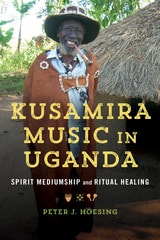
Kusamira Music in Uganda
Spirit Mediumship and Ritual HealingPeter J. Hoesing
University of Illinois Press, 2021
A performance culture of illness and wellness
In southern Uganda, ritual healing traditions called kusamira and nswezi rely on music to treat sickness and maintain well-being. Peter J. Hoesing blends ethnomusicological fieldwork with analysis to examine how kusamira and nswezi performance socializes dynamic processes of illness, wellness, and health. People participate in these traditions for reasons that range from preserving ideas to generating strategies that allow them to navigate changing circumstances. Indeed, the performance of kusamira and nswezi reproduces ideas that remain relevant for succeeding generations. Hoesing shows the potential of this social reproduction of well-being to shape development in a region where over 80 percent of the population relies on traditional healers for primary health care.
In southern Uganda, ritual healing traditions called kusamira and nswezi rely on music to treat sickness and maintain well-being. Peter J. Hoesing blends ethnomusicological fieldwork with analysis to examine how kusamira and nswezi performance socializes dynamic processes of illness, wellness, and health. People participate in these traditions for reasons that range from preserving ideas to generating strategies that allow them to navigate changing circumstances. Indeed, the performance of kusamira and nswezi reproduces ideas that remain relevant for succeeding generations. Hoesing shows the potential of this social reproduction of well-being to shape development in a region where over 80 percent of the population relies on traditional healers for primary health care.
Comprehensive and vivid with eyewitness detail, Kusamira Music in Uganda offers insight into important healing traditions and the overlaps between expressive culture and healing practices, the human and other-than-human, and Uganda's past and future.
[more]