Results by title
64 books match the query 'Georgia' and 3 start with k
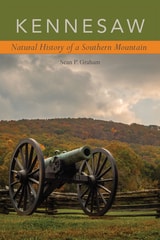
Kennesaw
Natural History of a Southern MountainSean P. Graham
University of Alabama Press, 2021
The first in-depth ecological treatment of one of the most frequently visited National Battlefield parks in the country.
Designated as a battlefield in 1917 and as a park in 1935, the 2,965-acre Kennesaw Mountain National Battlefield Park now preserves far more than the military history and fallen soldiers it was originally founded to commemorate. Featuring eighteen miles of interpretive trails looping around and over the mountain, the park is a popular destination for history buffs, outdoor recreationists, and nature enthusiasts alike. Located approximately twenty miles northwest of downtown Atlanta, Kennesaw Mountain rises 608 feet above the rolling hills and hardwood forests of the Georgia Piedmont. Kennesaw Mountain’s geology and topography create enough of a distinctive ecosystem to make it a haven for flora and fauna alike. As the tallest mountain in the metropolitan Atlanta area, it is also a magnet for human visitors.
Written for a diverse range of readers and park visitors, Kennesaw: Natural History of a Southern Mountain provides a comprehensive exploration of the entire park punctuated with humor, colorful anecdotes, and striking photographs of the landscape. Sean P. Graham begins with a brief summary of the park’s human history before transitioning to a discussion of the mountain’s nature, including its unique geology, vegetation, animals, and plant-animal interactions. Graham also focuses on Kennesaw Mountain’s most important ecological and conservation attribute—its status as a globally important bird refuge. An insightful chapter on bird watching and the region’s migrating bird populations includes details on migratory patterns, birding hot spots, and the mountain’s avian significance. An epilogue revisits the park’s Civil War history, describing how Union veterans pushed for establishment of the park as a memorial, inadvertently creating a priceless biological preserve in the process.
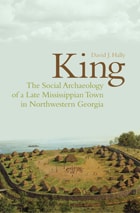
King
The Social Archaeology of a Late Mississippian Town in Northwestern GeorgiaDavid Hally
University of Alabama Press, 2008
At the time of Spanish contact in A.D. 1540, the Mississippian inhabitants of the great valley in northwestern Georgia and adjacent portions of Alabama and Tennessee were organized into a number of chiefdoms distributed along the Coosa and Tennessee rivers and their major tributaries. The administrative centers of these polities were large settlements with one or more platforms mounds and a plaza. Each had a large resident population, but most polity members lived in a half dozen or so towns located within a day’s walk of the center. This book is about one such town, located on the Coosa River in Georgia and known to archaeologists as the King site.
Excavations of two-thirds of the 5.1 acre King site reveal a detailed picture of the town’s domestic and public architecture and overall settlement plan. Intensive analysis of architectural features, especially of domestic structures, enables a better understanding of the variation in structure size, compass orientation, construction stages, and symbolic cosmological associations; the identification of multi-family households; and the position of individual structures within the town’s occupation sequence or life history. Comparison of domestic architecture and burials reveals considerable variation between households in house size, shell bead wealth, and prominence of adult members. One household is preeminent in all these characteristics and may represent the household of the town chief or his matrilineal extended family. Analysis of public architectural features has revealed the existence of a large meeting house with likely historical connections to 18th-century Creek town houses; a probable cosmological basis for the town’s physical layout; and an impressive stockade-and-ditch defensive perimeter.
The King site represents a nearly ideal opportunity to identify the kinds of status positions that were held by individual inhabitants; analyze individual households and investigate the roles they played in King site society; reconstruct the community that existed at King, including size, life history, symbolic associations, and integrative mechanisms; and place King in the larger regional political system. With excavations dating back to 1973, and supported in part by the National Endowment for the Humanities and the National Geographic Society, this is social archaeology at its best.
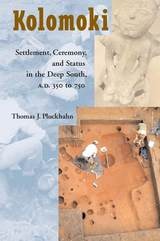
Kolomoki
Settlement, Ceremony, and Status in the Deep South, A.D. 350 to 750Thomas J. Pluckhahn
University of Alabama Press, 2003
A Dan Josselyn Memorial Publication
The first comprehensive and systematic investigation of a Woodland period ceremonial center.
Kolomoki, one of the most impressive archaeological sites in the southeastern United States, includes at least nine large earthen mounds in the lower Chattahoochee River valley of southwest Georgia. The largest, Mound A, rises approximately 20 meters above the terrace that borders it. From its flat-topped summit, a visitor can survey the string of smaller mounds that form an arc to the south and west.
Archaeological research had previously placed Kolomoki within the Mississippian period (ca. A.D. 1000-1500) primarily because of the size and form of the mounds. But this book presents data for the main period of occupation and mound construction that confirm an earlier date, in the Woodland period (ca. A.D. 350-750). Even though the long-standing confusion over Kolomoki’s dating has now been settled, questions remain regarding the lifeways of its inhabitants. Thomas Pluckhahn's research has recovered evidence concerning the level of site occupation and the house styles and daily lives of its dwellers. He presents here a new, revised history of Kolomoki from its founding to its eventual abandonment, with particular attention to the economy and ceremony at the settlement.
This study makes an important contribution to the understanding of middle range societies, particularly the manner in which ceremony could both level and accentuate status differentiation within them. It provides a readable overview of one of the most important but historically least understood prehistoric Native American sites in the United States.