Results by title
775 books match the query 'Germany' and 9 start with k
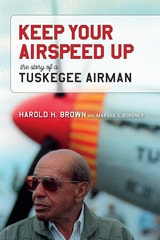
Keep Your Airspeed Up
The Story of a Tuskegee AirmanHarold H. Brown and Marsha S. Bordner
University of Alabama Press, 2017
Inspiring memoir of Colonel Harold H. Brown, one of the 930 original Tuskegee pilots, whose dramatic wartime exploits and postwar professional successes contribute to this extraordinary account.
Keep Your Airspeed Up: The Story of a Tuskegee Airman is the memoir of an African American man who, through dedication to his goals and vision, overcame the despair of racial segregation to great heights, not only as a military aviator, but also as an educator and as an American citizen.
Unlike other historical and autobiographical portrayals of Tuskegee airmen, Harold H. Brown’s memoir is told from its beginnings: not on the first day of combat, not on the first day of training, but at the very moment Brown realized he was meant to be a pilot. He revisits his childhood in Minneapolis where his fascination with planes pushed him to save up enough of his own money to take flying lessons. Brown also details his first trip to the South, where he was met with a level of segregation he had never before experienced and had never imagined possible.
During the 1930s and 1940s, longstanding policies of racial discrimination were called into question as it became clear that America would likely be drawn into World War II. The military reluctantly allowed for the development of a flight-training program for a limited number of African Americans on a segregated base in Tuskegee, Alabama. The Tuskegee Airmen, as well as other African Americans in the armed forces, had the unique experience of fighting two wars at once: one against Hitler’s fascist regime overseas and one against racial segregation at home.
Colonel Brown fought as a combat pilot with the 332nd Fighter Group during World War II, and was captured and imprisoned in Stalag VII A in Moosburg, Germany, where he was liberated by General George S. Patton on April 29, 1945. Upon returning home, Brown noted with acute disappointment that race relations in the United States hadn’t changed. It wasn’t until 1948 that the military desegregated, which many scholars argue would not have been possible without the exemplary performance of the Tuskegee Airmen.

Kibbutz Buchenwald
Survivors and PioneersJudith Tydor Baumel
Rutgers University Press, 1997
Kibbutz Buchenwald is the story of a nightmare that became a dream and a dream that became a reality. Emerging from the depths of the liberated concentration camp Buchenwald in the spring of 1945, a group of sixteen gaunt and battered young men organized and formed Kibbutz Buchenwald, the first agricultural collective in postwar Germany designed to prepare Jews for emigation to Palestine. What caused a handful of survivors to take their fate into their own hands within days of their liberation, at a time when most survivors were passively awaiting orders from the occupying forces? From what wellsprings did they draw the physical and emotional strength to begin life anew as Zionist pioneers in a world which had turned upside down?
Judith Baumel's moving account of this courageous group is divided into two parts. Part One, entitled "The Dream," examines the kibbutz from its creation in Germany until the departure of the founding group for Palestine in the summer of 1945. Part Two, "The Reality," follows the members of Kibbutz Buchenwald into Palestine, where they eventually established their own independent settlement in 1948. This settlement exists as Kibbutz Netzer Sereni today.
Drawing from the diaries of the kibbutz's founding members, Baumel provides a detailed account of an incredible story and places the central narrative in the larger contexts of communal living, European politics after the war, and the link between European Jewry and Israeli postwar nationhood. An afterword, "Where Are They Now," briefly describes the later life of each of the original kibbutz members.

Kinaesthetic Knowing
Aesthetics, Epistemology, Modern DesignZeynep Çelik Alexander
University of Chicago Press, 2017
In this book, Alexander offers the first major intellectual history of kinaesthetic knowing and its influence on the formation of modern art and architecture and especially modern design education. Focusing in particular on Germany and tracing the story up to the start of World War II, Alexander reveals the tension between intellectual meditation and immediate experience to be at the heart of the modern discourse of aesthetics, playing a major part in the artistic and teaching practices of numerous key figures of the period, including Heinrich Wölfflin, Hermann Obrist, August Endell, László Moholy-Nagy, and many others. Ultimately, she shows, kinaesthetic knowing did not become the foundation of the human sciences, as some of its advocates had hoped, but it did lay the groundwork—at such institutions as the Bauhaus—for modern art and architecture in the twentieth century.

Kingship and Justice in the Ottonian Empire
Laura E. Wangerin
University of Michigan Press, 2019
Scholars have recognized the importance of ritual and symbolic behaviors in the Ottonian political sphere, while puzzling over the apparent lack of administrative organization, a contradiction between what we know about the Ottonians as successful rulers and their traditional characterization as rulers of a disorganized polity. Trying to account for the apparent disparity between their political and military achievements, cultural and artistic efflorescence, and relative dynastic stability, which seemingly accompanied a disinterest in writing law or creating a centralized hierarchical administration, is a tension that persists in the scholarship. This book argues that far from being accidental successes or employing primitive methods of governance, the Ottonians were shrewd rulers and administrators who exploited traditional methods of conflict resolution and delegated jurisdictional authority to keep control over their vast empire. Thus, one of the important things that this book aims to accomplish is to challenge our preconceived notions of what successful government looks like.
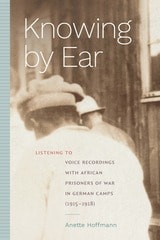
Knowing by Ear
Listening to Voice Recordings with African Prisoners of War in German Camps (1915–1918)Anette Hoffmann
Duke University Press, 2024
Knowledge Power And Discipline
German Studies And National IdentityPier Carlo Bontempelli
University of Minnesota Press, 2003
An essential critical history of German studies as an academic discipline
German Studies has confronted many crises, as well as severe criticism and self-criticism, and yet it has managed to maintain its disciplinary system through every upheaval—the revolution of 1848, the establishment of the Second Reich in 1871, the Weimar Republic, the Nazi Third Reich, the Second World War and the reconstruction era, the creation and reunification of the two German states. Pier Carlo Bontempelli focuses on this continuity, dating back to the early nineteenth century, when the “founding fathers” of Germanistik secured its status by grounding it in a set of fixed principles, revived by each successive generation of scholars in order to legitimize their position of power—and to ensure their capacity for cultural reproduction.
Using the works of Michel Foucault and Pierre Bourdieu, Bontempelli investigates the institution and principles of German Studies and critically reconstructs its history. Mindful of the mechanisms of choice and domination operating at every turn, his book exposes the repressed social and political history of German Studies.
Kracauer. Photographic Archive
Edited by Maria Zinfert
Diaphanes, 2014
Kracauer.Photographic Archive, a companion volume to The Past’s Threshold: Essays on Photography, collects previously unpublished photographs by Siegfried and Elisabeth, “Lili,” Kracauer. With its remarkably rich material, the book tells the story of the Kracauer’s close working relationship, from their marriage in Germany to their escape to Paris and the war and postwar years in the United States. While neither Kracauer nor his wife trained in photography, their portraits, city views, and landscapes evince impressive aesthetic and technical skill, while simultaneously shedding light on their lives marked by exile and flight.

Kurt Schwitters
Space, Image, ExileMegan R. Luke
University of Chicago Press, 2014

Kurt Wolff
A Portrait in Essays and LettersKurt Wolff
University of Chicago Press, 1991