Results by title
767 books match the query 'Hispanic & Latino Studies' and 4 start with k
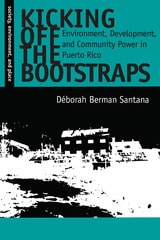
Kicking Off the Bootstraps
Environment, Development, and Community Power in Puerto RicoDéborah Berman Santana
University of Arizona Press, 1996
Kicking Off the Bootstraps is a powerful case history of such an effort. It describes a grassroots activist movement that emerged in the Puerto Rican community of Salinas to counter the poverty and economic dependence experienced by its citizens in the wake of "Operation Bootstrap," a post-World War II industrial development program. Déborah Berman Santana examines the efforts of the community to develop its own economic strategy based primarily on environmentally and socially responsible uses of local natural and human resources.
Berman Santana shows how local activists are seeking to empower the Salinas community to make decisions concerning economic development. She evaluates present-day efforts to develop positive alternatives, examining the motivations of the activists, the nature of their projects, their efforts to mobilize the community, their dealings with government and other organizations, and the obstacles they face. In a closing chapter, she addresses the potential roles of community leaders, outside activists, local businesses, and government in actualizing these alternatives.
A testimony to one community's efforts to determine its own future, Kicking Off the Bootstraps deals with real issues such as control over productive resources, quality of life, and environmental health. It also extends an examination of community-directed activism to an exploration of policy implications for sustainable development. While this concept is often too vague to be applied to real strategies, the Salinas experience provides a clear idea of what sustainable development can—and should—mean in actual practice.
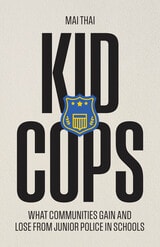
Kid Cops
What Communities Gain and Lose from Junior Police in SchoolsMai Thai
University of Chicago Press, 2026
Some might see police officers as benevolent sources of protection, but in many communities, they are often perceived as a threat due to a legacy of violent interactions and arrests for arbitrary offenses. How, then, do police sustain their presence in places where people might distrust them? In Kid Cops, sociologist Mai Thai offers one answer: junior police academies, high school programs in which police officers provide courses, mentorship, and job training to students in communities with high rates of juvenile delinquency and poverty. These school-police partnerships have expanded rapidly in the United States over the last few decades, largely in response to political unrest and police violence in the 1990s. Programs vary in their offerings, but they generally aim to ease tensions between communities and law enforcement, while also providing needed resources in neighborhoods where education and job opportunities are scarce.
Kid Cops draws on years of observations and interviews with educators, police officers, and, of course, kids. The junior police programs at each high school may have different emphases, but their common goal is for students to graduate from high school and enter college or the workforce. A second goal of the program is to cultivate a positive image of the police. Ultimately, however, Thai finds that these programs tighten the relationship between marginalized youth, schools, and the criminal justice system and strain the students’ relationships with their peers, families, and each other. These programs also distract residents from systemic issues of policing and suppress opportunities for meaningful change.
Written in an accessible tone that balances the seriousness of inequality with the playfulness of the study’s youth, Kid Cops moves beyond the narrative of detentions, suspensions, and arrests to tell a less conventional story about police in schools. It asks, does good, friendly policing exist—especially if it continues to tether low-income communities of color to the criminal justice system?
Killer Crónicas
Bilingual MemoriesSusana Chavez-Silverman
University of Wisconsin Press, 2004
Includes a chapter that was awarded first prize in El Andar magazine’s Chicano Literary Excellence Contest in the category of personal memoir.
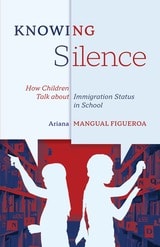
Knowing Silence
How Children Talk about Immigration Status in SchoolAriana Mangual Figueroa
University of Minnesota Press, 2024
Learning from children about citizenship status and how it shapes their schooling
There is a persistent assumption in the field of education that children are largely unaware of their immigration status and its implications. In Knowing Silence, Ariana Mangual Figueroa challenges this “myth of ignorance.” By listening carefully to both the speech and significant silences of six Latina students from mixed-immigration-status families, from elementary school into middle school and beyond, she reveals the complex ways young people understand and negotiate immigration status and its impact on their lives.
Providing these children with iPod Touches to record their own conversations, Mangual Figueroa observes when and how they choose to talk about citizenship at home, at school, and in public spaces. Analyzing family conversations about school forms, in-class writing assignments, encounters with the police, and applications for college, she demonstrates that children grapple with the realities of citizenship from an early age. Educators who underestimate children’s knowledge, Mangual Figueroa shows, can marginalize or misunderstand these students and their families.
Combining significant empirical findings with reflections on the ethical questions surrounding research and responsibility, Mangual Figueroa models new ways scholars might collaborate with educators, children, and families. With rigorous and innovative ethnographic methodologies, Knowing Silence makes audible the experiences of immigrant-origin students in their own terms, ultimately offering teachers and researchers a crucial framework for understanding citizenship in the contemporary classroom.