Results by title
71 books match the query 'Human beings' and 2 start with k
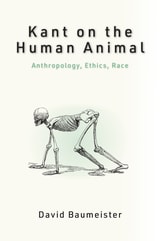
Kant on the Human Animal
Anthropology, Ethics, RaceDavid Baumeister
Northwestern University Press, 2022
While Immanuel Kant’s account of human reason is well known and celebrated, his account of human animality (Thierheit) is virtually unknown. Animality and reason, as pillars of Kant’s vision of human nature, are original and ineradicable. And yet, the relation between them is fraught: at times tense and violent, at other times complementary, even harmonious. Kant on the Human Animal offers the first systematic analysis of this central but neglected dimension of Kant’s philosophy.
David Baumeister tracks four decades of Kant’s intellectual development, surveying works published in Kant’s lifetime along with posthumously published notes and student lecture transcripts. They show the crucial role that animality plays in many previously unconnected areas of Kant’s thought, such as his account of the human’s originally quadrupedal posture, his theory of early childhood development, and his conception of the process of human racial differentiation. Beginning with a delineation of Kant’s understanding of the commonalities and differences between humans and other animals, Baumeister focuses on the contribution of animality to Kant’s views of ethics, anthropology, human nature, and race.
Placing divergent features of Kant’s thought within a unified interpretive framework, Kant on the Human Animal reveals how, for Kant, becoming human requires that animality not be eclipsed and overcome but rather disciplined and developed. What emerges is a new appreciation of Kant’s human being as the human animal it is.
[more]
Knowing as Moving
Perception, Memory, and PlaceSusan Leigh Foster
Duke University Press, 2025
In Knowing as Moving, Susan Leigh Foster theorizes how the act of moving in and through the world creates the potential for individual and collective bodies to connect. Starting from the assertion that knowing takes place through bodily movement, Foster moves away from the Western philosophical traditions of dance, critiquing the Cartesian mind-body duality and its colonizing politics. She draws on Native and Indigenous studies, ecological cognitive science, disability studies, phenomenology, and new materialism to explore how knowledge is neither static nor storable. Thinking is a physical action and the product of an entire neuromuscular system with its mobile postural and gestural configurations, perceptual systems, and brain activity. Foster outlines how reading, examining, talking, and remembering are all forms of moving and contends that any process of knowing establishes one’s identity and relationality. By focusing on the centrality of bodily movement to thought and self, she contributes a decolonial critique of the study of knowledge and being. In so doing, Foster replaces the Cartesian-colonial “I think, therefore I am” with a decolonial “I move, and therefore I know.”
[more]