Results by title
409 books match the query 'Human geography' and 5 start with k

Kanaka Hawai'i Cartography
Hula, Navigation, and OratoryRenee Pualani Louis
Oregon State University Press, 2017
Hawai'ian performance cartography is an interactive presentation of place as ‘experienced space’ that situates mapping in the environment, and encodes spatial knowledge into bodily memory via repetitive recitations and other habitual practices.
An important symbolic element in Hawai'ian cartography is the storied place name, which reflects Hawai'ian spatial knowledge of the environment. Many Hawai'ian place names performed in daily rituals were a conscious act of locating genealogical connections, recreating cultural landscapes, and regenerating cultural mores. They constitute a critically important body of Hawai'ian cultural knowledge. When Hawai'ian place names were incorporated into Western cartographic maps they were transformed epistemologically. They went from representing place as a repository of cultural knowledge to representing place as an object on the landscape. Hawai'ian spatial knowledge presentation is interactive, multi-sensual, and multi‐ dimensional.
Kanaka Hawai'i Cartography interweaves methodology with personal narrative and performance presentation in a playbill format. Three of the seven chapters are presented as “Acts” in a play. The remaining four chapters serve as intermissions or interludes together with a prologue and an epilogue for setting the stage and providing closure. To help make the topic more accessible, complex terms have been minimized, making academic theory easier for the educated reader to understand. The book will fill an important gap in Indigenous and Native Studies and will be welcomed by anyone interested in traditional Hawai’ian performance cartography.
[more]

Karnali Under Stress
Livelihood Strategies and Seasonal Rhythms in a Changing Nepal HimalayaBarry C. Bishop
University of Chicago Press, 1990
[more]

Kin
Thinking with Deborah Bird RoseThom van Dooren and Matthew Chrulew, editors
Duke University Press, 2022
The contributors to Kin draw on the work of anthropologist Deborah Bird Rose (1946–2018), a foundational voice in environmental humanities, to examine the relationships of interdependence and obligation between human and nonhuman lives. Through a close engagement over many decades with the Aboriginal communities of Yarralin and Lingara in northern Australia, Rose’s work explored possibilities for entangled forms of social and environmental justice. She sought to bring the insights of her Indigenous teachers into dialogue with the humanities and the natural sciences to describe and passionately advocate for a world of kin grounded in a profound sense of the connectivities and relationships that hold us together. Kin’s contributors take up Rose’s conceptual frameworks, often pushing academic fields beyond their traditional objects and methods of study. Together, the essays do more than pay tribute to Rose’s scholarship; they extend her ideas and underscore her ongoing critical and ethical relevance for a world still enduring and resisting ecocide and genocide.
Contributors. The Bawaka Collective, Matthew Chrulew, Colin Dayan, Linda Payi Ford, Donna Haraway, James Hatley, Owain Jones, Stephen Muecke, Kate Rigby, Catriona (Cate) Sandilands, Isabelle Stengers, Anna Tsing, Thom van Dooren, Kate Wright
Contributors. The Bawaka Collective, Matthew Chrulew, Colin Dayan, Linda Payi Ford, Donna Haraway, James Hatley, Owain Jones, Stephen Muecke, Kate Rigby, Catriona (Cate) Sandilands, Isabelle Stengers, Anna Tsing, Thom van Dooren, Kate Wright
[more]
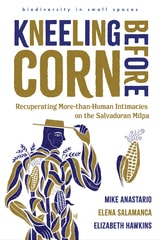
Kneeling Before Corn
Recuperating More-than-Human Intimacies on the Salvadoran MilpaMike Anastario, Elena Salamanca, and Elizabeth Hawkins
University of Arizona Press, 2024
The cultivation of the three sisters (corn, beans, and squash) on subsistence farms in El Salvador is a multispecies, world-making, and ongoing process. Milpa describes a small subsistence corn farm. It is derived from the word milli (‘field’, or a piece of land under active cultivation) in Nahuatl. The milpa is a farming practice that uses perennial, intercropping, and swidden (fire and fallow) techniques that predates the Spanish conquest of the Americas.
Kneeling Before Corn focuses on the intimate relations that develop between plants and humans in the milpas of the northern rural region of El Salvador. It explores the ways in which more-than-human intimacies travel away from and return to the milpa through human networks.
Collective and multivocal, this work reflects independent lines of investigation and multiple conversations between co-authors—all of whom have lived in El Salvador for extended periods of time. Throughout the six chapters, the co-authors invite readers to consider more-than-human intimacies by rethinking, experimenting with, and developing new ways of documenting, analyzing, and knowing the intimacies that form between humans and the plants that they cultivate, conserve, long for, and eat. This book offers an innovative account of rural El Salvador in the twenty-first century.
[more]

Kohler’s Company Town
Histories of Place and Space in a Working-Class CommunityKathryn J. Oberdeck, edited by James R. Barrett, Antoinette Burton, and William A. Munro
University of Illinois Press, 2027
Built in 1916 as a model company town, Kohler, Wisconsin, exemplified how industrial change reshaped space, work, and community in the United States. Kathryn J. Oberdeck traces how today’s popular resort town evolved from the tensions arising from the nexus of corporate planning, worker action, and gendered class conflict.
Walter J. Kohler’s vision of a model industrial town collided with increasingly restive workers—women among them—who challenged the company over the meaning of community. The leaders of Kohler Village devised a plan for individual homes that met the global standards of domestic hygiene the company promoted. At the same time, workers, managers, and residents debated issues across intersecting social divisions during village development, bitter labor struggles, political battles, geographic changes, and shifts in the global market economy. Throughout, Oberdeck’s analysis illuminates the dynamism of space and spatial relationships by delving into how people create, contest, and redefine places through work, family life, and political struggle.
The surprising backstory of a Midwest institution, Kohler’s Company Town explores how working men and women shaped their village’s transformation while adapting to the wider world.
[more]