517 books match the query 'In literature' and 3 start with k

cover of Kafka’s Blues: Figurations of Racial Blackness in the Construction of an Aesthetic

Kafka’s Blues

Figurations of Racial Blackness in the Construction of an Aesthetic

Mark Christian Thompson

Northwestern University Press, 2016

Kafka's Blues proves the startling thesis that many of Kafka's major works engage in a coherent, sustained meditation on racial transformation from white European into what Kafka refers to as the "Negro" (a term he used in English). Indeed, this book demonstrates that cultural assimilation and bodily transformation in Kafka's work are impossible without passage through a state of being "Negro." Kafka represents this passage in various ways—from reflections on New World slavery and black music to evolutionary theory, biblical allusion, and aesthetic primitivism—each grounded in a concept of writing that is linked to the perceived congenital musicality of the "Negro," and which is bound to his wider conception of aesthetic production. Mark Christian Thompson offers new close readings of canonical texts and undervalued letters and diary entries set in the context of the afterlife of New World slavery and in Czech and German popular culture.
[more]
cover of Kafu the Scribbler: The Life and Writings of Nagai Kafu, 1897–1959

Kafu the Scribbler

The Life and Writings of Nagai Kafu, 1897–1959

Edward Seidensticker

University of Michigan Press, 1990
Kafū the Scribbler is neither pure biography nor pure criticism nor yet a pure anthology, but a blending of the three. It is an introduction to Nagai Kafū and his city, accompanied by a fairly generous sampling from his works. Marleigh Ryan writes:
“In this book Edward Seidensticker presents a unique combination of biography and literary criticism by skillfully interweaving details of the life of Nagai Kafū with studies of his writing. With quotations of from Kafū’s fiction and nonfiction alike, Seidensticker is able to reconstruct many incidents in the author’s life which had previously been little understood. The latter half of the book is given over to translations of short stories and to selections from two novels and a journal. Seidensticker has thoughtfully given cross references to the material in both parts of the book which enable the reader to handle this wealth of material with some dexterity.
“Seidensticker’s skill as a translator is so well established that it seems almost unnecessary to comment on it further here but one cannot help being impressed by his rendering of Kafū’s lyrical style. As we realize when reading the critical material, there is remarkably little plot or character development in Kafū’s fiction. His position as leading modern writer is dependent to a considerable degree upon the beauty and grace of his style, and we are fortunate indeed to have such masterful translations as these to convey that style.”*
*Ryan, Marleigh. Journal of the American Oriental Society 88, no. 3 (1968): 624. doi:10.2307/596924.
[more]
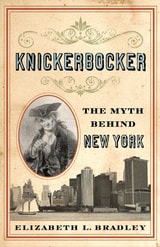
cover of Knickerbocker: The Myth behind New York

Knickerbocker

The Myth behind New York

Bradley, Elizabeth L

Rutgers University Press, 2009

Deep within New York's compelling, sprawling history lives an odd, ornery Manhattan native named Diedrich Knickerbocker. The name may be familiar today: his story gave rise to generations of popular tributes—from a beer brand to a basketball team and more—but Knickerbocker himself has been forgotten. In fact, he was New York's first truly homegrown chronicler, and as a descendant of the Dutch settlers, he singlehandedly tried to reclaim the city for the Dutch. Almost singlehandedly, that is. Diedrich Knickerbocker was created in 1809 by a young Washington Irving, who used the character to narrate his classic satire, A History of New York. According to Irving's partisan narrator, everything good and distinctive, proud and powerful, about New York City—from the doughnuts to the twisting streets of lower Manhattan—could be traced back to New Amsterdam. Terrific general interest, cultural history of a city with a rich and lively literary past. First-ever book on the eponymous myth that has informed New York City culture since the early 1800s. Coincides with the two-hundredth anniversary of Washington Irving's publication of A History of New York. Perfect gift book or addition to library collection of New York Cityùthemed books.

Includes a gallery of images that brings Diedrich Knickerbocker, his myth, time, and place to life Knickerbocker engagingly traces the creation, evolution, and prevalence of Irving's imaginary historian in New York literature and history, art and advertising, from the early nineteenth century to the present day. Who would imagine this satiric character, at once a snob and a champion of the people, would endure for two hundred years? In Elizabeth L. Bradley's words, "Whether you call it 'blood,' style, attitude, or moxie, the little Dutchman could deliver." And, from this engaging work, it is clear that he does.

Bradley's stunning volume offers a surprising and delightful glimpse behind the scenes of New York history, and invites readers into the world of Knickerbocker, the antihero who surprised everyone by becoming the standard-bearer for the city's exceptional sense of self, or what we now call a New York "attitude."

[more]