Results by title
456 books match the query 'India' and 4 start with k
Kaleidoscopic Ethnicity
International Migration and the Reconstruction of Community Identities in IndiaKurien, Prema A
Rutgers University Press, 2002
Co-Winner of the 2003 American Sociological Association's Asia/Asian American book award.
Based on ethnographic research in three communities (Ezhava Hindu, Mappila Muslim, and Syrian Christian) in Kerala, India, which sent large numbers of workers to the Middle East for temporary jobs, Kaleidoscopic Ethnicity explores the factors responsible for the striking differences in the groups’ patterns of migration and migration-induced social change. Most broadly, Prema Kurien seeks to understand what ethnicity is and how it affects people’s activities and decisions. She argues that, in each case, a community-specific nexus of religion, gender, and status shaped migration, and was, in turn, transformed by it.
The religious background of the three groups determined their social location within colonial and postcolonial Kerala. This social location in turn affected their occupational profiles, family structures, and social networks, as well as their conceptions of gender and honor, and thus was fundamental in shaping migration patterns. The rapid enrichment brought about by international migration resulted in a reinterpretation of religious identity and practice which was manifested by changes in patterns of gendered behavior and status in each of the three communities. What makes this book unique is its focus on the sociocultural patterns of short-term international migration and its comparative ethnographic approach.
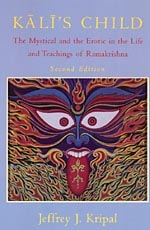
Kali's Child
The Mystical and the Erotic in the Life and Teachings of RamakrishnaJeffrey J. Kripal
University of Chicago Press, 1998
In a substantial new preface to this second edition, Kripal answers his critics, addresses the controversy the book has generated in India, and traces the genealogy of his work in the history of psychoanalytic discourse on mysticism, Hinduism, and Ramakrishna himself. Kali's Child has already proven to be provocative, groundbreaking, and immensely enjoyable.
"Only a few books make such a major contribution to their field that from the moment of publication things are never quite the same again. Kali's Child is such a book."—John Stratton Hawley, History of Religions
Winner of the American Academy of Religion's History of Religions Prize for the Best First Book of 1995

Kali's Child
The Mystical and the Erotic in the Life and Teachings of RamakrishnaJeffrey J. Kripal
University of Chicago Press, 1995
In this work, Jeffrey J. Kripal attempts to untangle the paradox. He demonstrates that Ramakrishna's famous mystical experiences were driven by erotic energies that he neither fully accepted nor understood; the key to understanding this extraordinary figure, Kripal argues, lies in Tantra and its ritual, symbolic, and doctrinal equation of the mystical and the erotic.
Moving through Ramakrishna's world both chronologically and conceptually, Kali's Child employs two complementary interpretive strategies, a nuanced phenomenological reinterpretation of original Bengali texts and a nonreductive psychoanalytic reading of Ramakrishna's mystical eroticism. Kripal shows how the heterosexual structure of Tantric symbolism, the abusive way its rituals were often forced upon the saint, and Ramakrishna's own homosexual desires all came together to produce in him profound feelings of shame, disgust, and fear. Kripal establishes that the homosexuality of this great, if unwilling, Tantric mystic is linked inextricably to virtually every aspect of his life and teachings.
Kinship and History in South Asia
Four LecturesThomas R. Trautmann, Editor
University of Michigan Press, 1974