Results by title
338 books match the query 'Indigenous Studies' and 4 start with k
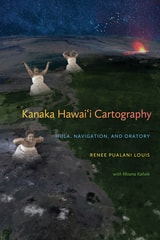
Kanaka Hawai'i Cartography
Hula, Navigation, and OratoryRenee Pualani Louis
Oregon State University Press, 2017
Hawai'ian performance cartography is an interactive presentation of place as ‘experienced space’ that situates mapping in the environment, and encodes spatial knowledge into bodily memory via repetitive recitations and other habitual practices.
An important symbolic element in Hawai'ian cartography is the storied place name, which reflects Hawai'ian spatial knowledge of the environment. Many Hawai'ian place names performed in daily rituals were a conscious act of locating genealogical connections, recreating cultural landscapes, and regenerating cultural mores. They constitute a critically important body of Hawai'ian cultural knowledge. When Hawai'ian place names were incorporated into Western cartographic maps they were transformed epistemologically. They went from representing place as a repository of cultural knowledge to representing place as an object on the landscape. Hawai'ian spatial knowledge presentation is interactive, multi-sensual, and multi‐ dimensional.
Kanaka Hawai'i Cartography interweaves methodology with personal narrative and performance presentation in a playbill format. Three of the seven chapters are presented as “Acts” in a play. The remaining four chapters serve as intermissions or interludes together with a prologue and an epilogue for setting the stage and providing closure. To help make the topic more accessible, complex terms have been minimized, making academic theory easier for the educated reader to understand. The book will fill an important gap in Indigenous and Native Studies and will be welcomed by anyone interested in traditional Hawai’ian performance cartography.
[more]
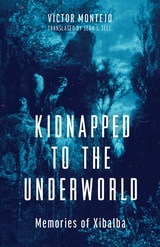
Kidnapped to the Underworld
Memories of XibalbaVíctor Montejo; Translated by Sean S. Sell
University of Arizona Press, 2024
Víctor Montejo’s story recounts the near-death experience of his grandfather, Antonyo Mekel Lawuxh (Antonio Esteban), who fell gravely ill in Guatemala in the late 1920s but survived to tell his family and community what he had witnessed of the afterlife.
Narrated from Antonio’s perspective, the reader follows along on a journey to the Maya underworld of Xibalba, accompanied by two spirit guides. Antonio traverses Xibalba’s levels of heaven and hell, encountering instructive scenes of punishment and reward: in one chapter, conquistadors are perpetually submerged in a pool of their victims’ blood; in another, the souls of animal abusers are forever unable to cross a crocodile-infested river. Infused with memory, the author illustrates Guatemala’s unique religious syncretism, exploring conceptions of heaven and hell shared between Catholicism and Indigenous Maya spirituality. In the tradition of both the Popol Vuh and the Divine Comedy, Montejo’s narrative challenges easy categorization—this is a work of family history, religious testimony, political allegory, and sacred literature.
Narrated from Antonio’s perspective, the reader follows along on a journey to the Maya underworld of Xibalba, accompanied by two spirit guides. Antonio traverses Xibalba’s levels of heaven and hell, encountering instructive scenes of punishment and reward: in one chapter, conquistadors are perpetually submerged in a pool of their victims’ blood; in another, the souls of animal abusers are forever unable to cross a crocodile-infested river. Infused with memory, the author illustrates Guatemala’s unique religious syncretism, exploring conceptions of heaven and hell shared between Catholicism and Indigenous Maya spirituality. In the tradition of both the Popol Vuh and the Divine Comedy, Montejo’s narrative challenges easy categorization—this is a work of family history, religious testimony, political allegory, and sacred literature.
[more]
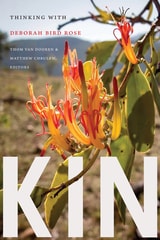
Kin
Thinking with Deborah Bird RoseThom van Dooren and Matthew Chrulew, editors
Duke University Press, 2022
The contributors to Kin draw on the work of anthropologist Deborah Bird Rose (1946–2018), a foundational voice in environmental humanities, to examine the relationships of interdependence and obligation between human and nonhuman lives. Through a close engagement over many decades with the Aboriginal communities of Yarralin and Lingara in northern Australia, Rose’s work explored possibilities for entangled forms of social and environmental justice. She sought to bring the insights of her Indigenous teachers into dialogue with the humanities and the natural sciences to describe and passionately advocate for a world of kin grounded in a profound sense of the connectivities and relationships that hold us together. Kin’s contributors take up Rose’s conceptual frameworks, often pushing academic fields beyond their traditional objects and methods of study. Together, the essays do more than pay tribute to Rose’s scholarship; they extend her ideas and underscore her ongoing critical and ethical relevance for a world still enduring and resisting ecocide and genocide.
Contributors. The Bawaka Collective, Matthew Chrulew, Colin Dayan, Linda Payi Ford, Donna Haraway, James Hatley, Owain Jones, Stephen Muecke, Kate Rigby, Catriona (Cate) Sandilands, Isabelle Stengers, Anna Tsing, Thom van Dooren, Kate Wright
Contributors. The Bawaka Collective, Matthew Chrulew, Colin Dayan, Linda Payi Ford, Donna Haraway, James Hatley, Owain Jones, Stephen Muecke, Kate Rigby, Catriona (Cate) Sandilands, Isabelle Stengers, Anna Tsing, Thom van Dooren, Kate Wright
[more]
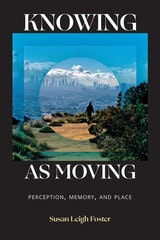
Knowing as Moving
Perception, Memory, and PlaceSusan Leigh Foster
Duke University Press, 2025
In Knowing as Moving, Susan Leigh Foster theorizes how the act of moving in and through the world creates the potential for individual and collective bodies to connect. Starting from the assertion that knowing takes place through bodily movement, Foster moves away from the Western philosophical traditions of dance, critiquing the Cartesian mind-body duality and its colonizing politics. She draws on Native and Indigenous studies, ecological cognitive science, disability studies, phenomenology, and new materialism to explore how knowledge is neither static nor storable. Thinking is a physical action and the product of an entire neuromuscular system with its mobile postural and gestural configurations, perceptual systems, and brain activity. Foster outlines how reading, examining, talking, and remembering are all forms of moving and contends that any process of knowing establishes one’s identity and relationality. By focusing on the centrality of bodily movement to thought and self, she contributes a decolonial critique of the study of knowledge and being. In so doing, Foster replaces the Cartesian-colonial “I think, therefore I am” with a decolonial “I move, and therefore I know.”
[more]