Results by title
130 books match the query 'Indonesia' and 5 start with k

Karawitan
Source Readings in Javanese Gamelan and Vocal Music, Volume 1Edited by Judith Becker with assistance from Alan H. Feinstein
University of Michigan Press, 1984
The twentieth century has spawned a great interest in Indonesian music, and now books, articles, and manuscripts can be found that expound exclusively about karawitan (the combined vocal and instrumental music of the gamelan). Scholar Judith Becker has culled several key sources on karawitan into three volumes and has translated them for the benefit of the Western student of the gamelan tradition.
The texts in her collection were written over a forty-five-year time period (ca 1930–1975) and include articles by Martopangrawit, Sumarsam, Sastrapustaka, Gitosaprodjo, Sindoesawarno, Poerbapangrawit, Probohardjono, Warsadiningrat, Purbodiningrat, Poerbatjaraka, and Paku Buwana X. The final volume also contains a glossary of technical terms, an appendix of the Javanese cipher notations (titilaras kepatihan), a biographical listing, and an index to the musical pieces (Gendhing).
[more]
Karawitan
Source Readings in Javanese Gamelan and Vocal Music, Volume 2Edited by Judith Becker with assistance from Alan H. Feinstein
University of Michigan Press, 1987
The twentieth century has spawned a great interest in Indonesian music, and now books, articles, and manuscripts can be found that expound exclusively about karawitan (the combined vocal and instrumental music of the gamelan). Scholar Judith Becker has culled several key sources on karawitan into three volumes and has translated them for the benefit of the Western student of the gamelan tradition.
The texts in her collection were written over a forty-five-year time period (ca 1930–1975) and include articles by Martopangrawit, Sumarsam, Sastrapustaka, Gitosaprodjo, Sindoesawarno, Poerbapangrawit, Probohardjono, Warsadiningrat, Purbodiningrat, Poerbatjaraka, and Paku Buwana X. The final volume also contains a glossary of technical terms, an appendix of the Javanese cipher notations (titilaras kepatihan), a biographical listing, and an index to the musical pieces (Gendhing).
[more]
Kebalian
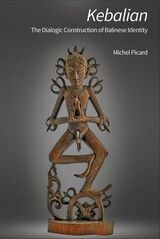
The Dialogic Construction of Balinese IdentityMichel Picard
National University of Singapore Press, 2024
An investigation into the complex forces that shape Balinese identity.
Over the past one hundred years, the Balinese have been challenged by colonial occupation, political turbulence, and, most recently, tourism. In response, they have come to rely on the idea of “Kebalian,” or Balinese-ness. Kebalian is likened to a tree whose roots are religion (agama), the trunk is tradition (adat), and the fruits, Balinese culture (budaya). To understand how this sense of Balinese-ness came to be, Michel Picard examines the dialogues that the Balinese have engaged in both among themselves and with outsiders by conducting over a hundred interviews with Balinese opinion leaders, officials, and religious reformers. A key throughline in the construction of Kebalian is what Picard identifies as a twofold process of “religionization” and “Hinduization.” This process began with the first years of the incorporation of Bali into the Dutch East Indies and became more urgent with Indonesia’s independence. Kebalian today encompasses the tension between those Balinese eager to defend their customary ritual practices and advocates of Hinduism who deny that such local traditions qualify as agama. Kebalian presents a fascinating picture of religious change, identities in motion, and culture. Scholars of religion, cultural change, and Southeast Asian area studies will find this to be a fascinating and important book.
Over the past one hundred years, the Balinese have been challenged by colonial occupation, political turbulence, and, most recently, tourism. In response, they have come to rely on the idea of “Kebalian,” or Balinese-ness. Kebalian is likened to a tree whose roots are religion (agama), the trunk is tradition (adat), and the fruits, Balinese culture (budaya). To understand how this sense of Balinese-ness came to be, Michel Picard examines the dialogues that the Balinese have engaged in both among themselves and with outsiders by conducting over a hundred interviews with Balinese opinion leaders, officials, and religious reformers. A key throughline in the construction of Kebalian is what Picard identifies as a twofold process of “religionization” and “Hinduization.” This process began with the first years of the incorporation of Bali into the Dutch East Indies and became more urgent with Indonesia’s independence. Kebalian today encompasses the tension between those Balinese eager to defend their customary ritual practices and advocates of Hinduism who deny that such local traditions qualify as agama. Kebalian presents a fascinating picture of religious change, identities in motion, and culture. Scholars of religion, cultural change, and Southeast Asian area studies will find this to be a fascinating and important book.
[more]
Kinship in Bali
Hildred Geertz and Clifford Geertz
University of Chicago Press, 1978
This work constitutes the first book-length examination of Balinese kinship in English and an important theoretical analysis of the central ethnographic concept of "kinship system." Hildred and Clifford Geertz's findings challenge the prevailing anthropological notion of a kinship system as an autonomous set of institutionalized social relationships. Their research in Bali suggests that kinship cannot be studied in isolation but must be perceived as a symbolic subsystem governed by ideas and beliefs unique to each culture.
[more]
Knowing Music, Making Music
Javanese Gamelan and the Theory of Musical Competence and InteractionBenjamin Brinner
University of Chicago Press, 1995
How do musicians know what they know? This study is a new approach to the nature of musical competence. Using the intricate collaborative structure of gamelan—Javanese ensemble music—as a point of departure, Knowing Music, Making Music lays the foundation for a comprehensive theory of musical competence and interaction.
Using illustrative examples from a variety of traditions, Benjamin Brinner first examines the elements and characteristics of musical competence, the different kinds of competence in a musical community, the development of multiple competences, and the acquisition and transformation of competence through time. He then shows how these factors come into play in musical interaction, establishing four intersecting theoretical perspectives based on ensemble roles, systems of communication, sound structures, and individual motivations. These perspectives are applied to the dynamics of gamelan performance to explain the social, musical, and contextual factors that affect the negotiation of consensus in musical interaction. The discussion ranges from sociocultural norms of interpersonal conduct to links between music, dance, theater, and ritual, and from issues of authority and deference to musicians' self-perceptions and mutual assessments.
Much more than a portrait of artists making music together, this book brings together a variety of cognitive approaches and a wide range of examples from many cultures to suggest ways of integrating our knowledge of music making both in individual cultures and crossculturally.
[more]