Results by title
751 books match the query 'International Relations' and 4 start with k
Kant's International Relations
The Political Theology of Perpetual PeaceSeán Molloy
University of Michigan Press, 2017
Why does Immanuel Kant (1724–1804) consistently invoke God and Providence in his most prominent texts relating to international politics? In this wide-ranging study, Seán Molloy proposes that texts such as Idea for a Universal History with Cosmopolitan Intent and Toward Perpetual Peace cannot be fully understood without reference to Kant’s wider philosophical projects, and in particular the role that belief in God plays within critical philosophy and Kant’s inquiries into anthropology, politics, and theology. Molloy’s broader view reveals the political-theological dimensions of Kant’s thought as directly related to his attempts to find a new basis for metaphysics in the sacrifice of knowledge to make room for faith.This book is certain to generate controversy. Kant is hailed as “the greatest of all theorists” in the field of International Relations (IR); in particular, he has been acknowledged as the forefather of Cosmopolitanism and Democratic Peace Theory. Yet, Molloy charges that this understanding of Kant is based on misinterpretation, neglect of particular texts, and failure to recognize Kant’s ambivalences and ambiguities. Molloy’s return to Kant’s texts forces devotees of Cosmopolitanism and other ‘Kantian’ schools of thought in IR to critically assess their relationship with their supposed forebear: ultimately, they will be compelled to seek different philosophical origins or to find some way to accommodate the complexity and the decisively nonsecular aspects of Kant’s ideas.
[more]
Kenya's Engagement with China
Discourse, Power, and AgencyAnita Plummer
Michigan State University Press, 2022
In recent decades, Kenya has witnessed profound changes in its economic, cultural, and environmental landscapes resulting from its interactions with China. University students are competing for scholarships to study in China, coastal artisanal fishers are increasingly worried about Chinese-owned trawlers depleting fish stocks, fishers on Lake Victoria are grappling with the impact of frozen tilapia from China, and unemployed youth are seeking a fair shot at working on one of Kenya’s multimillion-dollar Chinese-funded infrastructure projects. Anita Plummer’s Kenya’s Engagement with China investigates the tension between official Kenyan and Chinese state narratives and individual Kenyans’ reactions to China’s presence to provide insight into how everyday Kenyans exercise their political agency. The competing discourses Plummer uncovers in person, in the news, and online reveal how Kenyans use China to question local power structures, demand policy change, and articulate different visions for their country’s future. This critical text represents the next step in research on Sino-African relations.
[more]
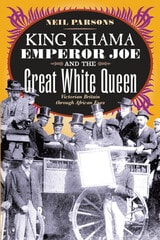
King Khama, Emperor Joe, and the Great White Queen
Victorian Britain through African EyesNeil Parsons
University of Chicago Press, 1997
In 1895 three African chiefs, dressed in the finest British clothing available, began a tour of the British Isles. That tour foiled Cecil Rhodes' grand plan for Africa and culminated in the Chamberlain Settlement, the document that indirectly led to the independence of present-day Botswana. King Khama, Emperor Joe, and the Great White Queen is the story of this bizarre journey, one of the most neglected events in British Victorian history, here revealed for the first time in its full detail and cultural complexity.
The chiefs initially went to England to persuade Queen Victoria not to give their lands to ruthless Rhodes and his British South Africa Company. Abandoned by the Secretary of State for the Colonies, Joseph Chamberlain, and denied an audience with the queen, the three rulers decided to tour the British Isles to plead their case to the populace. Appealing to the middle-class morality of Victorian society, the chiefs were remarkably successful in gaining support, eventually swaying Chamberlain into drafting the agreement that secured their territories against the encroachment of Rhodesia.
Historian Neil Parsons has reconstructed this journey with the help of African archival materials and news clippings from British papers, garnered from the clippings service the chiefs had the foresight to employ. In equal parts narrative of pilgrimage, voyage of discovery, and colonial resistance, King Khama, Emperor Joe, and the Great White Queen provides a view from the other side of colonialism and imperialism. It demonstrates the nuances of cultural and religious interaction between Africans and Europeans, and it does so with the richness and depth of a fully realized novel.
[more]
Knowledge Flows in a Global Age
A Transnational ApproachEdited by John Krige
University of Chicago Press, 2022
A transnational approach to understanding and analyzing knowledge circulation.
The contributors to this collection focus on what happens to knowledge and know-how at national borders. Rather than treating it as flowing like currents across them, or diffusing out from center to periphery, they stress the human intervention that shapes how knowledge is processed, mobilized, and repurposed in transnational transactions to serve diverse interests, constraints, and environments. The chapters consider both what knowledge travels and how it travels across borders of varying permeability that impede or facilitate its movement. They look closely at a variety of platforms and objects of knowledge, from tangible commodities—like hybrid wheat seeds, penicillin, Robusta coffee, naval weaponry, seed banks, satellites and high-performance computers—to the more conceptual apparatuses of plant phenotype data and statistics. Moreover, this volume decenters the Global North, tracking how knowledge moves along multiple paths across the borders of Mexico, India, Portugal, Guinea-Bissau, the Soviet Union, China, Angola, Palestine and the West Bank, as well as the United States and the United Kingdom. An important new work of transnational history, this collection recasts the way we understand and analyze knowledge circulation.
The contributors to this collection focus on what happens to knowledge and know-how at national borders. Rather than treating it as flowing like currents across them, or diffusing out from center to periphery, they stress the human intervention that shapes how knowledge is processed, mobilized, and repurposed in transnational transactions to serve diverse interests, constraints, and environments. The chapters consider both what knowledge travels and how it travels across borders of varying permeability that impede or facilitate its movement. They look closely at a variety of platforms and objects of knowledge, from tangible commodities—like hybrid wheat seeds, penicillin, Robusta coffee, naval weaponry, seed banks, satellites and high-performance computers—to the more conceptual apparatuses of plant phenotype data and statistics. Moreover, this volume decenters the Global North, tracking how knowledge moves along multiple paths across the borders of Mexico, India, Portugal, Guinea-Bissau, the Soviet Union, China, Angola, Palestine and the West Bank, as well as the United States and the United Kingdom. An important new work of transnational history, this collection recasts the way we understand and analyze knowledge circulation.
[more]