Results by title
496 books match the query 'Jewish' and 6 start with k
Kafka and Cultural Zionism
Dates in PalestineIris Bruce
University of Wisconsin Press, 2007
Kafka’s Son
Szilárd Borbély
Seagull Books, 2023
Born in 1963, Szilárd Borbély emerged as one of the most important poets of post-communist Europe, exploring the themes of grief, memory, and trauma in his critically acclaimed work. Following the murder of his mother during a burglary in 2000, and the subsequent breakdown and death of his father, Borbély suffered from post-traumatic depression and tragically ended his own life in 2014.
Among the manuscripts that Borbély left behind was Kafka’s Son, a fragmentary work, rendered still more fragmented through the author’s death. Through a series of haunting passages that explore early twentieth-century Prague, including the ruins of the ancient Jewish ghetto during the time of its demolition, Borbély inscribes the story of Franz Kafka and his father onto the city. We are used to hearing from Franz; here Hermann Kafka is also given a voice. “The son,” he tells us, “is the life of the father. The father is the death of the son.” By extension, then, this book is also an indirect telling of the story of Borbély and his father, and about sons and fathers in the Habsburg empire and the culture of brutality that defined Eastern Europe.
A posthumously published Hungarian masterpiece, Kafka’s Son now appears in English in award-winning translator Ottilie Mulzet’s sensitive translation, a fragmentary yet iridescent work inviting us to reflect on our fragmented lives.

Kazimira
Svenja Leiber
Seagull Books, 2024
Towards the end of the nineteenth century in East Prussia, a woman named Kazimira strolls the remote shores of the Baltic Sea, bringing home bits of amber that wash up on the beach. Her husband Antas is the region’s best carver, and he catches the attention of Moritz Hirschberg, owner of a nearby amber factory. Antas rises through the ranks, but Kazimira has the best ideas for processing and cutting the stones. Although establishing a new mine on such shifting terrain is hazardous, the venture finally pays off. It brings success, but envy and resentment swiftly follow, as antisemitism and nationalism sweep across the German Empire. Kazimira soon learns she must go her own way, as the Hirshbergs are expelled and World War I shatters her son. Three decades later, at the end of World War II, she becomes the last witness of German war crimes committed on West Beach, formerly a place of prosperity and progress.
At the dawn of the twenty-first century in Russia, a woman named Nadia operates an excavator in a massive open-pit amber mine until she is told to go sell trinkets alongside all the other shopgirls. In alternating passages weaving together vastly different eras across the span of a century and a half, Svenja Leiber’s Kazimira tells the story of the largest amber-mining operation in history, and its lasting effects expose pressing questions: Where do hatred and violence come from? What happens when life is declared worthless? Beginning with Kazimira and her bold struggle for self-determination, this saga follows five generations of women who envision an alternative world.
Kazimira
Svenja Leiber
Seagull Books, 2026
A family drama, a portrait of a community devastated by ideology, a fascinating history of amber—but, above all, a tale of remarkable women fighting for their rights.
Towards the end of the nineteenth century in East Prussia, a woman named Kazimira strolls the remote shores of the Baltic Sea, bringing home bits of amber that wash up on the beach. Her husband Antas is the region’s best carver, and he catches the attention of Moritz Hirschberg, the owner of a nearby amber factory. Antas rises through the ranks, but Kazimira has the best ideas for processing and cutting the stones. Although establishing a new mine on such shifting terrain is hazardous, the venture finally pays off. It brings success, but envy and resentment swiftly follow, as antisemitism and nationalism sweep across the German Empire. Kazimira soon learns she must go her own way, as the Hirshbergs are expelled and World War I shatters her son. Three decades later, at the end of World War II, she becomes the last witness of German war crimes committed on West Beach, formerly a place of prosperity and progress.
At the dawn of the twenty-first century in Russia, a woman named Nadia operates an excavator in a massive open-pit amber mine until she is told to go sell trinkets alongside all the other shopgirls.
In alternating passages weaving together vastly different eras across the span of a century and a half, Svenja Leiber’s Kazimira tells the story of the largest amber-mining operation in history. The lasting effects of this operation expose pressing questions: Where do hatred and violence come from? What happens when life is declared worthless? Beginning with Kazimira and her bold struggle for self-determination, this saga follows five generations of women who envision an alternative world.
King of Odessa
A Novel of Isaac BabelRobert A. Rosenstone
Northwestern University Press, 2007
A celebrated writer returns to his hometown of Odessa, pondering a deal with the secret police, pining for a daughter living abroad, and hoping to pen one last homage to his own past. Isaac Babel, the world famous spinner of tales about Cossacks and gangsters, arrives in Odessa to be treated for asthma-and perhaps help a condemned prisoner to escape. Or is it Babel who intends to escape?
For six decades our only record of Babel's visit has been the contents of letters and postcards sent abroad to his mother and sister. In King of Odessa, Robert A. Rosenstone imagines a version of this visit and the novel Babel wrote during those weeks. Babel himself is concerned with more than literary plots as he considers an escape just as he starts an affair with an actress who may be a police spy. He also ruminates on his past-his childhood as a sickly Jewish boy, the horrifying 1905 pogrom, the famous rides with the Cossacks that inspired Red Calvary, and above all his complicated relationships with women. Throughout the novel Rosenstone captures Babel's lively wit, his exhaustion with fame and the Soviet system, and his infectious charm.
This would prove to be Babel's last visit to Odessa. Three years later, he was arrested as a spy and executed. Rosenstone, the acclaimed biographer of writer and activist John Reed, mixes historical facts and fiction with the talent of a gifted storyteller. The result is a captivating exploration of a great writer surrounded by history and on the brink of falling out of it forever.
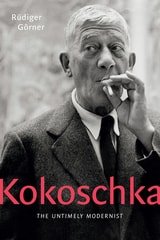
Kokoschka
The Untimely ModernistRüdiger Görner
Haus Publishing, 2024
The Austrian artist Oskar Kokoschka (1886–1980) achieved global fame with his intense expressionistic portraits and landscapes. In this first English-language biography, Rüdiger Görner depicts the artist in all his fascinating and contradictory complexity. He traces Kokoschka’s path from bête noire of the bourgeoisie and “hunger artist” who had to flee the Nazis to a wealthy and cosmopolitan political and critical artist who played a significant role in shaping the European art scene of the twentieth century and whose relevance is undiminished to this day.
In Kokoschka: A Life in Art, Görner emphasizes the artist’s versatility. Kokoschka, although best known for his expressionistic portraits and landscapes, was more than a mere visual artist: his achievements as a playwright, essayist, and poet bear witness to a remarkable literary talent. Music, too, played a central role in his work, and a passion for teaching led him to establish in 1953 the School of Seeing, an unconventional art school intended to revive humanist ideals in the horrific aftermath of war. This biography shows brilliantly how all the pieces of Kokoschka’s disparate interests and achievements cohered in the richly creative life of a singular artist.