108 books match the query 'Knowledge and learning' and 3 start with k

cover of Kafka Goes to the Movies

Kafka Goes to the Movies

Hanns Zischler

University of Chicago Press, 2002

"Went to the movies. Wept. Matchless entertainment." So wrote Franz Kafka in one of his diaries, giving us but one hint of his little-known passion for the cinema. Until now, Kafka aficionados have been left to speculate about which films moved Kafka so powerfully and how those films might have influenced his writing. With Kafka Goes to the Movies, German actor and film director Hanns Zischler draws on years of detective work to provide the first account of Kafka's moviegoing life.

Since many of Kafka's visits to the cinema occurred during bachelor trips with Max Brod, Zischler's research took him not only to Kafka's native Prague but to film archives in Munich, Milan, and Paris. Matching Kafka's cinematic references to reviews and stills from daily papers, Zischler hunted down rare films in collections all across Europe. A labor of love, then, by a true man of the cinema, Kafka Goes to the Movies brims with discoveries about the pioneering years of European film. With a wealth of illustrations, including reproductions of movie posters and other rare materials, Zischler opens a fascinating window onto movies that have been long forgotten or assumed lost.

But the real highlights of the book are those about Kafka himself. Long considered one of the most enigmatic figures in literature, the Kafka that emerges in this work is strikingly human. Kafka Goes to the Movies offers an absorbing look at a witty, passionate, and indulgently curious writer, one who discovered and used the cinema as a place of enjoyment and escape, as a medium for the ambivalent encounter with modern life, and as a filter for the changing world around him.
[more]
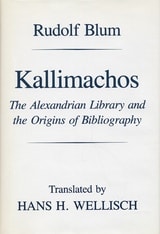
cover of Kallimachos: The Alexandrian Library and the Origins of Bibliography

Kallimachos

The Alexandrian Library and the Origins of Bibliography

Rudolf Blum

University of Wisconsin Press, 1991

The famous library of Alexandria, founded around 295 BCE by Ptolemaios I, housed the greatest collection of texts in the ancient world and was a fertile site of Hellenistic scholarship. Rudolf Blum’s landmark study, originally published in German in 1977, argues that Kallimachos of Kyrene was not only the second director of the Alexandrian library but also the inventor of two essential scholarly tools still in use to this day: the library catalog and the “biobibliographical” reference work. Kallimachos expanded the library’s inventory lists into volumes called the Pinakes, which extensively described and categorized each work and became in effect a Greek national bibliography and the source and paradigm for most later bibliographic lists of Greek literature. Though the Pinakes have not survived, Blum attempts a detailed reconstruction of Kallimachos’s inventories and catalogs based on a careful analysis of surviving sources, which are presented here in full translation.
[more]
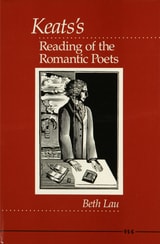
cover of Keats's Reading of the Romantic Poets

Keats's Reading of the Romantic Poets

Beth Lau

University of Michigan Press, 1991

Keats's Reading of the Romantic Poets offers the first comprehensive analysis of Keats’s familiarity with the works of his most famous contemporaries: Wordsworth, Coleridge, Byron, and Shelley. Beth Lau considers a variety of questions: which volumes and individual poems Keats read, what editions he used, when he read them, where he might have acquired copies, and why he read and responded as he did to certain works at particular periods of his life. The book presents a complex, detailed portrait of Keats's intellectual relationships with the major poets of his age.This study situates Keats in the literary climate of his time and provides Keats scholars with a reliable record that may assist future intertextual, influence, biographical, or critical studies. While previous work has concentrated on Keats's debt to Shakespeare, Milton, Spenser, and other great Renaissance and Medieval writers, the most significant influences on a poet's style and outlook are generally contemporary sources. In fact, Keats's very interest in Renaissance and Medieval poetry and drama was a taste he shared with his age. Keats's Reading of the Romantic Poets, in laying the groundwork for a new examination of the poet in relation to the literature of his time, helps us to see the Romantic poets as a genuine literary group that read and responded to one another's works.Each chapter contains an essay and checklists that conveniently organize information on Keats's familiarity with each of the other poets’ publications. The checklists also distinguish reliable evidence — direct references and quotations, items in Keats's library, and statements by people who knew Keats — from more conjectural echoes and allusions. The essays draw conclusions from the information presented in the checklists and consider other types of evidence that do not lend themselves to a checklist format. One source of such evidence is the libraries and literary tastes of Keats's friends: people like Charles Cowden Clarke, Leigh Hunt, Benjamin Robert Haydon, John Hamilton Reynolds, Benjamin Bailey, and William Hazlitt, who were influential in shaping Keats's opinions about literature. In fact, the book may be considered a study of two levels in Keats's relationship to his contemporaries: his literary relationships with the major poets of his day, and his personal interactions with an immediate circle that helped stimulate and focus his reading and thinking about poetry.Keats's Reading of the Romantic Poets is an important reference work for scholars and critics interested in Keats, in the connections among the major poets of the early nineteenth century, and in biography and social history. The book’s clear, jargon-free prose makes it accessible to a variety of students and scholars.
[more]