Results by title
4030 books match the query 'Language Arts & Disciplines' and 16 start with k
Kallimachos
The Alexandrian Library and the Origins of BibliographyRudolf Blum
University of Wisconsin Press, 1991
The famous library of Alexandria, founded around 295 BCE by Ptolemaios I, housed the greatest collection of texts in the ancient world and was a fertile site of Hellenistic scholarship. Rudolf Blum’s landmark study, originally published in German in 1977, argues that Kallimachos of Kyrene was not only the second director of the Alexandrian library but also the inventor of two essential scholarly tools still in use to this day: the library catalog and the “biobibliographical” reference work. Kallimachos expanded the library’s inventory lists into volumes called the Pinakes, which extensively described and categorized each work and became in effect a Greek national bibliography and the source and paradigm for most later bibliographic lists of Greek literature. Though the Pinakes have not survived, Blum attempts a detailed reconstruction of Kallimachos’s inventories and catalogs based on a careful analysis of surviving sources, which are presented here in full translation.
Kenneth Burke and the Conversation after Philosophy
Timothy W. Crusius
Southern Illinois University Press, 1999
Throughout much of his long life (1897–1993), Kenneth Burke was recognized as a leading American intellectual, perhaps the most significant critic writing in English since Coleridge. From about 1950 on, rhetoricians in both English and speech began to see him as a major contributor to the New Rhetoric. But despite Burke's own claims to be writing philosophy and some notice from reviewers and critics that his work was philosophically significant, Timothy W. Crusius is the first to access his work as philosophy.
Crusius traces Burke's commitment and contributions to philosophy prior to 1945, from Counter-Statement (1931) through The Philosophy of Literary Form (1941). While Burke might have been a late modernist thinker, Crusius shows that Burke actually starts from a position closely akin to such postmodern figures as Michel Foucault and Richard Rorty.
Crusius then examines Burke's work from A Grammar of Motives (1945) up to his last published essays, drawing most heavily on A Rhetoric of Motives, The Rhetoric of Religion, and uncollected essays from the 1970s. This part concerns Burke's contributions to human activities always closely associated with rhetoric-hermeneutics, dialectic, and praxis. Burke's highly developed notion of our species as the "symbol-using animal," argues Crusius, draws together the various strands of his later philosophy—his concern with interpretation, with dialectic and dialogue, with a praxis devoted to awareness and control of the self-deceiving and potentially self-destructive motives inherent in language itself.
Key Concepts in Critical Cultural Studies
Edited by Linda Steiner and Clifford Christians
University of Illinois Press, 2010
Key Theoretical Frameworks
Teaching Technical Communication in the Twenty-First CenturyAngela M. Haas
Utah State University Press, 2018
The collection provides a valuable resource for teachers new to translating social justice theories to the classroom by presenting concrete examples related to technical communication. Each contribution adopts a particular theoretical approach, explains the theory, situates it within disciplinary scholarship, contextualizes the approach from the author’s experience, and offers additional teaching applications.
The first volume of its kind, Key Theoretical Frameworks for Teaching Technical Communication in the Twenty-First Century links the theoretical with the pedagogical in order to articulate, use, and assess social justice frameworks for designing and teaching courses in technical communication.
Contributors: Godwin Y. Agboka, Matthew Cox, Marcos Del Hierro, Jessica Edwards, Erin A. Frost, Elise Verzosa Hurley, Natasha N. Jones, Cruz Medina, Marie E. Moeller, Kristen R. Moore, Donnie Johnson Sackey, Gerald Savage, J. Blake Scott, Barbi Smyser-Fauble, Kenneth Walker, Rebecca Walton
Keywords in Design Thinking
A Lexical Primer for Technical Communicators and DesignersJason C. K. Tham
University Press of Colorado, 2023
Keywords in Technical and Professional Communication
Han Yu
University Press of Colorado, 2024
Keywords in Writing Studies
Paul Heilker
Utah State University Press, 2015
Keywords in Writing Studies is an exploration of the principal ideas and ideals of an emerging academic field as they are constituted by its specialized vocabulary. A sequel to the 1996 work Keywords in Composition Studies, this new volume traces the evolution of the field’s lexicon, taking into account the wide variety of theoretical, educational, professional, and institutional developments that have redefined it over the past two decades.
Contributors address the development, transformation, and interconnections among thirty-six of the most critical terms that make up writing studies. Looking beyond basic definitions or explanations, they explore the multiple layers of meaning within the terms that writing scholars currently use, exchange, and question. Each term featured is a part of the general disciplinary parlance, and each is a highly contested focal point of significant debates about matters of power, identity, and values. Each essay begins with the assumption that its central term is important precisely because its meaning is open and multiplex.
Keywords in Writing Studies reveals how the key concepts in the field are used and even challenged, rather than advocating particular usages and the particular vision of the field that they imply. The volume will be of great interest to both graduate students and established scholars.
Kid Cops
What Communities Gain and Lose from Junior Police in SchoolsMai Thai
University of Chicago Press, 2026
Some might see police officers as benevolent sources of protection, but in many communities, they are often perceived as a threat due to a legacy of violent interactions and arrests for arbitrary offenses. How, then, do police sustain their presence in places where people might distrust them? In Kid Cops, sociologist Mai Thai offers one answer: junior police academies, high school programs in which police officers provide courses, mentorship, and job training to students in communities with high rates of juvenile delinquency and poverty. These school-police partnerships have expanded rapidly in the United States over the last few decades, largely in response to political unrest and police violence in the 1990s. Programs vary in their offerings, but they generally aim to ease tensions between communities and law enforcement, while also providing needed resources in neighborhoods where education and job opportunities are scarce.
Kid Cops draws on years of observations and interviews with educators, police officers, and, of course, kids. The junior police programs at each high school may have different emphases, but their common goal is for students to graduate from high school and enter college or the workforce. A second goal of the program is to cultivate a positive image of the police. Ultimately, however, Thai finds that these programs tighten the relationship between marginalized youth, schools, and the criminal justice system and strain the students’ relationships with their peers, families, and each other. These programs also distract residents from systemic issues of policing and suppress opportunities for meaningful change.
Written in an accessible tone that balances the seriousness of inequality with the playfulness of the study’s youth, Kid Cops moves beyond the narrative of detentions, suspensions, and arrests to tell a less conventional story about police in schools. It asks, does good, friendly policing exist—especially if it continues to tether low-income communities of color to the criminal justice system?
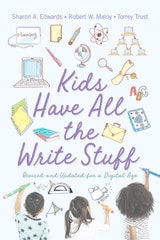
Kids Have All the Write Stuff
Revised and Updated for a Digital AgeRobert W. Maloy
University of Massachusetts Press, 2019
You'll discover:
· how to implement writing as a part of daily life with family and friends;
· processes and invitations fit for young writers;
· strategies for connecting writing to math and coding;
· writing materials and technologies; and
· creative and practical writing ideas, from fiction, nonfiction, and videos to blogs and emails.
In order to connect writing to today's digital revolution, veteran educators Sharon A. Edwards, Robert W. Maloy, and Torrey Trust reveal how digital tools can inspire children to write, and a helpful companion website brings together a range of resources and technologies. This essential book offers enjoyment and inspiration to young writers!

Kindergarten Magic
Theme-Based Lessons for Building Literacy and Library SkillsKathy MacMillan
American Library Association, 2012
King Lear and the Naked Truth
Rethinking the Language of Religion and ResistanceJudy Kronenfeld
Duke University Press, 1998
Kronenfeld’s focus expands from the text of Shakespeare’s play to a discussion of a shared Christian culture—a shared language and set of values—a common discursive field that frames the social ethics of the play. That expanded focus is used to address the multiple ways that clothing and nakedness function in the play, as well as the ways that these particular images and terms are understood in that shared context. As Kronenfeld moves beyond Lear to uncover the complex resonances of clothing and nakedness in sermons, polemical tracts, legislation, rhetoric, morality plays, and actual or alleged practices such as naked revolts by Anabaptists and the Adamians’ ritual disrobing during religious services, she demonstrates that many key terms and concepts of the period cannot be tied to a single ideology. Instead, they represent part of an intricate network of thought shared by people of seemingly opposite views, and it is within such shared cultural networks that dissent, resistance, and creativity can emerge. Warning her readers not to take the language of literary texts out of the linguistic context within which it first appeared, Kronenfeld has written a book that reinterprets the linguistic model that has been the basis for much poststructuralist criticism.
Kinship Systems
Change and ReconstructionPatrick McConvell
University of Utah Press, 2013
One key argument in the book is that linguistic evidence for reconstruction of ancient terminologies can provide strong independent evidence to complement anthropologists’ notions of structural kinship transformations and ground them in actual historical and geographical contexts. There are principles that we all share, no matter what kind of society we live in, and these provide a common “language” for anthropology and linguistics. With this language we can accurately compare how family relations are organized in different societies, as well as how we talk about such relations. Because this concept has often been denied by the trajectories in anthropology over the last few decades, Kinship Systems represents a reassertion of, and advances on, classical kinship theory and methods. Innovations and interdisciplinary methods are described by the originators of the new approaches and other leading regional experts.

Knocking on Heaven’s Door
Six Minor Leaguers in Search of the Baseball DreamMarty Dobrow
University of Massachusetts Press, 2010
The rich slice of Americana found in minor league baseball presents a contradictory culture. On the one hand, the minors are filled with wholesome, family-friendly entertainment-fluffy mascots, kitschy promotions, and earnest young men signing autographs for wide-eyed Little Leaguers. On the other, they comprise a world of cutthroat competition in which a teammate's failure or injury can be the cause of quiet celebration and 90 percent of all players never play a single inning in the major leagues.
In Knocking on Heaven's Door, award-winning sportswriter Marty Dobrow examines this double-edged culture by chronicling the lives of six minor leaguers—Brad Baker, Doug Clark, Manny Delcarmen, Randy Ruiz, Matt Torra, and Charlie Zink—all struggling to make their way to “The Show.” What links them together, aside from their common goal, is that they are all represented by the same team of agents—Jim and Lisa Masteralexis and their partner Steve McKelvey—whose own aspirations parallel those of the players they represent.
The story begins during spring training in 2005 and ends in the fall of 2008, followed by a brief epilogue that updates each player's fortunes through the 2009 season. Along the way Dobrow offers a revealing, intimate look at life in minor league baseball: the relentless tedium of its itinerant routines and daily rituals; the lure of performance-enhancing drugs as a means of gaining a competitive edge; the role of agents in negotiating each player's failures as well as his successes; and the influence of wives, girlfriends, and family members who have invested in the dream.
Knowledge Management
An IntroductionKevin C. Desouza
American Library Association, 2011
Knowledge and the Flow of Information
Fred I. Dretske
CSLI, 1999
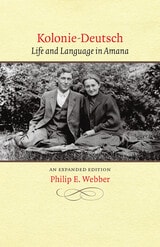
Kolonie-Deutsch
Life and Language in Amana, An Expanded EditionPhilip E. Webber
University of Iowa Press, 1993
Founded as a communal society in 1855 by German Pietists, the seven villages of Iowa’s Amana Colonies make up a community whose crafts, architecture, and institutions reflect—and to an extent perpetuate—the German heritage of earlier residents. In this intriguing blend of sociolinguistic research and stories from Colonists both past and present, Philip Webber examines the rich cultural and linguistic traditions of the Amanas.
Although the Colonies are open to the outside world, particularly after the Great Change of 1932, many distinctive vestiges of earlier lifeways survive, including the local variety of German known by its speakers as Kolonie-Deutsch. Drawing upon interviews with more than fifty Amana-German speakers in 1989 and 1990, Webber explores the nuances of this home-grown German, signaling the development of local microdialects, the changing pattern in the use of German in the Colonies, and the reciprocal influence of English and German on residents’ speech. By letting his sources tell their own stories of earlier days, in which the common message seems to be wir haben fun gehabt or “we had fun working together,” he illuminates the history and unique qualities of each Colony through the prism of language study.
Webber’s introduction to this paperback edition provides an up-to-date itinerary for visitors to the Colonies, information about recent publications on Amana history and culture, and an overview of expanded research opportunities for language study and historical inquiry. The result is an informative and engaging study that will be appreciated by linguists, anthropologists, and historians as well as by general readers interested in these historic villages.