Results by title
622 books match the query 'Language Study' and 8 start with k
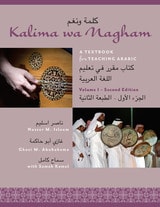
Kalima wa Nagham
A Textbook for Teaching Arabic, Volume 1By Nasser M. Isleem and Ghazi M. Abuhakema
University of Texas Press, 2020
Presenting a new Teaching Arabic as a Foreign Language (TAFL) curriculum that can be used in secondary and postsecondary educational settings, Kalima wa Nagham (Volume I) is a textbook that uniquely and simultaneously introduces Modern Standard Arabic (MSA) and salient aspects of Educated Spoken Arabic (ESA) to beginning language students. Students who fully utilize this book should be able to develop the different language skills: listening, speaking, reading, writing, and expressing deep cultural knowledge.
Written by Arabic language teaching practitioners and experienced educators who are certified language testers, Volume I of Kalima wa Nagham employs a threaded story that introduces language concepts along with music to enhance vocabulary retention and recall. At the core of the textbook are dialogues that present students and teachers with examples of Arabic grammatical concepts and important cultural aspects, as well as related vocabulary. These are supplemented by drills and activities that can be used in a classroom setting or pursued individually. Dialogues, pronunciation and listening drills, and charts to accompany the lessons are available on the UT Press website. This volume is student-centered in content and methodology, which will enable learners to meet and exceed linguistic and cultural proficiency expectations.
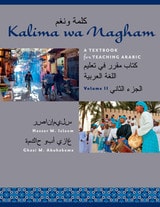
Kalima wa Nagham
A Textbook for Teaching Arabic, Volume 2By Nasser M. Isleem and Ghazi M. Abuhakema
University of Texas Press, 2016
Presenting a new Teaching Arabic as a Foreign Language (TAFL) curriculum that can be used in secondary and postsecondary educational settings, Kalima wa Nagham, Volume 2, is a textbook that uniquely and simultaneously introduces Modern Standard Arabic (MSA) and salient aspects of Educated Spoken Arabic (ESA) to level two language students. Students who fully utilize this book should be able to develop important language skills: listening, speaking, reading, writing, and expressing deep cultural knowledge.
Written by Arabic language teaching practitioners and experienced educators who are certified language testers, Kalima wa Nagham employs a threaded story that introduces language concepts along with music to enhance vocabulary retention and recall. At the core of the textbook are dialogues that present students and teachers with examples of Arabic grammatical concepts and important cultural aspects, as well as related vocabulary. These are supplemented by drills and activities that can be used in a classroom setting or pursued individually. Volume 2 incorporates media language to help students understand news reports and other media texts as well as original cartoons that demonstrate the meaning and significance of idiomatic expressions in a refreshing way. Dialogues and pronunciation and listening drills to accompany the lessons are available on the University of Texas Press website. This volume is student-centered in content and methodology, which will enable learners to meet and exceed linguistic and cultural proficiency expectations.
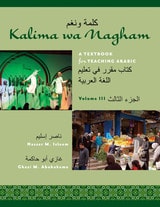
Kalima wa Nagham
A Textbook for Teaching Arabic, Volume 3By Nasser M. Isleem and Ghazi M. Abuhakema
University of Texas Press, 2020
Presenting a new Teaching Arabic as a Foreign Language (TAFL) curriculum that can be used in secondary and postsecondary educational settings, Kalima wa Nagham, volume 3, is a textbook that uniquely and simultaneously introduces Modern Standard Arabic (MSA) and salient aspects of Educated Spoken Arabic (ESA) to students whose proficiency level is at least intermediate high according to ACTFL’s rating scale. Students who fully use this book should be able to develop important language skills—listening, speaking, reading, writing, and expressing deep cultural knowledge—and reach the advanced high proficiency level by the end of the book.
Written by Arabic language teaching practitioners and experienced educators who are certified language testers, Kalima wa Nagham employs a threaded story that introduces language concepts along with music to enhance vocabulary retention and recall. At the core of the textbook are written and oral texts that present students and teachers with examples of Arabic grammatical concepts and important cultural aspects, as well as related vocabulary. These are supplemented by drills and activities that can be used in a classroom setting or pursued individually. Dialogues and pronunciation and listening drills that accompany the lessons are available on the University of Texas Press website. This volume is student-centered in content and methodology, which will enable learners to meet and exceed linguistic and cultural proficiency expectations.
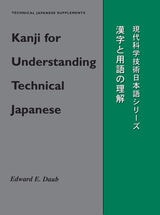
Kanji For Comprehending Technical Japanese
Edward E. Daub
University of Wisconsin Press, 1995
Designed as a companion and study guide for the textbook Comprehending Technical Japanese, this book may also be used as a supplement to the textbook Basic Technical Japanese. It provides detailed explanations of the origin and meaning of the 500 kanji featured in CTJ, which were chosen for their frequency and significance in chemistry, physics, and biology.
Each chapter is keyed to a chapter in CTJ, presenting twenty kanji, vocabulary that use those kanji, a kanji-card format for study and review, and the Japanese essay that appears at the close of each CTJ chapter, and its English translation. This volume also introduces significant scientific vocabulary that include kanji other than the 500 introduced in CTJ.
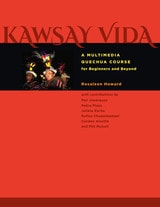
Kawsay Vida
A Multimedia Quechua Course for Beginners and BeyondBy Rosaleen Howard
University of Texas Press, 2014
Kawsay Vida is a course book and interactive multimedia program for the teaching and learning of the Quechua language from beginner to advanced levels. The course book is based on contemporary Bolivian Quechua, while the multimedia program contains a section on Bolivian Quechua (beginner to intermediate levels) and a section on southern Peruvian Quechua (advanced level). The book provides a practical introduction to spoken Quechua through the medium of English, while the multimedia program offers a choice of English or Spanish as the medium of instruction. The video clips introduce us to Quechua speakers in the valleys of Northern Potosí (Bolivia) and Cuzco (Peru), giving a sense of immediacy that the printed page cannot achieve, and highlighting the social and cultural settings in which the language is spoken. The multimedia program is available for both PC and Macintosh platforms.
The book contains twenty-two units of study. As students work through these, cross-references take them to relevant sections of the multimedia program. The Bolivian and Peruvian Quechua sections of the multimedia program are divided into thematically and grammatically ordered modules, which introduce users to different aspects of Andean life, while progressing language learning in a structured way. Users engage with the audio, video, and visual material contained in the program through a range of interactive exercises, which reinforce listening and comprehension skills. Once familiarity with the language is acquired, the multimedia program may be used independently from the book.
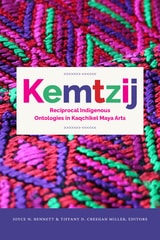
Kemtzij
Reciprocal Indigenous Ontologies in Kaqchikel Maya ArtsEdited by Joyce N. Bennett and Tiffany D. Creegan Miller
Amherst College Press, 2027
Kemtzij: Weaving Reciprocal Indigenous Ontologies in Kaqchikel Maya Arts focuses on the artistic contributions of contemporary Kaqchikel Mayas in Guatemala and their diasporas. Rather than representing Kaqchikel Mayas as exclusively existing in their pre-Hispanic past, the contributors to this edited volume—Kaqchikel and non-Kaqchikel scholars—demonstrate the distinct interdisciplinary ways that contemporary Kaqchikels engage with present-day Maya aesthetics and artistic initiatives in Guatemala and abroad. With a focus on the key concepts of reciprocity and duality, the chapters in this book consider the myriad ways in which Kaqchikel Mayas express their identities, through poetry, textiles, community street art, and digital photo collages. Kemtzij is unique in being published bilingually in Kaqchikel and English, making it one of few texts to consider Kaqchikel lives and artistic production—and the ontological implications of that work—in and through the Kaqchikel language.
Keys to Teaching Grammar to English Language Learners, Second Ed.
A Practical HandbookKeith S. Folse
University of Michigan Press, 2016
Keys to Teaching Grammar to English Language Learners: A Practical Handbook is not intended to be an exhaustive reference book about ESL grammar. Written for classroom teachers (K-12, ESL, EFL), this book teaches the most common ESL grammar points in an accessible way through real ESL errors together with suggested teaching techniques. Relevant grammar terminology is explained.
The four objectives of this book are to help teachers: (1) identify common ESL grammar points and understand the details associated with each one; (2) improve their ability to answer any grammar question on the spot (when on the “hot seat”); (3) anticipate common ESL errors by grammar point, by first language, and/or by proficiency level; and (4) develop more effective grammar/language learning lessons. These objectives are for all teachers, whether they are teaching grammar directly or indirectly in a variety of classes – including a grammar class, a writing class, a speaking class, an ESP class, or a K-12 class.
In the Second Edition, all chapters have been updated and substantively revised. The number of marginal (gray) boxes with tips and extra information has doubled. A 16th Key, on Negating, and three new appendixes have been added. One of the new appendixes provides a sample exercise from an actual ESL textbook plus relevant notes about the designing of grammar activities and suggestions for teaching each grammar point.
Also added to each Key is a section on the vocabulary items (e.g., collocations) that are related to the teaching of that particular grammar point. This information is unique to this edition and cannot be found elsewhere on the market.
The Workbook for the Second Edition (978-0-472-03679-0), available in 2017, includes numerous activities that practice the essentials of grammar and issues relevant to ESL teachers.
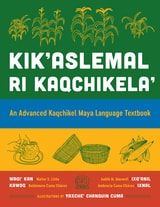
Kik’aslemal ri Kaqchikela’
An Advanced Kaqchikel Maya Language TextbookWaqi’ Kan (Walter E. Little), Ixq’anil (Judith M. Maxwell), Kawoq (Baldomero Cuma Chávez), Ixnal (Ambrocia Cuma Chávez). Illustrations: Yaxche’ Chanquin Cuma
University of Texas Press, 2026
An advanced Kaqchikel textbook that blends language learning with Maya culture.
About half a million Maya in the highlands of Guatemala speak Kaqchikel, making it one of the most widely used Mayan languages. Following the 2006 publication of ¿La ütz awäch?, an introduction to Kaqchikel, Kik’aslemal ri Kaqchikela’ offers guidance for advanced students. Unlike many language textbooks, it is designed with not only fluency but also cultural competency in mind.
Inspired by conversations with native speakers, Kaqchikel teachers, and anthropologists focused on Maya communities, Kik’aslemal ri Kaqchikela’ supports language learning through readings on topics important to speakers in Guatemala, including Maya’ Nimab’äl K’u’x (Maya cosmology); Ri Tiko’n (agriculture); Yab’il rik’in Aq’om (disease and medicine); Samaj pa Jay, pa Tinamït (work at home and in town); and more. Chapters present readings on each theme, alongside worksheets, discussion questions framed around Maya history and culture, and a contextualizing essay in English. A Kaqchikel/Spanish/English glossary, extensive grammar appendix, and English translations of the readings support learning. The result is not the usual explanation of language mechanics but instead a nuanced lesson in communication across porous boundaries of cultural difference.