Results by title
1993 books match the query 'Latin America' and 5 start with k

Kaqchikel Chronicles
The Definitive EditionWith translation and exegesis by Judith M. Maxwell and Robert M. Hill II
University of Texas Press, 2006
The collection of documents known as the Kaqchikel Chronicles consists of rare highland Maya texts, which trace Kaqchikel Maya history from their legendary departure from Tollan/Tula through their migrations, wars, the Spanish invasion, and the first century of Spanish colonial rule. The texts represent a variety of genres, including formal narrative, continuous year-count annals, contribution records, genealogies, and land disputes.
While the Kaqchikel Chronicles have been known to scholars for many years, this volume is the first and only translation of the texts in their entirety. The book includes two collections of documents, one known as the Annals of the Kaqchikels and the other as the Xpantzay Cartulary. The translation has been prepared by leading Mesoamericanists in collaboration with Kaqchikel-speaking linguistic scholars. It features interlinear glossing, which allows readers to follow the translators in the process of rendering colonial Kaqchikel into modern English. Extensive footnoting within the text restores the depth and texture of cultural context to the Chronicles. To put the translations in context, Judith Maxwell and Robert Hill have written a full scholarly introduction that provides the first modern linguistic discussion of the phonological, morphological, syntactic, and pragmatic structure of sixteenth-century Kaqchikel. The translators also tell a lively story of how these texts, which derive from pre-contact indigenous pictographic and cartographic histories, came to be converted into their present form.

Killer Books
Writing, Violence, and Ethics in Modern Spanish American NarrativeBy Aníbal González
University of Texas Press, 2002
Writing and violence have been inextricably linked in Spanish America from the Conquest onward. Spanish authorities used written edicts, laws, permits, regulations, logbooks, and account books to control indigenous peoples whose cultures were predominantly oral, giving rise to a mingled awe and mistrust of the power of the written word that persists in Spanish American culture to the present day.
In this masterful study, Aníbal González traces and describes how Spanish American writers have reflected ethically in their works about writing's relation to violence and about their own relation to writing. Using an approach that owes much to the recent "turn to ethics" in deconstruction and to the works of Jacques Derrida and Emmanuel Levinas, he examines selected short stories and novels by major Spanish American authors from the late nineteenth through the twentieth centuries: Manuel Gutiérrez Nájera, Manuel Zeno Gandía, Teresa de la Parra, Jorge Luis Borges, Alejo Carpentier, Gabriel García Márquez, and Julio Cortázar. He shows how these authors frequently display an attitude he calls "graphophobia," an intense awareness of the potential dangers of the written word.

Kings for Three Days
The Play of Race and Gender in an Afro-Ecuadorian FestivalJean Muteba Rahier
University of Illinois Press, 2013
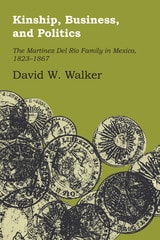
Kinship, Business, and Politics
The Martinez Del Rio Family in Mexico, 1823-1867By David W. Walker
University of Texas Press, 1987
The Martínez del Río family was a vigorous contestant in the highly politicized economy of early national Mexico. David Walker’s case study of its successes and failures provides a unique insider’s view of the trials and tribulations of doing business in a hostile environment. The family’s ordeal in Mexico—a series of personal dislocations and traumas—mirrored the painful contractions of an old society reluctantly giving birth to a new nation.
Using previously undiscovered primary source materials (including the private correspondence and business records of the family, public notary documents, transcripts of judicial proceedings, and the archives of Mexico’s Ministry of Foreign Relations and the British Foreign Office), Walker employs family history to analyze problems relating more generally to the development of state and society in newly independent Mexico.
The processes of socioeconomic formation in Mexico differed from those of Western Europe and the United States; accordingly, entrepreneurial activity had markedly contrasting implications for economic development and class formation. In the downwardly spiraling economy of nineteenth-century Mexico, economic activity was a zero-sum game. No new wealth was being created; most sectors remained stagnant and unproductive. To make their fortunes, empresarios, the Mexican capitalists, could not rely on income generated from authentic economic growth. Instead, they exploited the arbitrary acts of the interventionist Mexican state, which proscribed the free movement of factors within the marketplace. Speculation in the public debt took the place of more substantive undertakings. Coercive state power was diverted to create artificial environments in which otherwise inefficient and unproductive enterprises could flourish. But however well the empresarios might imitate the outward forms of industrial capitalism, they could not unlock the productive capacity of the Mexican economy. Instead, they and their allies and rivals engaged in destructive struggles to manipulate the state for personal gain, to the detriment of class interests, economic growth, and political stability.

Kiss Of Death
Joseph Bastien
University of Utah Press, 1998