Results by title
1917 books match the query 'Law' and 6 start with k
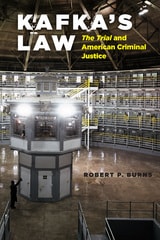
Kafka's Law
"The Trial" and American Criminal JusticeRobert P. Burns
University of Chicago Press, 2014
The Trial is actually closer to reality than fantasy as far as the client’s perception of the system. It’s supposed to be a fantastic allegory, but it’s reality. It’s very important that lawyers read it and understand this.” Justice Anthony Kennedy famously offered this assessment of the Kafkaesque character of the American criminal justice system in 1993. While Kafka’s vision of the “Law” in The Trial appears at first glance to be the antithesis of modern American legal practice, might the characteristics of this strange and arbitrary system allow us to identify features of our own system that show signs of becoming similarly nightmarish?
With Kafka’s Law, Robert P. Burns shows how The Trial provides an uncanny lens through which to consider flaws in the American criminal justice system today. Burns begins with the story, at once funny and grim, of Josef K., caught in the Law’s grip and then crushed by it. Laying out the features of the Law that eventually destroy K., Burns argues that the American criminal justice system has taken on many of these same features. In the overwhelming majority of contemporary cases, police interrogation is followed by a plea bargain, in which the court’s only function is to set a largely predetermined sentence for an individual already presumed guilty. Like Kafka’s nightmarish vision, much of American criminal law and procedure has become unknowable, ubiquitous, and bureaucratic. It, too, has come to rely on deception in dealing with suspects and jurors, to limit the role of defense, and to increasingly dispense justice without the protection of formal procedures. But, while Kennedy may be correct in his grim assessment, a remedy is available in the tradition of trial by jury, and Burns concludes by convincingly arguing for its return to a more central place in American criminal justice.
With Kafka’s Law, Robert P. Burns shows how The Trial provides an uncanny lens through which to consider flaws in the American criminal justice system today. Burns begins with the story, at once funny and grim, of Josef K., caught in the Law’s grip and then crushed by it. Laying out the features of the Law that eventually destroy K., Burns argues that the American criminal justice system has taken on many of these same features. In the overwhelming majority of contemporary cases, police interrogation is followed by a plea bargain, in which the court’s only function is to set a largely predetermined sentence for an individual already presumed guilty. Like Kafka’s nightmarish vision, much of American criminal law and procedure has become unknowable, ubiquitous, and bureaucratic. It, too, has come to rely on deception in dealing with suspects and jurors, to limit the role of defense, and to increasingly dispense justice without the protection of formal procedures. But, while Kennedy may be correct in his grim assessment, a remedy is available in the tradition of trial by jury, and Burns concludes by convincingly arguing for its return to a more central place in American criminal justice.
[more]
Kalmykia in Russia's Past and Present National Policies and Administrative System
Konstantin N. Maksimov
Central European University Press, 2008
Kalmykia is a constituent of the Russian Federation that shaped and has been developing within Russia for several centuries. Kalmykia was incorporated into the Russian state in the early second half of the 17 th century, it was officially recognized by the Russian authorities and constituted as an ethno-political entity in the form of feudal khanate with the status of a virtually autonomous unit. The Kalmyk Khanate's status as a largely self-ruling area within the Russian Empire gradually transformed into the status of a regular administrative territory under the Astrakhan governor. It received the status of a Republic from Stalin.Maksimov examines issues of interrelations between the Kalmyk people and Russia before and after the Kalmyks' accession to the Russian state. Analyzes the Soviet national policy and to the destiny of Kalmykia under the communist regime. The legal status of this republic and its development under the new Russian federalism are discussed in great details.
[more]
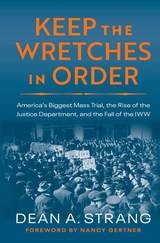
Keep the Wretches in Order
America's Biggest Mass Trial, the Rise of the Justice Department, and the Fall of the IWWDean A. Strang
University of Wisconsin Press, 2020
Before World War I, the government reaction to labor dissent had been local, ad hoc, and quasi-military. Sheriffs, mayors, or governors would deputize strikebreakers or call out the state militia, usually at the bidding of employers. When the United States entered the conflict in 1917, government and industry feared that strikes would endanger war production; a more coordinated, national strategy would be necessary. To prevent stoppages, the Department of Justice embarked on a sweeping new effort—replacing gunmen with lawyers. The department systematically targeted the nation’s most radical and innovative union, the Industrial Workers of the World, also known as the Wobblies, resulting in the largest mass trial in U.S. history.
In the first legal history of this federal trial, Dean Strang shows how the case laid the groundwork for a fundamentally different strategy to stifle radical threats, and had a major role in shaping the modern Justice Department. As the trial unfolded, it became an exercise of raw force, raising serious questions about its legitimacy and revealing the fragility of a criminal justice system under great external pressure.
In the first legal history of this federal trial, Dean Strang shows how the case laid the groundwork for a fundamentally different strategy to stifle radical threats, and had a major role in shaping the modern Justice Department. As the trial unfolded, it became an exercise of raw force, raising serious questions about its legitimacy and revealing the fragility of a criminal justice system under great external pressure.
[more]
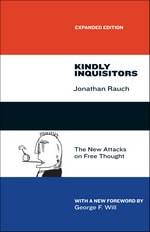
Kindly Inquisitors
The New Attacks on Free Thought, Expanded EditionJonathan Rauch
University of Chicago Press, 2014
A rousing defense of the value of free speech, and the dangers of well-meaning censorship
“A liberal society stands on the proposition that we should all take seriously the idea that we might be wrong. This means we must place no one, including ourselves, beyond the reach of criticism; it means that we must allow people to err, even where the error offends and upsets, as it often will.” So writes Jonathan Rauch in Kindly Inquisitors, which has challenged readers for decades with its bracing and provocative exploration of the issues surrounding attempts to limit free speech. In it, Rauch makes a persuasive argument for the value of “liberal science” and the idea that conflicting views produce knowledge within society.
In this expanded edition of Kindly Inquisitors, a new foreword by George F. Will strikingly shows the book’s continued relevance, while a substantial new afterword by Rauch elaborates upon his original argument and brings it fully up to date. Two decades after the book’s initial publication, while some progress has been made, the regulation of hate speech has grown domestically—especially in American universities—and has spread even more internationally, where there is no First Amendment to serve as a meaningful check. But the answer to bias and prejudice, Rauch argues, is pluralism—not purism. Rather than attempting to legislate bias and prejudice out of existence or to drive them underground, we must pit them against one another to foster a more vigorous and fruitful discussion. It is this process that has been responsible for the growing acceptance of the moral acceptability of homosexuality over the last twenty years. And it is this process, Rauch argues, that will enable us as a society to replace hate with knowledge, both ethical and empirical.
“It is a melancholy fact that this elegant book, which is slender and sharp as a stiletto, is needed, now even more than two decades ago. Armed with it, readers can slice through the pernicious ideas that are producing the still-thickening thicket of rules, codes, and regulations restricting freedom of thought and expression.”—George F. Will, from the foreword
[more]
Knowing Where It Comes From
Labeling Traditional Foods to Compete in a Global MarketFabio Parasecoli
University of Iowa Press, 2017
Offering the first broadly comparative analysis of place-based labeling and marketing systems, Knowing Where It Comes From examines the way claims about the origins and meanings of traditional foods get made around the world, from Italy and France to Costa Rica and Thailand. It also highlights the implications of different systems for both producers and consumers.
Labeling regimes have moved beyond intellectual property to embrace community-based protections, intangible cultural heritage, cultural landscapes, and indigenous knowledge. Reflecting a rich array of juridical, regulatory, and activist perspectives, these approaches seek to level the playing field on which food producers and consumers interact.
Labeling regimes have moved beyond intellectual property to embrace community-based protections, intangible cultural heritage, cultural landscapes, and indigenous knowledge. Reflecting a rich array of juridical, regulatory, and activist perspectives, these approaches seek to level the playing field on which food producers and consumers interact.
[more]
Knowing the Suffering of Others
Legal Perspectives on Pain and Its MeaningsAustin Sarat
University of Alabama Press, 2014
In Knowing the Suffering of Others, legal scholar Austin Sarat brings together essays that address suffering as it relates to the law, highlighting the ways law imagines suffering and how pain and suffering become jurisprudential facts.
From fetal imaging to end-of-life decisions, torts to international human rights, domestic violence to torture, and the law of war to victim impact statements, the law is awash in epistemological and ethical problems associated with knowing and imagining suffering. In each of these domains we might ask: How well do legal actors perceive and understand suffering in such varied domains of legal life? What problems of representation and interpretation bedevil efforts to grasp the suffering of others? What historical, political, literary, cultural, and/or theological resources can legal actors and citizens draw on to understand the suffering of others?
In Knowing the Suffering of Others, Austin Sarat presents legal scholarship that explores these questions and puts the problem of suffering at the center of thinking about law. The contributors to this volume do not regard pain and suffering as objective facts of a universe remote from law; rather they examine how both are discursively constructed in and by law. They examine how pain and suffering help construct and give meaning to the law as we know it. The authors attend to the various ways suffering appears in law as well as the different forms of suffering that require the law’s attention.
Throughout this book law is regarded as a domain in which the meanings of pain and suffering are contested, and constituted, as well as an instrument for inflicting suffering or for providing or refusing its relief. It challenges scholars, lawyers, students, and policymakers to ask how various legal actors and audiences understand the suffering of others.
Contributors
Montré D. Carodine / Cathy Caruth / Alan L. Durham / Bryan K.Fair / Steven H. Hobbs / Gregory C. Keating
/ Linda Ross Meyer / Meredith M. Render / Jeannie Suk / John Fabian Witt
[more]