Results by title
998 books match the query 'Life' and 6 start with k
Kafu the Scribbler
The Life and Writings of Nagai Kafu, 1897–1959Edward Seidensticker
University of Michigan Press, 1990
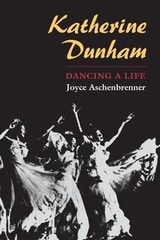
Katherine Dunham
DANCING A LIFEJoyce Aschenbrenner
University of Illinois Press, 2002
Founder of the first self-supporting African American dance company, Dunham relied on her fieldwork as an anthropologist to fundamentally change modern dance. She shaped new dance techniques and introduced other cultures to U.S. and European audiences by fusing Caribbean and African-based movement with ballet and modern dance. Her revolutionary approaches to dance and its greater connection to the world have influenced a generation of dancers, theatrical performers, and scholars. She believes that dance involves the development of an entire person and the rituals and traditions of dance are integral to the study of culture. Throughout her career she has been a living model of the socially responsible artist working to whet cultural appetites and combat social injustice.
Joyce Aschenbrenner's multifaceted portrait blends personal observations based on her own interactions with Dunham, archival documents, and interviews with Dunham's colleagues, students, and members of the Katherine Dunham Dance Company.
Integrating these sources, Aschenbrenner characterizes the social, familial, and cultural environment of Dunham's upbringing and the intellectual and artistic community she embraced at the University of Chicago that laid the groundwork for her development as a dancer, anthropologist, and humanitarian. The book vividly depicts Dunham's and her dancers' touring experiences and includes detailed descriptions of her community cultural and educational programs in East St. Louis.
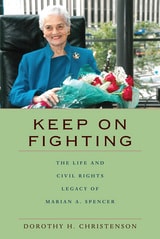
Keep On Fighting
The Life and Civil Rights Legacy of Marian A. SpencerDorothy H. Christenson
Ohio University Press, 2015
Marian Alexander Spencer was born in 1920 in the Ohio River town of Gallipolis, Ohio, one year after the “Red Summer” of 1919 that saw an upsurge in race riots and lynchings. Following the example of her grandfather, an ex-slave and community leader, Marian joined the NAACP at thirteen and grew up to achieve not only a number of civic leadership firsts in her adopted home city of Cincinnati, but a legacy of lasting civil rights victories.
Of these, the best known is the desegregation of Cincinnati’s Coney Island amusement park. She also fought to desegregate Cincinnati schools and to stop the introduction of observers in black voting precincts in Ohio. Her campaign to raise awareness of industrial toxic-waste practices in minority neighborhoods was later adapted into national Superfund legislation.
In 2012, Marian’s friend and colleague Dot Christenson sat down with her to record her memories. The resulting biography not only gives us the life story of remarkable leader but encapsulates many of the twentieth century’s greatest struggles and advances. Spencer’s story will prove inspirational and instructive to citizens and students alike.
Keep True
A Life in PoliticsHoward Pawley
University of Manitoba Press, 2011
King Me
Three One-Act Plays Inspired by the Life and Legacy of Dr. Martin Luther King Jr.Clinnesha D. Sibley
University of Arkansas Press, 2013
Kolonie-Deutsch
Life and Language in Amana, An Expanded EditionPhilip E. Webber
University of Iowa Press, 1993
Founded as a communal society in 1855 by German Pietists, the seven villages of Iowa’s Amana Colonies make up a community whose crafts, architecture, and institutions reflect—and to an extent perpetuate—the German heritage of earlier residents. In this intriguing blend of sociolinguistic research and stories from Colonists both past and present, Philip Webber examines the rich cultural and linguistic traditions of the Amanas.
Although the Colonies are open to the outside world, particularly after the Great Change of 1932, many distinctive vestiges of earlier lifeways survive, including the local variety of German known by its speakers as Kolonie-Deutsch. Drawing upon interviews with more than fifty Amana-German speakers in 1989 and 1990, Webber explores the nuances of this home-grown German, signaling the development of local microdialects, the changing pattern in the use of German in the Colonies, and the reciprocal influence of English and German on residents’ speech. By letting his sources tell their own stories of earlier days, in which the common message seems to be wir haben fun gehabt or “we had fun working together,” he illuminates the history and unique qualities of each Colony through the prism of language study.
Webber’s introduction to this paperback edition provides an up-to-date itinerary for visitors to the Colonies, information about recent publications on Amana history and culture, and an overview of expanded research opportunities for language study and historical inquiry. The result is an informative and engaging study that will be appreciated by linguists, anthropologists, and historians as well as by general readers interested in these historic villages.