Results by title
534 books match the query 'Making' and 4 start with k

Killing Poetry
Blackness and the Making of Slam and Spoken Word CommunitiesJohnson, Javon
Rutgers University Press, 2017
Winner of the 2019 Lilla A. Heston Award
Co-winner of the 2018 Ethnography Division’s Best Book from the NCA
In recent decades, poetry slams and the spoken word artists who compete in them have sparked a resurgent fascination with the world of poetry. However, there is little critical dialogue that fully engages with the cultural complexities present in slam and spoken word poetry communities, as well as their ramifications.
In Killing Poetry, renowned slam poet, Javon Johnson unpacks some of the complicated issues that comprise performance poetry spaces. He argues that the truly radical potential in slam and spoken word communities lies not just in proving literary worth, speaking back to power, or even in altering power structures, but instead in imagining and working towards altogether different social relationships. His illuminating ethnography provides a critical history of the slam, contextualizes contemporary black poets in larger black literary traditions, and does away with the notion that poetry slams are inherently radically democratic and utopic.
Killing Poetry—at times autobiographical, poetic, and journalistic—analyzes the masculine posturing in the Southern California community in particular, the sexual assault in the national community, and the ways in which related social media inadvertently replicate many of the same white supremacist, patriarchal, and mainstream logics so many spoken word poets seem to be working against. Throughout, Johnson examines the promises and problems within slam and spoken word, while illustrating how community is made and remade in hopes of eventually creating the radical spaces so many of these poets strive to achieve.
[more]
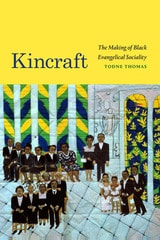
Kincraft
The Making of Black Evangelical SocialityTodne Thomas
Duke University Press, 2021
In Kincraft Todne Thomas explores the internal dynamics of community life among black evangelicals, who are often overshadowed by white evangelicals and the common equation of the “Black Church” with an Afro-Protestant mainline. Drawing on fieldwork in an Afro-Caribbean and African American church association in Atlanta, Thomas locates black evangelicals at the center of their own religious story, presenting their determined spiritual relatedness as a form of insurgency. She outlines how church members cocreate themselves as spiritual kin through what she calls kincraft—the construction of one another as brothers and sisters in Christ. Kincraft, which Thomas traces back to the diasporic histories and migration experiences of church members, reflects black evangelicals' understanding of Christian familial connection as transcending racial, ethnic, and denominational boundaries in ways that go beyond the patriarchal nuclear family. Church members also use their spiritual relationships to navigate racial and ethnic discrimination within the majority-white evangelical movement. By charting kincraft's functions and significance, Thomas demonstrates the ways in which black evangelical social life is more varied and multidimensional than standard narratives of evangelicalism would otherwise suggest.
[more]
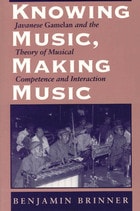
Knowing Music, Making Music
Javanese Gamelan and the Theory of Musical Competence and InteractionBenjamin Brinner
University of Chicago Press, 1995
How do musicians know what they know? This study is a new approach to the nature of musical competence. Using the intricate collaborative structure of gamelan—Javanese ensemble music—as a point of departure, Knowing Music, Making Music lays the foundation for a comprehensive theory of musical competence and interaction.
Using illustrative examples from a variety of traditions, Benjamin Brinner first examines the elements and characteristics of musical competence, the different kinds of competence in a musical community, the development of multiple competences, and the acquisition and transformation of competence through time. He then shows how these factors come into play in musical interaction, establishing four intersecting theoretical perspectives based on ensemble roles, systems of communication, sound structures, and individual motivations. These perspectives are applied to the dynamics of gamelan performance to explain the social, musical, and contextual factors that affect the negotiation of consensus in musical interaction. The discussion ranges from sociocultural norms of interpersonal conduct to links between music, dance, theater, and ritual, and from issues of authority and deference to musicians' self-perceptions and mutual assessments.
Much more than a portrait of artists making music together, this book brings together a variety of cognitive approaches and a wide range of examples from many cultures to suggest ways of integrating our knowledge of music making both in individual cultures and crossculturally.
[more]

Koviashuvik
Making a Home in the Brooks RangeSam Wright
University of Arizona Press, 1997
On a slope above a mountain lake in Alaska’s Brooks Range, Sam and Billie Wright built a twelve-by-twelve-foot log cabin with hand tools and named it Koviashuvik—an Eskimo word meaning "living in the present moment with quiet joy and happiness." Sam’s account of the twenty years they spent there is both a tale of wilderness survival and an inspiring meditation on the natural world and humanity’s relationship to it.
[more]