Results by title
1415 books match the query 'Medical' and 8 start with k

Kampala Women Getting By
Wellbeing in the Time of AIDSSandra Wallman
Ohio University Press, 1996
What do ordinary women in an African city do in the face of “serious enough” infections in themselves and signs of acute illness in their young children? How do they manage? What does it take to get by? How do they maintain the wellbeing of the household in a setting without what would be considered as basic health provision in an American or European city?
Professor Wallman focuses on women in a densely-populated part of Kampala called Kamwokya. With the help of a team of Ugandans and non-Ugandans, a vivid picture emerges, enhanced by color photographs, sketches and maps.
Women are largely responsible for the management of illness in all members of the family. Young children are at particular risk and the women have to take the first crucial decisions about treatment. Formal health resources are scarce and so they most often resort to an extraordinary range of treatments provided in the informal economy. A holistic picture of all the options that local people recognize is drawn, and an enriched understanding of problems and opportunities for health care in tropical cities emerges.
Multidisciplinary work on sexually transmitted disease is rare, even in this time of AIDS, and the book effectively maps the social contexts of its perception and management. Moreover, it focuses on women as ordinary citizens, selected by residence and not by reference to known medical conditions or high risk behavior. It is important too that the field strategies have encouraged local informants to become active participants in the definition of local problems and their solutions.

Katrina's Imprint
Race and Vulnerability in AmericaWailoo, Keith
Rutgers University Press, 2010

Kibler's Medical Terms for Interpreters
English to JapaneseJeanette Kibler and Karl T. Rew
Michigan Publishing Services, 2018
通訳者は状況に合わせて的確な言葉を発することが非常に重要であることを承知しています。 医療通訳者にとって専門分野に特有の言葉を素早く探すことが困難な場合もあるでしょう。 「キブラーの通訳者向け医学用語集」は目的の擁護へ素早くたどりつくための実際に役立つ資料です。
• Speeds up your word-finding. Unlike a typical dictionary, Kibler’s Medical Terms for Interpreters is organized in sections by medical specialty, so you can quickly locate the specific words that will be useful for a patient encounter.
• Makes medical words easily accessible, from common terms to highly technical jargon.
• Reduces the need to search a dictionary for individual words while interpreting.
• Has proved to be a valuable resource for both beginning and veteran interpreters.
• Is easily used while interpreting or when preparing prior to an appointment.
• 用語の検索が速くなります。典型的な辞書とは異なり「キブラーの通訳者向け医学用語集」は専門分野ごとに分類されており、患者さんの診察時に特定の単語を素早く見つけることができます。
• 一般的な言葉から高度な専門用語まで様々な医療用語を簡単に利用することができます。
• 通訳中に特定の言葉を辞書で調べる手間が省けます。
• 初級の通訳者にも、ベテランの通訳者にも価値のある参考資料であることが実証されています。
• 通訳の途中でも事前の予習時でも簡単に使うことができます。
Kibler's Medical Terms for Interpreters
Japanese to EnglishJeanette Kibler and Karl T. Rew
Michigan Publishing Services, 2018
通訳者は状況に合わせて的確な言葉を発することが非常に重要であることを承知しています。 医療通訳者にとって専門分野に特有の言葉を素早く探すことが困難な場合もあるでしょう。 「キブラーの通訳者向け医学用語集」は目的の擁護へ素早くたどりつくための実際に役立つ資料です。
• Speeds up your word-finding. Unlike a typical dictionary, Kibler’s Medical Terms for Interpreters is organized in sections by medical specialty, so you can quickly locate the specific words that will be useful for a patient encounter.
• Makes medical words easily accessible, from common terms to highly technical jargon.
• Reduces the need to search a dictionary for individual words while interpreting.
• Has proved to be a valuable resource for both beginning and veteran interpreters.
• Is easily used while interpreting or when preparing prior to an appointment.
• 用語の検索が速くなります。典型的な辞書とは異なり「キブラーの通訳者向け医学用語集」は専門分野ごとに分類されており、患者さんの診察時に特定の単語を素早く見つけることができます。
• 一般的な言葉から高度な専門用語まで様々な医療用語を簡単に利用することができます。
• 通訳中に特定の言葉を辞書で調べる手間が省けます。
• 初級の通訳者にも、ベテランの通訳者にも価値のある参考資料であることが実証されています。
• 通訳の途中でも事前の予習時でも簡単に使うことができます。
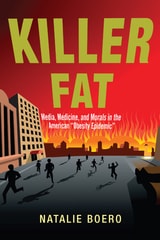
Killer Fat
Media, Medicine, and Morals in the American "Obesity Epidemic”Boero, Natalie
Rutgers University Press, 2013
In the past decade, obesity has emerged as a major public health concern in the United States and abroad. At the federal, state, and local level, policy makers have begun drafting a range of policies to fight a war against fat, including body-mass index (BMI) report cards, “snack taxes,” and laws to control how fast food companies market to children. As an epidemic, obesity threatens to weaken the health, economy, and might of the most powerful nation in the world.
In Killer Fat, Natalie Boero examines how and why obesity emerged as a major public health concern and national obsession in recent years. Using primary sources and in-depth interviews, Boero enters the world of bariatric surgeries, Weight Watchers, and Overeaters Anonymous to show how common expectations of what bodies are supposed to look like help to determine what sorts of interventions and policies are considered urgent in containing this new kind of disease.
Boero argues that obesity, like the traditional epidemics of biological contagion and mass death, now incites panic, a doomsday scenario that must be confronted in a struggle for social stability. The “war” on obesity, she concludes, is a form of social control. Killer Fat ultimately offers an alternate framing of the nation’s obesity problem based on the insights of the “Health at Every Size” movement.

Kinflix
Adoption and Assisted Reproductive Technologies in FilmMarina Fedosik
The Ohio State University Press, 2025
Resisting simple ideological readings of film genres, Fedosik unsettles cultural scripts around adoption and reproduction and scrutinizes moments where formulaic genre logic may be troubled by representations of lived experience that transcend common tropes of family formation. She argues that adoption as a reproductive technology is uniquely situated to expose cultural tensions around nontraditional methods of reproduction that are rapidly developing in the post-IVF biocultural landscape. Rapidly changing reproductive technologies, Fedosik asserts, demand a cultural response—and require more expansive reflection on reproductive futurities.

Knowledge and Representation
Albert Newen, Andreas Bartels, and Eva-Maria Jung
CSLI, 2011
This compilation of cutting-edge philosophical and scientific research comprises a survey of recent neuroscientific research on representational systems in animals and humans. Representational systems provide their owners with useful information about their environment and are shaped by the special informational needs of the organism with respect to its environment. In this volume, the authors address the long-standing dispute about the usefulness of the notion of representation in the study of behavior systems and offer a fresh perspective on representational systems that combines philosophical insights and experimental experience.

Knowledge in the Time of Cholera
The Struggle over American Medicine in the Nineteenth CenturyOwen Whooley
University of Chicago Press, 2013
These cholera outbreaks raised fundamental questions about medical knowledge and its legitimacy, giving fuel to alternative medical sects that used the confusion of the epidemic to challenge both medical orthodoxy and the authority of the still-new American Medical Association. In Knowledge in the Time of Cholera, Owen Whooley tells us the story of those dark days, centering his narrative on rivalries between medical and homeopathic practitioners and bringing to life the battle to control public understanding of disease, professional power, and democratic governance in nineteenth-century America.