Results by title
683 books match the query 'Middle East' and 4 start with k

Kafka and Cultural Zionism
Dates in PalestineIris Bruce
University of Wisconsin Press, 2007
Kafka and Cultural Zionism is an illumination of the individual Jewish identity of this major modernist German author. Through a thorough examination of Kafka's life, his influences, and his writings, Iris Bruce makes a case for Kafka's interest in Zionism and demonstrates the presence of Jewish themes and motifs in Kafka's literary works. In recognizing this essential part of Kafka's individual voice, Bruce hopes to provide a new perspective on Kafka and his writings that allows the reader to find the humor, playfulness, rebelliousness, and challenge that can be overlooked if the reader expects to find a Kafka who is disengaged from his ethnic and cultural identity, as well as the politics of his age.
Outstanding Academic Title, Choice Magazine
[more]
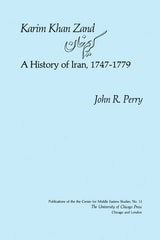
Karim Khan Zand
A History of Iran, 1747-1779John R. Perry
University of Chicago Press, 1979
A forward thinking and notably popular leader, Karim Khan Zand (1705-1779) was the founder of the Zand dynasty in Iran. In this insightful profile of a man before his time, esteemed academic John Perry shows how by opening up international trade, employing a fair fiscal system and showing respect for existing religious institutions, Karim Khan succeeded in creating a peaceful and prosperous state in a particularly turbulent epoch of history.
[more]
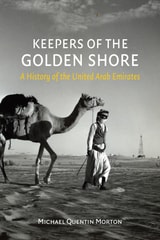
Keepers of the Golden Shore
A History of the United Arab EmiratesMichael Quentin Morton
Reaktion Books, 2016
For those who visit the United Arab Emirates (UAE), staying in its the lavish hotels and browsing in the ultra-modern shopping malls of Abu Dhabi or Dubai, the country can be a mystery, a glass and concrete creation that seems to have sprung from the desert overnight. Keepers of the Golden Shore looks behind this glossy façade, illuminating the region’s history, which stretches from the ancient Arabian tribes who controlled a desolate but economically important shoreline to the ostentatious architectural wonders—bankrolled by a massive wealth of oil—that characterize it today.
As Michael Quentin Morton recounts, the region now known as the UAE likely began as a trading post between Mesopotamia and Oman, and since that time has been the stage of important economic and cultural exchanges. It has seen the rise and fall of a thriving pearl industry, piracy, invasions and wars, and the arrival of the oil age that would make it one of the richest countries on earth. Since the early 1970s, when seven sheikhs agreed to enter into a union, it has been a sovereign nation, carrying on the resourceful spirit—with resplendent fervor—that the brutally inhospitable landscape has long demanded of the people. Ultimately, Morton shows that the country is not only rich in oil and money but in an extraordinarily deep history and culture.
As Michael Quentin Morton recounts, the region now known as the UAE likely began as a trading post between Mesopotamia and Oman, and since that time has been the stage of important economic and cultural exchanges. It has seen the rise and fall of a thriving pearl industry, piracy, invasions and wars, and the arrival of the oil age that would make it one of the richest countries on earth. Since the early 1970s, when seven sheikhs agreed to enter into a union, it has been a sovereign nation, carrying on the resourceful spirit—with resplendent fervor—that the brutally inhospitable landscape has long demanded of the people. Ultimately, Morton shows that the country is not only rich in oil and money but in an extraordinarily deep history and culture.
[more]
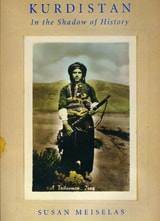
Kurdistan
In the Shadow of History, Second EditionSusan Meiselas
University of Chicago Press, 2008
Kurdistan was erased from world maps after World War I, when the victorious powers carved up the Middle East, leaving the Kurds without a homeland. Today the Kurds, who live on land that straddles the borders of Turkey, Iran, Iraq, and Syria, are by far the largest ethnic group in the world without a state.
Renowned photographer Susan Meiselas entered northern Iraq after the 1991 Gulf War to record the effects of Saddam Hussein’s campaigns against Iraq’s Kurdish population. She joined Human Rights Watch in documenting the destruction of Kurdish villages (some of which Hussein had attacked with chemical weapons in 1988) and the uncovering of mass graves. Moved by her experiences there, Meiselas began work on a visual history of the Kurds. The result, Kurdistan: In the Shadow of History, gives form to the collective memory of the Kurds and creates from scattered fragments a vital national archive.
In addition to Meiselas’s own photographs, Kurdistan presents images and accounts by colonial administrators, anthropologists, missionaries, soldiers, journalists, and others who have traveled to Kurdistan over the last century, and, not to forget, by Kurds themselves. The book’s pictures, personal memoirs, government reports, letters, advertisements, and mapsprovide multiple layers of representation, juxtaposing different orders of historiographical evidence and memories, thus allowing the reader to discover voices of the Kurds that contest Western notions of them. In its layering of narratives—both textual and photographic—Kurdistan breaks new ground, expanding our understanding of how images can be used as a medium for historical and cultural representation.
A crucial repository of memory for the Kurdish community both in exile and at home, this new edition appears at a time when the world’s attention has once again been drawn to the lands of this little-understood but historically consequential people.
[more]